
Al Qusais is one of Dubai’s most commercially active and well-connected communities, a Deira district neighbourhood with a thriving business ecosystem spanning wholesale trade, logistics, professional services, retail, food and beverage, and community services.
For employers and business owners in Al Qusais, UAE Corporate Tax represents both a compliance obligation and a planning opportunity, with Small Business Relief available for many smaller businesses and a range of legitimate tax planning strategies available for larger enterprises. Professional corporate tax filing services for Al Qusais businesses ensure you capture every available benefit while staying fully compliant.
Our corporate tax filing services for Al Qusais businesses provide the expert, practical CT support that every type of business in this active community needs, from straightforward Small Business Relief assessment elections for small enterprises to complex transfer pricing for trading businesses with related party supply arrangements.
Corporate Tax for Al Qusais Businesses
Al Qusais businesses face UAE CT obligations that reflect the diversity of their commercial activities. Each sector brings its own compliance considerations, and accurate corporate tax filing services for Al Qusais businesses must account for all of them.
Wholesale and retail trading: Trading businesses calculate taxable income from their gross margin, which is revenue less cost of goods sold. The accuracy of inventory accounting, the consistency of cost of goods methodology, and the correct treatment of related party procurement arrangements are the key CT compliance considerations for traders. Inventory valuation and COGS consistency is the foundation that every trading business CT return must be built on.
Logistics businesses: Logistics companies calculate taxable income from service margins, which is revenue from logistics services less direct operational costs including fleet depreciation, fuel, driver wages, and warehouse costs. For logistics operators with significant vehicle fleets or equipment, depreciation optimisation for capital assets can meaningfully reduce the annual tax burden.
Professional service firms: Consultancy and advisory businesses calculate taxable income from professional fees after deductible operating expenses, with revenue recognition timing particularly important for project-based engagements.
Food and restaurant businesses: F&B businesses calculate taxable income from their food and beverage margins, with specific considerations around food inventory, advance bookings, and the treatment of delivery platform costs. Correct bookkeeping underpins the accuracy of every F&B tax return.
Our Corporate Tax Filing Services for Al Qusais
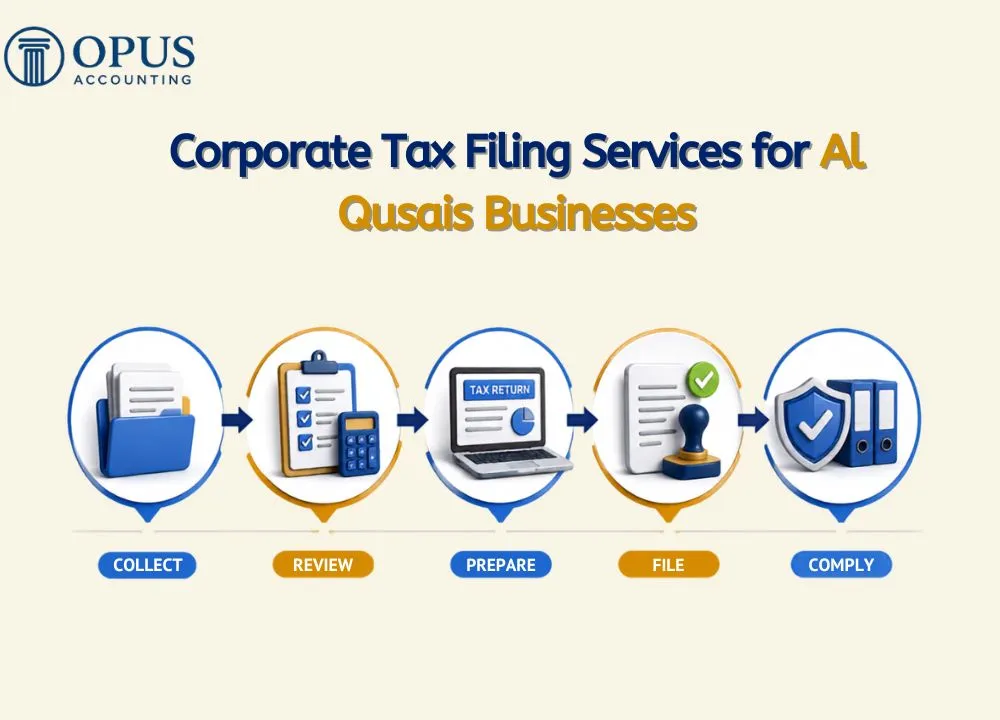
We provide comprehensive corporate tax filing services for Al Qusais businesses covering every CT obligation:
- FTA corporate tax registration
- Small Business Relief assessment, eligibility review, and annual election
- Trading business taxable income calculation covering COGS and gross margin
- Inventory valuation and COGS consistency review across tax periods
- Logistics business cost deductibility analysis
- Professional service revenue recognition
- Expense deductibility review, including entertainment and interest limitations
- Related party transaction analysis and arm’s length documentation
- Annual CT return preparation and FTA submission
- CT payment scheduling
- FTA correspondence support
- Multi-year CT planning, including loss carryforward planning and depreciation optimisation for capital assets
This full-spectrum approach to corporate tax filing services for Al Qusais businesses ensures nothing is missed, whether your business is claiming Small Business Relief or managing complex group structures with international supply chains.
Transfer Pricing for Al Qusais Trading Businesses
Many Al Qusais trading businesses are part of larger commercial groups, purchasing from related overseas suppliers, selling through related domestic or international customers, or sharing business infrastructure with affiliated companies. These related party arrangements require careful transfer pricing management. Transfer pricing for trading businesses is one of the most scrutinized areas of CT compliance, and getting it right protects your business from costly FTA adjustments.
Common transfer pricing scenarios for Al Qusais traders:
Import purchasing from related overseas suppliers: An Al Qusais importer that buys from a related overseas manufacturer must demonstrate that the purchase price is consistent with what it would pay an unrelated supplier for the same goods at the same specification and quality. Inflated related party purchase prices reduce UAE taxable income, and the FTA will examine significant related party purchases closely. Our corporate tax filing services for Al Qusais businesses include full documentation of every related party import arrangement.
Distribution margins within trading groups: Where an Al Qusais trader is the UAE distribution arm of an international group, the margin retained in the UAE must reflect the genuine economic value of the distribution function, consistent with what an independent distributor would earn for performing the same function. Transfer pricing for trading businesses in this scenario requires a functional analysis that maps the distributor’s actual activities, risks, and assets.
Shared facility costs: Al Qusais businesses that share warehouse space, transport fleet, or other infrastructure with related parties must charge and receive cost contributions at arm’s length rates. We assess and document these arrangements as part of the annual CT filing.
We document the arm’s length basis for all related party transactions as part of our corporate tax filing services for Al Qusais businesses, protecting clients in the event of FTA scrutiny.
CT Planning for Al Qusais Businesses
Al Qusais businesses have access to several legitimate CT planning strategies. Our corporate tax filing services for Al Qusais businesses include proactive planning that goes beyond simple return preparation.
Small Business Relief maximisation: For businesses with revenues close to the AED 3 million threshold, careful revenue management and timing can ensure the relief is available in each period, maximising the benefit of zero-tax treatment. Our Small Business Relief assessment evaluates eligibility each year and manages the election process with the FTA to ensure you never miss this benefit when it is available.
Depreciation optimisation for capital assets: For businesses with significant capital assets, such as logistics vehicles, industrial equipment, or commercial fit-out, ensuring depreciation policies are IFRS-consistent and correctly applied maximises available annual deductions. Depreciation optimisation for capital assets is particularly valuable for Al Qusais logistics operators and manufacturers who have invested heavily in fleet and machinery. A well-structured depreciation schedule can reduce taxable income significantly over multiple years.
Loss carryforward planning: Businesses that incur losses in their initial CT periods can carry those losses forward to offset future profits. Loss carryforward planning is an important element of multi-year CT strategy, particularly for newer businesses anticipating profitable periods ahead. We track your loss position across each tax year and apply the carried-forward loss correctly against future taxable income, reducing future CT liabilities at the right time.
Group structure review: For business groups with multiple entities in Al Qusais, assessing whether a qualifying tax group election would be beneficial, allowing losses to be transferred between group companies, is a potentially valuable planning exercise. This review often connects with transfer pricing for trading businesses, since group transactions and group structure decisions affect each other directly. For a broader perspective on structuring decisions, our financial consultancy team can support the process.
FAQ’s | Corporate Tax Filing Services for Al Qusais Businesses
1. We are an Al Qusais wholesale trader with revenues of AED 7 million. Our net margin is about 5%. What is our likely CT liability?
At 5% net margin on AED 7 million revenue, your taxable income would be approximately AED 350,000, which falls below the AED 375,000 threshold for the 9% rate. Your CT liability would be zero at this margin level. If your margin increases and taxable income exceeds AED 375,000, the excess is taxed at 9%. Our corporate tax filing services for Al Qusais businesses include margin monitoring to anticipate these thresholds.
2. Our Al Qusais business buys products from our family’s overseas business. How do we document the arm’s length pricing?
We conduct a comparability analysis, identifying comparable transactions between unrelated parties in the same industry for the same or similar products, and comparing the prices. We document this analysis in a transfer pricing report that demonstrates your intercompany pricing is arm’s length. Transfer pricing for trading businesses with family-connected supply chains is one of the most common scenarios we handle for Al Qusais clients.
3. We have a logistics and a trading division in the same entity. Should we report CT for each separately?
No. A single legal entity files a single CT return covering all of its activities. However, the financial statements and CT return should clearly reflect the revenues and costs of each division to support accurate taxable income calculation. Proper segmentation also supports depreciation optimisation for capital assets in your logistics division separately from your trading inventory costs.
4. Our Al Qusais food business lost money in its first year of operation. Can this loss reduce future CT payments?
Yes. A tax loss from one period can be carried forward to reduce taxable income in future periods. Loss carryforward planning ensures that your loss position is tracked accurately and applied correctly against future taxable income, reducing future CT liabilities. We manage this across every filing period so no loss benefit is wasted.
5. Can Opus Accounting handle both our VAT compliance and corporate tax filing?
Yes. We provide corporate tax filing services for Al Qusais businesses alongside VAT consulting support. Managing both together ensures consistency between your VAT returns and CT return, prevents conflicting positions on revenue recognition or expense timing, and gives you a single point of contact for all tax compliance matters.
Expert Corporate Tax Filing for Your Al Qusais Business
Al Qusais businesses are the commercial engine of one of Dubai’s most active communities. Our expert corporate tax filing services for Al Qusais businesses ensure the tax management of those businesses is as efficient and well-managed as the businesses themselves, covering transfer pricing for trading businesses, Small Business Relief assessment, inventory valuation and COGS consistency, loss carryforward planning, and depreciation optimisation for capital assets. Every return we prepare is thorough, compliant, and built to withstand scrutiny.
Contact Opus Accounting today for a free consultation and discover how expert CT filing can protect and benefit your Al Qusais business.