
DAMAC Hills is not a typical commercial district, and the businesses within it do not have typical corporate tax profiles. Anchored by the Trump International Golf Club Dubai and built around a premium, master-planned lifestyle, this community is home to golf and sports operations, luxury wellness and spa businesses, short-term villa rental operators, and a network of premium service providers. Each of these carries corporate tax characteristics that a standard filing approach simply does not address, which is precisely why specialist corporate tax filing services for DAMAC Hills businesses matter here.
Corporate tax in the UAE is not a one-size-fits-all exercise. The way income is recognised, the way seasonal performance is planned for, and the way related-party arrangements are documented all change depending on the nature of the business. Our corporate tax filing services for DAMAC Hills businesses are built specifically around the community’s premium, lifestyle-led economy, and they form part of our wider corporate tax filing services in Dubai.
Why DAMAC Hills Businesses Need a Specialist Corporate Tax Approach
Most corporate tax guidance is written for conventional trading and service businesses, steady monthly revenue, straightforward income recognition, and simple ownership. DAMAC Hills businesses rarely fit that mould. A golf and sports operation earns seasonally. A wellness business collects membership and package fees in advance. A luxury rental operator earns highly variable, occupancy-driven income. And in a developer-anchored community, related-party arrangements between connected entities are common.
Each of these features has a direct bearing on how corporate tax should be calculated, planned for, and filed. Getting the timing of income wrong, mishandling advance payments, or failing to document related-party transactions can all lead to an incorrect tax position and potential exposure with the Federal Tax Authority. Our corporate tax filing services for DAMAC Hills businesses are designed to handle exactly these features, turning a complex tax profile into a clean, compliant, well-planned filing.
Our Corporate Tax Filing Services for DAMAC Hills
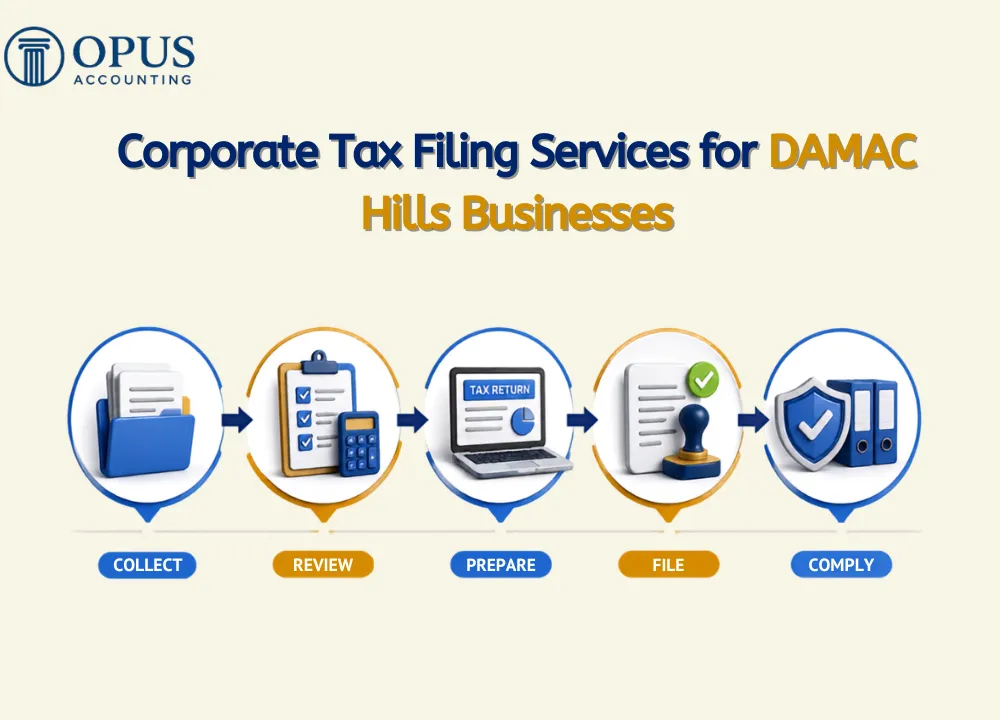
We provide a comprehensive corporate tax service for DAMAC Hills businesses:
- Corporate tax registration and deregistration management
- Small Business Relief assessment and eligibility review
- Taxable income calculation with correct income recognition
- Golf and sports business seasonal CT planning
- Membership and treatment package deferred income management
- Short-term rental CT treatment analysis
- Related party transaction analysis and documentation
- Adjustments, exempt income, and deductible expense review
- Corporate tax return preparation and FTA submission
- Provisioning and CT liability forecasting
- Coordination with financial reporting and bookkeeping
Reliable filing depends on reliable records, so this service works hand in hand with our bookkeeping for DAMAC Hills companies and financial reporting for DAMAC Hills businesses.
Seasonal Corporate Tax Planning for Golf and Sports Businesses
The golf and sports operations that define DAMAC Hills earn their income in a distinctly seasonal pattern, strong through Dubai’s cooler months and much quieter through the summer. This seasonality has real corporate tax implications that a flat, month-by-month approach misses entirely:
Matching income and expense across the year: seasonal businesses must ensure income and the costs of earning it are recognised in the correct period, so the annual taxable profit reflects genuine performance rather than a distorted mid-year snapshot.
Provisioning across the season: because profit is concentrated in part of the year, our golf and sports business seasonal CT planning builds a full-year view early, so the eventual corporate tax liability is understood and provisioned for well before it falls due, rather than arriving as a surprise.
Managing advance and prepaid income: green fees, tournament income, and seasonal packages are often paid ahead of the period they relate to, which ties directly into how deferred income must be handled (below).
Seasonal CT planning gives golf and sports operators a clear, year-round picture of their tax position, aligned to the rhythm of how they actually earn.
Deferred Income: Memberships and Treatment Packages
Wellness businesses, spas, golf clubs, and lifestyle operators across DAMAC Hills frequently collect income in advance, annual memberships, multi-session treatment packages, and pre-paid programmes. Handling this correctly is one of the most important, and most commonly mishandled, aspects of corporate tax for these businesses:
Recognising income as it is earned: an annual membership paid upfront is not all earned on the day the cash arrives. It should be recognised across the membership period. The same applies to a multi-treatment spa package, which is earned as each treatment is delivered.
The corporate tax impact: recognising advance income too early overstates taxable profit in the current period, while handling it correctly aligns the tax charge with the period the income genuinely relates to. Our membership and treatment package deferred income management ensures advance payments are recognised properly, so your taxable profit, and your CT liability, are stated accurately.
Consistency with your accounts: correct deferred income treatment must flow consistently from your bookkeeping through your financial statements to your tax return, which is why we coordinate the CT work directly with your underlying records.
Short-Term Rental and Related-Party Considerations
Two further features are common in a premium, developer-anchored community like DAMAC Hills, and both carry specific corporate tax treatment:
Short-term rental CT treatment analysis: luxury villa and holiday-home rental operations earn variable, occupancy-driven income and incur a particular mix of costs, management fees, furnishing, maintenance, and platform commissions. Determining what is taxable, what is deductible, and how the income is correctly recognised requires a considered analysis rather than an assumption. Our short-term rental CT treatment analysis establishes the correct position for these operations.
Related party transaction analysis: in a community built around a major developer and its connected entities, transactions between related parties, management charges, shared services, intercompany rentals, are common. Under UAE corporate tax, related-party transactions must be conducted and documented on an arm’s length basis. Our related party transaction analysis reviews these arrangements, tests them against the arm’s length principle, and prepares the documentation needed to support your filing and withstand FTA scrutiny.
FAQ’s | Corporate Tax Filing Services for DAMAC Hills Businesses
1. Our DAMAC Hills business is small. Do we qualify for Small Business Relief?
Possibly. Small Business Relief is available to resident businesses whose revenue stays at or below the threshold set by the Federal Tax Authority, allowing them to be treated as having no taxable income for the period. Our Small Business Relief assessment reviews your revenue and circumstances against the current federal Tax Authority conditions and confirms whether electing for the relief is available and beneficial for your business.
2. We run a golf and sports operation that earns mostly in winter. How does that affect our corporate tax?
Seasonal earning does not change your annual tax obligation, but it does change how you should plan for it. Through golf and sports business seasonal CT planning, we build a full-year view of your income and costs early in the year, ensure income is recognised in the correct period, and forecast your CT liability so it is provisioned for well ahead of the deadline rather than arriving as a year-end surprise.
3. We collect annual memberships and spa packages upfront. Is that all taxable when we receive it?
No, and treating it that way would overstate your taxable profit. Advance memberships and multi-session packages should be recognised as income across the period they are earned, not entirely on receipt. Our membership and treatment package deferred income management ensures this advance income is recognised correctly, so your taxable profit and CT charge reflect genuine performance.
4. We operate short-term luxury villa rentals. How is that income treated for corporate tax?
Short-term rental income is variable and comes with a specific cost profile, management fees, furnishing, maintenance, and platform commissions. Our short-term rental CT treatment analysis determines exactly what income is taxable, which costs are deductible, and how the income should be recognised, giving you an accurate and defensible corporate tax position for the rental operation.
5. We have transactions between connected companies in the community. Do we need to do anything special?
Yes. Under UAE corporate tax, transactions between related parties must be conducted on an arm’s length basis and properly documented. Our related party transaction analysis reviews your intercompany arrangements, management charges, and shared-service costs, tests them against the arm’s length principle, and prepares the supporting documentation your filing needs to withstand FTA scrutiny.
Corporate Tax Filing for Your DAMAC Hills Business
DAMAC Hills businesses have some of the most distinctive corporate tax profiles in Dubai, seasonal, membership-driven, rental-based, and often interconnected. Our corporate tax filing services for DAMAC Hills businesses are built around exactly these features, ensuring your filing is accurate, your income is recognised correctly, and your tax position is planned rather than reactive.
Explore our full range of corporate tax filing services, browse all Opus Accounting services, then contact us today for a free consultation. For broader planning, our financial planning service for DAMAC Hills businesses can support you further, and for legal contract drafting, our partners at Omam Consultancy in Dubai provide specialist support.