
Dubai’s Dynamic Business Landscape with Strategic Financial Insight
In Dubai’s hyper-competitive and rapidly evolving business environment, staying ahead requires more than just a great product or service. With the International Monetary Fund (IMF) projecting Dubai’s economy to expand by 3.3% in 2025, opportunities for growth are abundant. However, this growth also intensifies competition.
Thriving in this landscape demands sharp, data-driven strategies and a deep understanding of your company’s financial mechanics, which is exactly what professional managerial & cost accounting services in Dubai are built to provide.
This is where traditional accounting, focused primarily on historical reporting and compliance, falls short. Businesses need a forward-looking approach to financial management, one that turns raw financial data into a roadmap for profitability and strategic growth.
The Demands of Dubai’s Competitive Market
Dubai’s market is characterized by its diversity, speed, and global integration. From real estate and manufacturing to a booming e-commerce sector and emerging tech industries, every business faces unique pressures.
These include fluctuating operational costs, complex supply chains, evolving consumer behaviors, and the constant need to innovate. Relying on standard financial statements alone is like driving a high-performance car by only looking in the rearview mirror. It tells you where you’ve been, but not where you’re going or how to navigate the road ahead.
The Strategic Imperative: Beyond Basic Compliance to Proactive Financial Management
The shift from basic bookkeeping and compliance to proactive financial management is no longer a luxury, it’s a strategic necessity. While compliance, financial statements, and auditing are crucial for regulatory adherence and stakeholder reporting, they are fundamentally reactive.
Proactive financial management, powered by managerial and cost accounting, is about using financial intelligence to make informed decisions that actively shape the future of the business. It’s about answering critical questions: Which products are truly profitable? Where are we wasting resources? How should we price our new service? Is this expansion plan financially viable?
How Managerial & Cost Accounting Fuel Profitability and Strategic Growth
Managerial and cost accounting provide the tools to answer these questions with precision. They peel back the layers of high-level financial reports to reveal the operational realities underneath.
By meticulously tracking, analyzing, and interpreting cost and performance data, these specialized managerial and cost accounting services empower management to optimize operations, control expenses, set strategic pricing, and identify new opportunities for growth. They transform the finance function from a mere record-keeper into a strategic partner in value creation.
Beyond Basic Bookkeeping: Differentiating Managerial & Cost Accounting for Strategic Advantage
While often grouped together, managerial and cost accounting serve distinct yet complementary functions that go far beyond the scope of traditional bookkeeping. Understanding their differences is key to unlocking their combined strategic power for your Dubai based business.
What is Managerial Accounting? Powering Internal Decision-Making
Managerial accounting, also known as management accounting, is a future-focused discipline designed exclusively for internal use. Its primary purpose is to provide management with the timely and relevant financial and non-financial information needed for planning, controlling, and decision-making. Unlike financial accounting, which adheres to strict external standards (like IFRS), management accounting is flexible and tailored to the specific needs of the organization. It encompasses budgeting, forecasting, performance analysis, and creating detailed reports that help executives steer the company toward its strategic objectives.
What is Cost Accounting? The Foundation of Profitability
Cost accounting is a subset of management accounting that provides the detailed data necessary for many managerial decisions. Its core function is to capture, analyze, and report on all costs associated with producing a product or delivering a service.
By classifying costs, for example fixed versus variable, direct versus indirect, it provides a clear picture of a company’s cost structure. This detailed analysis is the foundation for critical business functions such as setting prices, managing inventory, controlling expenses, and evaluating the profitability of individual products, services, or customer segments.
Unlocking Hidden Profitability: Core Cost Accounting Services for Dubai Businesses
Effective cost accounting is the engine of profitability. By dissecting your company’s cost structure, our cost accounting services help you identify inefficiencies, optimize resource allocation, and make pricing decisions that protect and enhance your margins.
Strategic Cost Analysis, Cost Management & Cost Reduction
This foundational service involves a deep dive into all business expenditures. It’s about more than just cutting costs, it’s about understanding them. Strategic cost management identifies value-adding activities versus non-value-adding ones, enabling targeted reductions that don’t compromise quality or growth potential. For a logistics company in Dubai, this could mean analyzing fuel consumption patterns to optimize delivery routes, thereby reducing a major operational expense.
Activity-Based Costing (ABC): Precision in Resource Allocation
Traditional costing methods often allocate overheads, like rent or administrative salaries, using broad-brush averages. Activity-Based Costing provides a far more accurate picture by assigning these costs to the specific activities that consume them. A software firm in Dubai Media City might use Activity-Based Costing to determine that one client’s frequent support requests consume a disproportionate amount of technical resources, revealing their true, lower profitability.
Marginal Costing & Contribution Margin Analysis: Informed Pricing and Production Decisions
Marginal costing focuses on the change in total cost resulting from producing one additional unit. This is crucial for short-term decision-making. By calculating the contribution margin, selling price minus variable costs, a business can determine how much each sale contributes to covering fixed costs and generating profit. This analysis helps in setting prices for special orders, deciding on product mix, and understanding the impact of promotions.
Break-Even Analysis & Breakthrough Points: Setting Realistic Financial Goals
Break-Even Analysis calculates the point at which total revenues equal total costs, the point of zero profit. This simple yet powerful tool helps businesses understand the sales volume needed to become profitable. It’s essential for new ventures, product launches, and setting realistic sales targets. Understanding this threshold allows management to plan for breakthrough points where profitability significantly accelerates.
Overhead Analysis & Variance Analysis: Gaining Control Over Expenses
Overhead analysis scrutinizes all indirect costs that aren’t tied to a specific product, such as rent, utilities, and administrative salaries. Variance Analysis then compares these actual costs against budgeted amounts. This isn’t just a reporting exercise, it’s an early warning system. A significant variance can signal issues like an unexpected price hike from a supplier or internal inefficiencies, allowing management to take corrective action before they escalate.
Fueling Strategic Growth: Advanced Managerial Accounting for Informed Management in Dubai
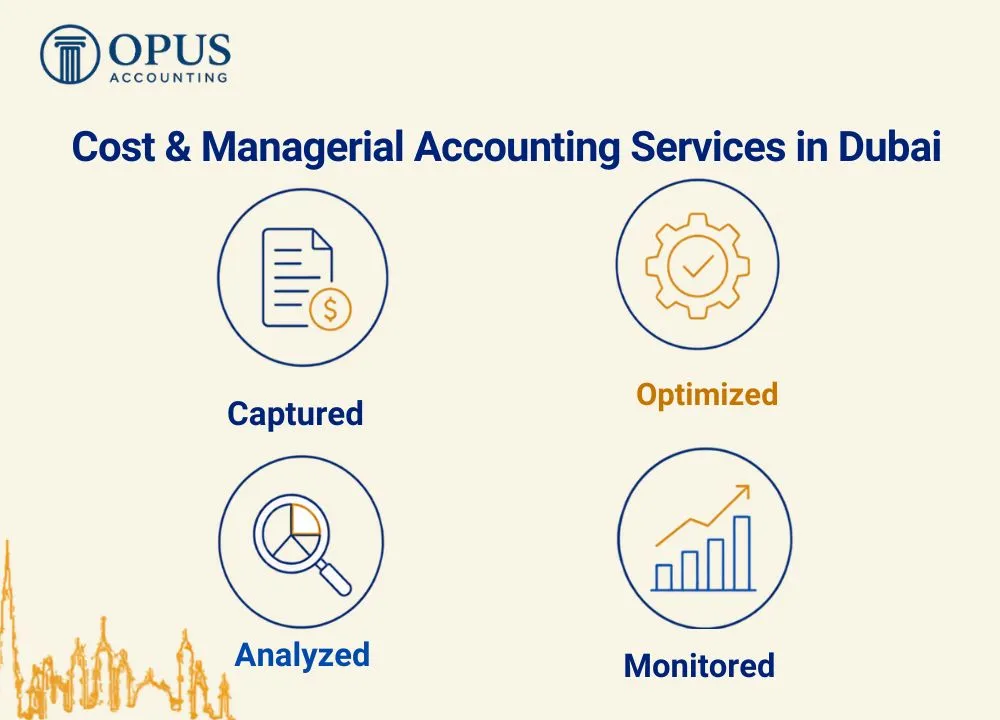
With a solid foundation of cost data, managerial accounting translates this information into a forward-looking strategy that drives growth and navigates risk.
Strategic Budgeting & Forecasting for Future Success
Effective budgeting goes beyond an annual financial exercise. Strategic Budgeting & Forecasting aligns financial planning with long-term business goals. Managerial accounting facilitates this with techniques like zero-based budgeting or rolling forecasts, which provide a more dynamic and responsive financial plan. Accurate forecasting, informed by historical data and market analysis, is critical for managing cash flow, securing financing, and making sound investment decisions.
Performance Management & Key Performance Indicators (KPIs)
Managerial accounting develops and tracks relevant KPIs that measure what truly matters for business success. These go beyond simple revenue figures to include metrics like Customer Lifetime Value, cost per acquisition, or production efficiency. Creating dashboards with these KPIs gives management a real-time view of business performance, enabling swift, data-backed adjustments to strategy.
Deep-Dive Profitability Analysis & Opportunity Identification
This involves analyzing profitability by product line, service, customer segment, or geographic region. A distributor in Jebel Ali Free Zone might discover that while a high-volume client generates significant revenue, their demanding service requirements and requests for discounts make them one of the least profitable accounts. This insight allows the business to renegotiate terms or reallocate resources to more profitable opportunities.
Empowering Strategic Decision-Making Across Your Organization
Ultimately, the goal of managerial accounting is to embed data-driven decision-making into the company culture. From make-or-buy decisions and capital investment appraisals, such as evaluating new machinery, to strategic pricing models, this discipline provides the quantitative framework to evaluate options, manage risk, and choose the path that maximizes long-term value. This is especially vital for the 91% of UAE SMEs who are optimistic about their prospects and need robust financial guidance to turn that optimism into reality.
Industry-Specific Applications: Tailored Accounting for Dubai’s Diverse Sectors
The principles of managerial and cost accounting are universal, but their application must be tailored to the unique challenges and opportunities of specific industries in Dubai.
Real Estate: Project Costing, Profitability Analysis, and Investment Decisions
In real estate development, project costing is paramount. Cost accounting meticulously tracks all expenses, land acquisition, materials, labor, permits, for each individual project. Managerial accounting then uses this data to assess the profitability of each development, model cash flow projections, and conduct feasibility studies for future investments.
Manufacturing: Standard Cost Accounting, Lean Accounting, and Cost of Goods & Services Optimization
For manufacturers, standard costing sets benchmarks for material, labor, and overhead costs. Variance Analysis highlights deviations, pointing to production inefficiencies. Lean accounting principles further support waste reduction across the production process, directly optimizing the Cost of Goods Sold and improving margins.
E-Commerce: Tracking Variable Costs, Customer Acquisition Costs, and Product Profitability Analysis
E-commerce businesses in Dubai face a unique cost structure dominated by variable costs like marketing, shipping, and payment processing fees. Cost accounting is essential for tracking Customer Acquisition Cost and comparing it to Customer Lifetime Value. This analysis reveals which marketing channels deliver the best ROI and which products are most profitable after all associated costs are considered.
Services Sector: Optimizing Service Delivery Costs
For service-based businesses, such as healthcare, event management, and marine, the primary cost is often labor. Cost accounting helps allocate staff time and other resources to specific clients or projects. An event management company, for example, can use this data to accurately price its services, ensure each event is profitable, and identify opportunities to streamline its service delivery process.
Emerging Industries: Navigating Complex Cost Structures
Industries like oil and gas involve massive capital expenditures and complex, multi-stage operational costs. Sophisticated cost accounting methods are required to manage project budgets, allocate joint costs, and comply with industry-specific financial reporting regulations, ensuring financial control over large-scale operations.
The Role of Technology: Enhancing Strategic Accounting with Advanced Tools
Modern technology is a powerful accelerant for managerial and cost accounting, transforming it from a manual, time-consuming process into a dynamic, real-time source of strategic intelligence.
Leveraging Accounting Software & Advanced Financial Reporting & Analysis Tools
Cloud-based accounting platforms, ERP systems, and specialized Advanced Financial Reporting & Analysis Tools automate data collection and processing. This eliminates manual errors and frees up finance professionals to focus on high-value analysis rather than data entry. These tools can generate custom reports, dashboards, and financial models in minutes, providing management with instant access to critical insights.
Transforming Financial Data into Data-Driven Insights for Competitive Advantage
The integration of technology is crucial in a market where the UAE artificial intelligence sector is projected to reach USD 1.17 billion in 2025. Advanced tools use AI and machine learning to analyze historical data, identify trends, and generate more accurate forecasts. This transforms raw financial data from a simple record into a predictive tool, enabling businesses to anticipate market shifts, manage risk proactively, and seize a significant competitive advantage.
Why Strategic Managerial & Cost Accounting is a Necessity, Not a Luxury, in Dubai
In a market defined by rapid growth and fierce competition, relying on intuition or incomplete financial data is a recipe for failure. Strategic managerial and cost accounting services provide the clarity, control, and foresight necessary to navigate this complex environment successfully.
Driving Sustainable Profitability and Accelerated Strategic Growth
By providing a granular view of costs, these disciplines allow for precise control over expenses and data-driven pricing strategies, directly enhancing profitability. Simultaneously, they empower strategic decision-making, from operational improvements to major investment choices, that fuels sustainable, long-term growth. They are the essential link between daily financial operations and the achievement of your company’s most ambitious goals. For the thousands of new businesses launched with support from initiatives like Dubai SME, adopting these practices early is critical for building a resilient and successful enterprise.
FAQ’s | Managerial & Cost Accounting Services in Dubai
1. What is the difference between managerial accounting and cost accounting?
Managerial accounting is the broader discipline covering budgeting, forecasting, and performance analysis for internal decision-making. Cost accounting is a subset of it, focused specifically on capturing, classifying, and analyzing the costs of producing goods or delivering services.
2. How does Activity-Based Costing improve on traditional costing methods?
Activity-Based Costing assigns overhead costs to the specific activities that actually consume them, rather than spreading them evenly across all products or services. This gives a far more accurate picture of true profitability by product, client, or service line.
3. Why is Break-Even Analysis important for a new business in Dubai?
Break-Even Analysis shows the exact sales volume needed to cover all costs before a business starts generating profit. It is essential for setting realistic sales targets and understanding the financial viability of a new venture or product launch.
4. What role does Variance Analysis play in controlling costs?
Variance Analysis compares actual costs against budgeted figures to flag deviations early. It acts as an early warning system, helping management spot issues like supplier price increases or internal inefficiencies before they escalate.
5. How do Strategic Budgeting & Forecasting support long-term growth?
Strategic Budgeting & Forecasting align financial planning with long-term business goals using techniques like zero-based budgeting or rolling forecasts. This gives management a dynamic, responsive financial plan for managing cash flow and investment decisions.
6. Do I need Advanced Financial Reporting & Analysis Tools if I already use basic accounting software?
Basic accounting software handles bookkeeping and compliance, but Advanced Financial Reporting & Analysis Tools go further, generating real-time dashboards, custom reports, and forecasts that support strategic decision-making rather than just historical record-keeping.
7. Which industries in Dubai benefit most from managerial and cost accounting services?
Real estate, manufacturing, e-commerce, service-based businesses, and emerging sectors like oil and gas all benefit, since each has distinct cost structures that require tailored cost accounting and profitability analysis.
Conclusion
Navigating Dubai’s dynamic business landscape requires more than just keeping accurate books, it demands strategic financial intelligence. Managerial and cost accounting are the disciplines that provide this intelligence, moving your business beyond simple compliance to a state of proactive financial management. By meticulously analyzing costs, these managerial and cost accounting services unlock hidden profitability and enhance operational efficiency. By transforming that data into forward-looking insights, they empower informed decision-making, strategic budgeting, and effective performance management.
From real estate projects and manufacturing floors to e-commerce platforms and service providers, the application of these principles is the key to understanding true profitability and identifying concrete opportunities for growth. In a market where approximately 95% of companies are SMEs, leveraging these powerful managerial and cost accounting services is not a luxury reserved for large corporations, it is a fundamental requirement for survival and success.
The next step is to move from understanding to action. Assess your current financial reporting capabilities. Are you making critical business decisions based on comprehensive cost data and forward-looking forecasts, or are you relying on historical information alone? Investing in professional managerial and cost accounting services is an investment in clarity, control, and the sustainable, profitable future of your business in Dubai.
Contact Opus Accounting today for a free consultation. Let us discuss how our tailored bookkeeping solutions can empower your Dubai Creek Harbour business from its very inception and throughout its journey of success, backed by the same rigor we apply to auditing and financial statement work through our audits and assurance services. We look forward to becoming your trusted financial partner, and for Legal Contract Drafting contact Omam Consultancy in Dubai.