
Bookkeeping is the foundation on which every other financial function of a business rests. Accurate records are what make VAT returns correct, Corporate Tax filings possible, payroll compliant, audits smooth, and management decisions sound. For businesses across the emirate, professional Bookkeeping Services Dubai are no longer a back-office afterthought but a genuine requirement, driven by an evolving regulatory landscape that expects every business to maintain proper, up-to-date financial records. Understanding what good bookkeeping involves, and how to resource it well, is one of the most valuable things a Dubai business owner can do.
This guide explains what bookkeeping is, how it differs from accounting, the compliance obligations it underpins, and how to decide whether to keep it in-house or outsource it.
What Bookkeeping Is, and Why It Matters in Dubai
Bookkeeping is the systematic recording of a business’s financial transactions, every sale, purchase, payment, and receipt, into an organised, reliable set of records. It is the raw material from which financial statements, tax returns, and management reports are all produced. Without accurate bookkeeping, everything downstream becomes unreliable.
In Dubai’s current environment, good bookkeeping matters more than ever for several reasons.
Regulatory compliance: VAT and Corporate Tax both require businesses to maintain accurate financial records and retain them for years, and poor bookkeeping puts compliance at immediate risk.
Decision-making: Owners who rely on their bank balance rather than accurate records make poorly informed decisions, while good bookkeeping gives a true picture of performance.
Financing and audit: Banks, investors, and auditors all expect clean, credible records, and businesses that cannot produce them struggle to secure finance or pass an audit.
Cost control: Accurate records reveal where money is actually going, making it possible to control costs and protect margins.
Bookkeeping Versus Accounting: Understanding the Distinction
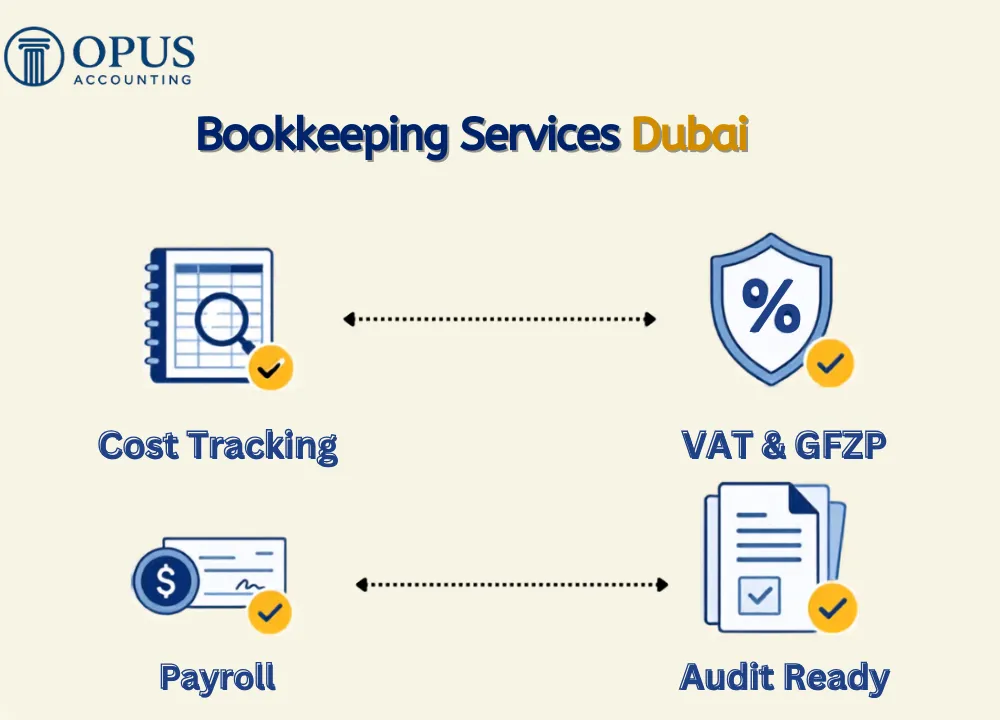
One of the most common points of confusion for business owners is the bookkeeping versus accounting distinction, and understanding it helps you resource each function correctly.
Bookkeeping is the day-to-day recording and organising of financial transactions, maintaining the books, reconciling bank accounts, tracking receivables and payables, and keeping the records accurate and current. It is detailed, ongoing, and foundational.
Accounting builds on the bookkeeping records to interpret, analyse, and report, preparing financial statements, calculating tax, advising on strategy, and turning the recorded data into insight and compliance. Accounting asks what the numbers mean; bookkeeping ensures the numbers are there and correct in the first place.
The two are complementary rather than interchangeable. A business needs both, accurate bookkeeping as the foundation and skilled accounting built on top, and the best providers deliver them as an integrated service. Our bookkeeping services and financial reporting services work together in exactly this way, so the recording and the reporting are seamlessly connected.
Bookkeeping and Compliance: Payroll, VAT, and Free Zone Audit
Much of the value of professional bookkeeping in Dubai lies in the compliance it underpins, and three areas deserve particular attention.
WPS-compliant payroll bookkeeping: Salaries in the UAE must be paid through the Wage Protection System, and payroll must be recorded accurately in the books, with correct treatment of salaries, allowances, deductions, and end-of-service accruals. WPS-compliant payroll bookkeeping keeps your payroll records accurate and your salary payments compliant, feeding correctly into both your accounts and your obligations, and it connects directly with our payroll and HR-related accounting services.
VAT compliance bookkeeping: VAT-registered businesses must record every transaction with the correct VAT treatment, maintain proper tax invoices, and keep records that support accurate quarterly returns. VAT compliance bookkeeping ensures your day-to-day records are VAT-correct throughout the period, so your returns are accurate and defensible rather than reconstructed under pressure at filing time, and it supports the work of our VAT and indirect tax consulting.
Free zone auditing submission standards: Many free zone entities are required to submit audited financial statements as a condition of licence renewal, and meeting free zone auditing submission standards depends entirely on well-maintained books throughout the year. Bookkeeping kept to audit-ready condition makes the annual audit straightforward rather than a scramble, and supports the licence renewal that our compliance and licensing services manage.
In-House or Outsourced? The Bookkeeping Cost Comparison
A key decision for every Dubai business is whether to keep bookkeeping in-house or outsource it, and an honest outsourced bookkeeping cost comparison usually favours outsourcing for small and medium businesses.
The true cost of in-house bookkeeping: Employing a bookkeeper means salary, benefits, WPS obligations, software licences, training, and management time, and for a smaller business this often means paying for more capacity than the workload actually requires. There is also key-person risk when that single employee is on leave or leaves the business.
The outsourced alternative: Outsourced bookkeeping typically provides a qualified team, up-to-date software, and consistent delivery for a predictable monthly fee, usually well below the fully loaded cost of an in-house hire, and scales up or down with the business. The outsourced bookkeeping cost comparison also factors in the value of accuracy and compliance expertise that an outsourced specialist brings, reducing the risk of costly errors.
When in-house makes sense: Larger businesses with high transaction volumes and complex operations may reach a point where an in-house function, or a hybrid model, becomes efficient. The right answer depends on scale, complexity, and how much specialist compliance support the business needs.
For most small and medium Dubai businesses, outsourcing delivers professional bookkeeping at lower cost and lower risk than an in-house hire, which is why it has become the default choice for so many.
FAQ’s | Bookkeeping Services Dubai
1. What is the difference between bookkeeping and accounting?
The bookkeeping versus accounting distinction is essentially recording versus interpreting. Bookkeeping is the day-to-day recording and organising of financial transactions, keeping the books accurate and current. Accounting builds on those records to prepare financial statements, calculate tax, and advise on strategy. A business needs both, accurate bookkeeping as the foundation and skilled accounting on top, ideally delivered as one integrated service.
2. Do I legally need to keep bookkeeping records in Dubai?
Yes. Both VAT and Corporate Tax require businesses to maintain accurate financial records and retain them for several years, and free zone entities often need audited statements as well. Beyond the legal requirement, accurate records are essential for correct tax filing, financing, and sound decisions. Professional Bookkeeping Services Dubai ensure you meet these obligations rather than risk penalties for inadequate records.
3. How does bookkeeping support VAT and payroll compliance?
Through VAT compliance bookkeeping, every transaction is recorded with the correct VAT treatment and proper tax invoices, so your quarterly returns are accurate. Through WPS-compliant payroll bookkeeping, salaries are recorded correctly and paid through the Wage Protection System. In both cases, keeping the records right day to day is what makes compliance straightforward rather than a stressful reconstruction at deadline time.
4. Should I hire a bookkeeper or outsource?
For most small and medium businesses, an honest outsourced bookkeeping cost comparison favours outsourcing. An in-house bookkeeper carries salary, benefits, software, and management costs, often for more capacity than a smaller business needs, plus key-person risk. Outsourcing provides a qualified team and consistent delivery for a predictable, usually lower, monthly fee that scales with your business. Larger, more complex businesses may eventually benefit from an in-house or hybrid model.
5. What are the bookkeeping requirements for a free zone company?
Many free zone entities must submit audited financial statements to meet free zone auditing submission standards as a condition of licence renewal, and this depends on well-maintained books throughout the year. Keeping your bookkeeping in audit-ready condition makes the annual audit smooth and supports your licence renewal, rather than leaving you to reconstruct records under pressure when the audit falls due.
Professional Bookkeeping for Your Dubai Business
Accurate bookkeeping is the foundation of compliance, sound decisions, and financial credibility for any Dubai business. Understanding what good bookkeeping involves, how it differs from accounting, the compliance it underpins, and when to outsource it, puts you in a strong position to resource this essential function well. Professional Bookkeeping Services Dubai give you accurate records, full regulatory compliance, and the clarity to run your business with confidence.
Our bookkeeping services and the full range of accounting services we offer across Dubai are built to deliver exactly this, precise records, integrated compliance, and reporting you can rely on. Contact us today for a free consultation, and for Legal Contract Drafting contact Omam Consultancy in Dubai.