
Jebel Ali Free Zone (JAFZA) is the UAE’s largest and most commercially significant free zone, home to over 8,000 companies across manufacturing, logistics, trading, and professional services. JAFZA companies operate within a regulatory framework that is fundamentally different from mainland Dubai businesses: the Qualifying Free Zone Person (QFZP) regime under UAE Corporate Tax law, Designated Zone VAT classification for goods transactions, mandatory JAFZA audit requirements, and Economic Substance Regulations all create bookkeeping obligations that standard mainland-focused accounting practices cannot adequately address.
Our JAFZA bookkeeping services provide the free zone-specific expertise that JAFZA companies need. We deliver bookkeeping that supports the QFZP regime, maintains Designated Zone VAT classification accuracy, produces JAFZA audit requirement and IFRS-compliant financial statements, manages payroll bookkeeping for expatriate and UAE national staff, and provides Economic Substance Regulations (ESR) support through properly structured financial records.
What Makes JAFZA Bookkeeping Different from Mainland
JAFZA companies face bookkeeping requirements that are shaped by their free zone status. Understanding these requirements is the starting point for effective JAFZA bookkeeping services.
QFZP regime demands precise income segregation. Under UAE Corporate Tax, JAFZA companies that qualify as a Qualifying Free Zone Person benefit from a 0% CT rate on qualifying income. However, maintaining this status requires your bookkeeping to clearly segregate qualifying income (income from qualifying activities conducted with other free zone persons or from qualifying activities that are not excluded) from non-qualifying income (which is taxed at the standard 9% rate). This segregation must be embedded in your chart of accounts and maintained transaction by transaction throughout the year, not reconstructed at year-end.
Designated Zone VAT classification creates specific transaction rules. JAFZA holds Designated Zone status under UAE VAT law, meaning goods entering JAFZA from outside the UAE are not subject to import VAT (they remain outside the UAE VAT territory for goods purposes). However, services supplied to JAFZA companies are subject to standard VAT treatment, and goods moving between JAFZA and mainland UAE trigger specific VAT events. Correct Designated Zone VAT classification for every transaction is essential for accurate VAT compliance.
JAFZA mandates audited financial statements. Unlike many mainland businesses, all JAFZA companies must submit audited financial statements annually to the JAFZA authority. This JAFZA audit requirement means your bookkeeping must produce IFRS-compliant financial statements at a standard that satisfies both your auditor and the authority, every year without exception.
ESR reporting depends on financial records. JAFZA companies conducting “relevant activities” under the UAE’s Economic Substance Regulations must demonstrate adequate substance in the UAE. The financial data that supports ESR filings, including revenue, expenditure, assets, and employee numbers, comes directly from your bookkeeping records.
Multi-national workforces require compliant payroll. JAFZA companies employ large expatriate workforces alongside UAE national staff with specific Emiratisation requirements. Payroll bookkeeping for expatriate and UAE national staff must handle diverse compensation structures, WPS compliance, and the distinct cost implications of each employee category.
Our JAFZA Bookkeeping Services
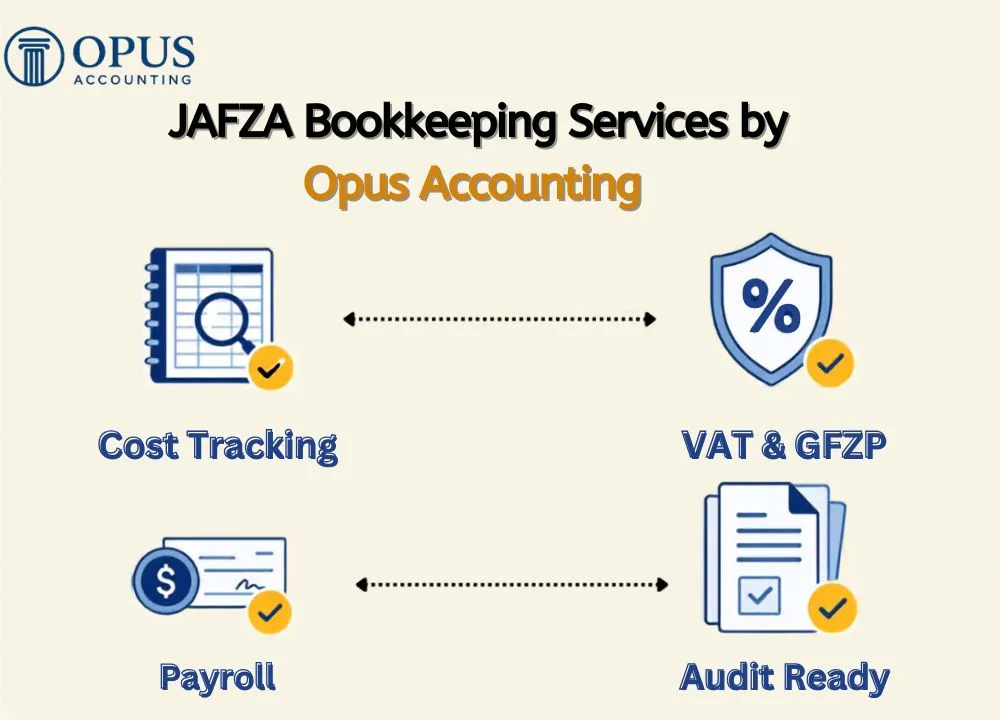
Bookkeeping Structured for the QFZP Regime
The Qualifying Free Zone Person regime is the most significant financial advantage available to JAFZA companies, but maintaining QFZP status requires bookkeeping that supports it. Our JAFZA bookkeeping services are structured around QFZP requirements:
- Qualifying versus non-qualifying income segregation built into your chart of accounts from setup, ensuring every revenue transaction is classified correctly at the point of recording rather than reclassified retrospectively.
- Counterparty tracking recording whether each customer is a free zone person, a non-free zone person, or located outside the UAE, as this classification determines whether income qualifies under the QFZP regime.
- Qualifying activity mapping ensuring your recorded activities align with the activities that qualify for 0% CT treatment under the QFZP provisions.
- Substance documentation support maintaining the financial records that demonstrate adequate substance (expenditure, assets, employees) in the free zone, a condition of QFZP eligibility.
- Non-qualifying income threshold monitoring tracking the proportion of non-qualifying income to ensure it does not breach the de minimis thresholds that could jeopardize your QFZP status. Accurate QFZP regime bookkeeping is not optional for JAFZA companies seeking the 0% CT rate. Our JAFZA bookkeeping services build this compliance into your daily financial recording, ensuring your corporate tax position is supported by properly structured records, as required by the UAE Federal Tax Authority .
Designated Zone VAT Classification
JAFZA’s Designated Zone status creates VAT treatment rules that do not apply to mainland businesses. Our Designated Zone VAT classification bookkeeping covers:
- Goods import recording correctly treating goods entering JAFZA from outside the UAE as remaining outside the VAT territory (no import VAT), while goods transferred from JAFZA to mainland UAE are treated as an import at that point.
- Intra-Designated Zone transfers recording goods movements between JAFZA and other Designated Zones (e.g., DAFZA, KIZAD) without triggering VAT events, subject to meeting the conditions.
- Services VAT treatment applying standard 5% VAT to services supplied to JAFZA companies, distinguishing clearly between goods transactions (Designated Zone rules apply) and services transactions (standard VAT rules apply).
- Mixed supply management for JAFZA companies that supply both goods and services, ensuring each component of a mixed supply is correctly classified for VAT purposes.
- Quarterly FTA return preparation with accurate Designated Zone VAT classification applied to every transaction, preventing the classification errors that trigger FTA penalties. Designated Zone VAT classification is one of the most technically demanding aspects of JAFZA bookkeeping services because the rules differ by transaction type (goods vs. services), counterparty location (Designated Zone vs. mainland vs. international), and direction of supply (into JAFZA, within JAFZA, out of JAFZA to mainland). Errors create both underpayment and overpayment risks.
JAFZA Audit Requirement and IFRS-Compliant Financial Statements
Every JAFZA company must submit audited financial statements to the JAFZA authority annually. This is not discretionary. Our bookkeeping ensures your financial records produce JAFZA audit requirement and IFRS-compliant financial statements:
- Year-round audit readiness maintaining your books at a standard that supports audit at any point, not just at year-end.
- IFRS-compliant recording applying International Financial Reporting Standards to revenue recognition, asset valuation, inventory accounting, lease treatment, and provisions from day one.
- Chart of accounts designed for IFRS disclosure structuring your accounts to produce the line items and notes that IFRS financial statements require.
- Supporting schedule maintenance keeping fixed asset registers, inventory schedules, receivables and payables aging, and reconciliation documentation current and organized.
- Auditor coordination providing your appointed auditor with clean, reconciled records and prompt responses to audit queries, minimizing audit duration and cost.
- JAFZA submission management ensuring audited statements are submitted to JAFZA within the authority’s deadline, preventing compliance penalties. The JAFZA audit requirement and IFRS-compliant financial statements obligation means your bookkeeping quality is externally verified every year. JAFZA companies that maintain accurate monthly bookkeeping experience smooth, efficient audits. Those that do not face costly year-end reconstruction, extended audit processes, and potential qualified audit opinions that affect their JAFZA compliance standing.
Payroll Bookkeeping for Expatriate and UAE National Staff
JAFZA companies employ diverse workforces with specific payroll considerations. Our payroll bookkeeping for expatriate and UAE national staff covers:
- Expatriate compensation processing handling multi-component packages including basic salary, housing allowance, transport allowance, education allowance, and annual flight provisions, all correctly structured for WPS compliance and gratuity calculation.
- UAE national payroll processing salaries for Emirati employees with specific considerations for Nafis programme requirements, social insurance contributions (GPSSA), and any Emiratisation-linked benefits or incentives.
- WPS salary information file preparation and submission ensuring accurate SIF submissions for all staff categories every pay cycle.
- Gratuity accrual maintaining monthly end-of-service provisions calculated on basic salary for all eligible employees.
- Leave tracking and accrual recording the financial liability for accrued annual leave across all employee categories.
- Payroll journal entries integrating total workforce costs into your general ledger with correct departmental or cost centre allocation for management reporting.
- Final settlement processing calculating gratuity, leave encashment, notice period, and terminal payments for departing employees. Payroll bookkeeping for expatriate and UAE national staff is more complex in JAFZA than in mainland operations because of the scale of expatriate workforces, the multi-component compensation structures common in free zones, and the specific requirements around Emiratisation compliance. Our JAFZA bookkeeping services handle this complexity as standard. Our dedicated payroll team provides additional support for larger or more complex workforce structures.
Economic Substance Regulations (ESR) Support
JAFZA companies conducting relevant activities as defined under UAE ESR must demonstrate adequate economic substance in the UAE. Our Economic Substance Regulations (ESR) support through bookkeeping covers:
- Relevant activity identification confirming whether your JAFZA company’s activities fall within the scope of ESR (including distribution, service centre, holding company, and other defined activities).
- Financial data preparation for ESR notification and reporting maintaining the revenue, expenditure, asset, and employee data that ESR filings require, drawn directly from your bookkeeping records.
- Substance indicators maintenance ensuring your financial records document the operating expenditure incurred in the UAE, the number of full-time employees or equivalent, and the physical assets maintained in the zone, all of which support your ESR substance claim.
- ESR filing support providing the accurate financial data needed for your annual ESR notification and, where required, your ESR report. Economic Substance Regulations (ESR) support is a bookkeeping function because the substance evidence regulators assess is fundamentally financial: how much you spend, how many people you employ, and what assets you hold, all of which are recorded in your books. Our JAFZA bookkeeping services ensure this data is accurately maintained throughout the year. Financial consultancy can further advise on structuring your operations to strengthen your substance position.
Core Monthly Bookkeeping
Every JAFZA bookkeeping engagement includes our complete monthly processing:
- Transaction recording capturing all income, expenses, and financial movements with correct QFZP income classification and Designated Zone VAT treatment.
- Bank and payment reconciliation monthly reconciliation of all accounts against recorded transactions.
- Accounts receivable and payable management customer invoicing, supplier invoice processing, and aging analysis.
- Inventory bookkeeping for JAFZA trading and manufacturing companies with stock tracking, valuation, and cost of goods sold calculation. Accurate cost accounting complements this inventory management with profitability analysis.
- Monthly management accounts delivering P&L, Balance Sheet, and Cash Flow statements with QFZP income segregation clearly presented.
- Compliance calendar management tracking all filing deadlines including VAT returns, CT filing, JAFZA audit submission, and ESR notification.
Sector-Specific JAFZA Bookkeeping Expertise
JAFZA hosts businesses across diverse sectors, each with specific bookkeeping requirements:
Trading and re-export companies: Designated Zone VAT classification for goods movements, landed cost inventory valuation, multi-currency supplier transactions, and letter of credit accounting. QFZP regime income tracking for qualifying trading activities.
Manufacturing businesses: Production cost accounting with raw material, labour, and overhead allocation. Inventory management across raw materials, work-in-progress, and finished goods. Fixed asset depreciation for production equipment. JAFZA audit requirement and IFRS-compliant financial statements with manufacturing-specific disclosures.
Logistics and warehousing operators: Contract-based revenue recognition, fleet depreciation, multi-client cost allocation, and Designated Zone VAT classification for goods handling and storage services.
Professional service firms: Project-based revenue recognition under IFRS 15, staff utilization tracking, retainer management, and QFZP regime counterparty classification for service income.
Holding companies: Investment income recording, dividend tracking, intercompany loan management, and Economic Substance Regulations (ESR) support for holding company relevant activities.
E-commerce and distribution: Multi-channel revenue reconciliation, inventory tracking across warehouses, last-mile delivery cost management, and Designated Zone VAT classification for goods shipped to mainland UAE customers.
Why JAFZA Bookkeeping Quality Matters More Than Mainland
For mainland Dubai businesses, bookkeeping errors are costly but often correctable. For JAFZA companies, the stakes are higher:
QFZP status is conditional. If your bookkeeping cannot demonstrate qualifying income segregation, counterparty classification, and substance requirements, your 0% CT rate is at risk. Losing QFZP status retroactively exposes your entire qualifying income to 9% Corporate Tax.
VAT classification errors compound quickly. Incorrect Designated Zone VAT classification, whether treating a mainland supply as a Designated Zone transfer or applying import VAT to goods that should remain outside the VAT territory, creates compliance exposure that grows with every misclassified transaction.
Annual audit provides external verification. Unlike mainland businesses that may go years without external scrutiny of their books, JAFZA companies face annual audit. Your auditor will identify bookkeeping deficiencies, and qualified audit opinions affect your JAFZA compliance standing.
ESR non-compliance carries penalties. Failing to maintain the financial records that support Economic Substance Regulations (ESR) compliance can result in penalties, information exchange with foreign authorities, and potential licence revocation.
Licensing compliancedepends on financial transparency. JAFZA licence renewals increasingly require financial documentation that demonstrates your business is operating as licensed and maintaining adequate substance. Our JAFZA bookkeeping services are built around these elevated requirements, ensuring your financial records support every aspect of your free zone compliance.
FAQ’s | JAFZA Bookkeeping Services
1. Our JAFZA trading company sells to both free zone and mainland customers. How does QFZP regime bookkeeping handle this?
We configure your chart of accounts to classify every sale by counterparty type: free zone person, mainland UAE customer, or international customer. Sales to other free zone persons from qualifying activities are recorded as qualifying income eligible for 0% CT. Sales to mainland UAE customers are recorded as non-qualifying income subject to 9% CT. This classification happens at the point of recording each transaction, not as a year-end exercise. Your monthly management accounts show the qualifying versus non-qualifying income split clearly, and your corporate tax return is prepared directly from this pre-classified data, ensuring your QFZP regime position is fully supported.
2. We import raw materials into JAFZA from China and export finished goods to the GCC. What VAT treatment applies?
Goods entering JAFZA from outside the UAE benefit from Designated Zone VAT classification, meaning no import VAT is payable when goods arrive in JAFZA. Your raw materials are recorded at landed cost without a UAE VAT component. Finished goods exported from JAFZA to GCC countries are treated as exports and are zero-rated for VAT purposes. If any finished goods are sold to mainland UAE customers, VAT is triggered at the point of transfer from JAFZA to mainland. Our JAFZA bookkeeping services classify every goods movement correctly based on origin, destination, and Designated Zone rules, and prepare your quarterly FTA return with accurate VAT treatment for each transaction type.
3. Our JAFZA audit is due in three months and our books are not up to date. Can you help?
Yes. We provide catch-up bookkeeping that brings your records current and prepares them for the JAFZA audit requirement and IFRS-compliant financial statements standard your auditor requires. We reconstruct missing periods from bank statements, invoices, and available documentation, reconcile all accounts, prepare supporting schedules, and ensure your financial statements are IFRS-compliant before the audit begins. Once the catch-up is complete, we transition you to monthly JAFZA bookkeeping services that maintain audit readiness year-round, preventing this situation from recurring.
4. We employ 60 staff including three UAE nationals under Nafis. How does payroll bookkeeping handle both categories?
Payroll bookkeeping for expatriate and UAE national staff processes both categories within a single integrated payroll cycle but with distinct treatment. Your 57 expatriate employees are processed with their specific allowance structures and WPS submissions. Your three UAE national employees are processed with GPSSA social insurance contributions correctly calculated and remitted, any Nafis programme salary support accurately recorded, and their compensation structured according to Emiratisation requirements. All 60 employees’ payroll generates integrated journal entries that feed into your management accounts with clear visibility of total workforce cost by employee category.
5. Our JAFZA holding company needs to file an ESR report. What financial data does this require from our bookkeeping?
Economic Substance Regulations (ESR) support for holding companies requires your bookkeeping to provide: total revenue from holding activities (dividends, capital gains, interest from subsidiaries), total operating expenditure incurred in the UAE (not globally), number of full-time employees or equivalent based in the UAE, details of physical assets held in the UAE, and evidence that strategic decision-making occurs in the UAE. Our JAFZA bookkeeping services maintain all of this data throughout the year so your ESR report is compiled from accurate, current records. Financial consultancy can further advise on whether your current substance position meets regulatory expectations or needs strengthening.
Expert Bookkeeping for Your JAFZA Company
JAFZA companies operate within a regulatory framework where bookkeeping quality directly determines your tax position, audit outcome, VAT compliance, and ESR standing. Our JAFZA bookkeeping services deliver the free zone-specific expertise, IFRS technical knowledge, and proactive compliance management that JAFZA’s demanding regulatory environment requires. Contact us today for a free consultation.