
Dubai Academic City is a unique free zone ecosystem where education, research, and innovation converge. Home to internationally recognized universities, research centres, and a growing community of knowledge-based startups and spin-offs, this is a district where entrepreneurial ambition is fuelled by academic infrastructure and supported by free zone incentives.
For the entrepreneurs building businesses here, whether launching EdTech platforms, commercialising research-driven intellectual property, or scaling training and consultancy ventures, financial consultancy for Academic City entrepreneurs is the strategic discipline that converts ambition into sustainable, fundable, and profitable enterprise.
Opus Accounting provides dedicated financial consultancy for Academic City entrepreneurs, tailored to the specific challenges and opportunities of knowledge-based businesses operating within a free zone environment. From early-stage unit economics and fundraising financial advisory through to QFZP corporate tax planning and IP valuation, we provide the financial guidance that turns innovative ideas into commercially viable businesses.
Why Academic City Entrepreneurs Need Specialised Financial Consultancy
Academic City entrepreneurs face financial challenges that differ fundamentally from those encountered by traditional trading or service businesses. The revenue models are often subscription-based or project-driven. The cost structures are dominated by intellectual capital rather than physical inventory. Growth is frequently funded through grants, investment rounds, or institutional partnerships rather than organic cash flow. These characteristics demand financial consultants who understand the knowledge economy and its unique financial dynamics.
Financial consultancy for Academic City entrepreneurs must address:
Non-traditional revenue models: SaaS platforms, licensing arrangements, consultancy retainers, and grant-funded projects each have distinct revenue recognition, cash flow, and profitability characteristics that standard financial templates do not accommodate.
Free zone compliance obligations: Academic City operates as a DAFZA-managed free zone, with specific licensing, reporting, and economic substance requirements. Businesses qualifying as free zone persons face additional considerations around QFZP corporate tax planning.
Investor and grant-funder expectations: Institutional investors, venture capital funds, angel networks, and grant-awarding bodies each require specific financial information, presented in formats they recognise, with metrics they value. Fundraising financial advisory prepares your financial story for the audience that matters.
Intellectual property as a core asset: Many Academic City businesses are built on IP, whether software, proprietary methodologies, research outcomes, or educational content. Understanding the financial value of this IP, and how to reflect it in your accounts and business valuation, is a specialised financial consultancy requirement.
Our financial consultancy for Academic City entrepreneurs addresses every one of these challenges with practical, expert guidance.
Our Financial Consultancy Services for Academic City Entrepreneurs
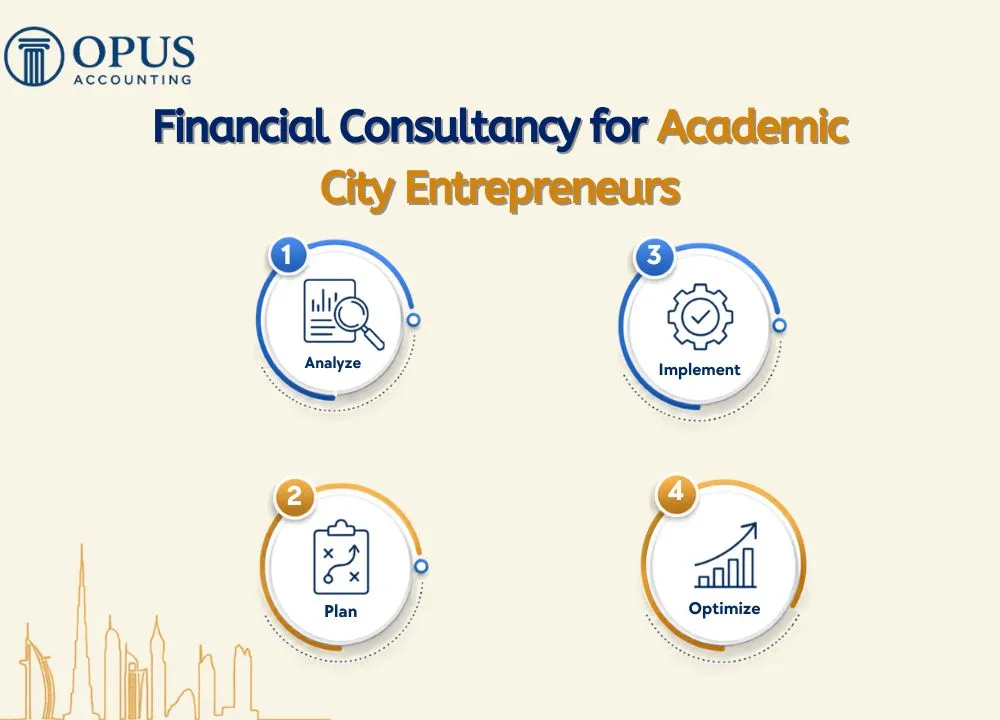
Opus Accounting provides a comprehensive suite of financial consultancy for Academic City entrepreneurs covering every stage of business development:
- Unit economics CAC and LTV analysis for subscription and platform businesses
- Grant and project financial management, including budgeting, tracking, and reporting
- Fundraising financial advisory covering pitch decks, financial models, and investor due diligence
- IP valuation and commercialisation advisory
- QFZP corporate tax planning for free zone-qualified businesses
- Revenue model design and financial projection
- Cash flow forecasting and runway management
- Cost structure analysis and breakeven modelling
- Business plan financial section development
- Financial reporting aligned with investor, grant-funder, and regulatory requirements
- Free zone compliance and economic substance advisory
Unit Economics: CAC and LTV Analysis
For Academic City entrepreneurs building technology platforms, EdTech products, or subscription-based services, unit economics is the financial language that investors speak and that sustainable growth depends on. Unit economics CAC and LTV analysis provides the metrics that determine whether your business model is fundamentally viable at scale.
Customer Acquisition Cost (CAC): We calculate your fully loaded CAC, encompassing not just advertising spend but also sales team costs, content marketing investment, partnership development costs, and the overhead associated with your acquisition activities. Many Academic City startups underestimate their true CAC by excluding indirect acquisition costs, which creates a misleading picture of growth efficiency.
Lifetime Value (LTV): We model the total revenue (or gross profit) you expect to generate from a customer over the duration of their relationship with your business. For subscription businesses, this involves churn rate analysis, upselling potential, and expansion revenue modelling. For project-based businesses, it involves repeat engagement probability and average project value tracking.
LTV:CAC ratio: The ratio of lifetime value to acquisition cost is the single most important metric for investor conversations. We calculate and track this ratio, segment it by customer cohort and acquisition channel, and identify the specific actions needed to improve it. Unit economics CAC and LTV analysis at this level of granularity is essential for fundraising financial advisory, because it demonstrates not just growth but profitable growth.
Payback period: How many months does it take for a new customer’s revenue to cover the cost of acquiring them? We model this payback period and incorporate it into your cash flow forecasting, ensuring your growth spending does not outrun your cash runway. Our financial consultancy for Academic City entrepreneurs treats unit economics as the foundation of every growth conversation.
Grant and Project Financial Management
Academic City’s proximity to universities and research institutions means many entrepreneurs here receive or pursue grant funding, whether from government innovation programmes, research councils, university commercialisation funds, or international development organisations. Grant and project financial management requires a disciplined approach that satisfies both the funder’s reporting requirements and your own business accounting needs.
Grant budget development: We help you structure grant budgets that accurately reflect the costs of the proposed project while maximizing the funding request within programme guidelines. This includes correctly categorizing costs as direct, indirect, and overhead, and ensuring your budget aligns with the funder’s eligible cost categories.
Project cost tracking: Once a grant is awarded, every eligible cost must be tracked, documented, and allocated to the correct project. We establish project accounting structures within your bookkeeping system that capture costs at the level of detail funders require, without creating excessive administrative burden on your team.
Funder reporting: Grant funders typically require periodic financial reports, often quarterly or at project milestones, showing actual expenditure against budget, with supporting documentation. Our grant and project financial management service produces these reports accurately and on schedule, maintaining the funder relationship and ensuring continued disbursements.
Revenue recognition for grant income: Grant income is recognized in accordance with IFRS, typically as conditions are met or performance obligations are satisfied. This can create timing differences between cash received and income recognized. We ensure your financial statements correctly reflect the grant income recognition treatment, which also affects your corporate tax position.
Multi-funder management: Some Academic City businesses manage multiple grants simultaneously, each with different reporting requirements, eligible cost categories, and reporting periods. Our financial consultancy for Academic City entrepreneurs coordinates financial management across multiple funding sources without allowing the complexity to overwhelm your finance function.
IP Valuation and Commercialisation
Intellectual property is often the most valuable asset an Academic City business possesses, yet it is also the most difficult to value and the most commonly underrepresented in financial statements. IP valuation and commercialisation advisory helps entrepreneurs understand what their IP is worth and how to maximize its financial contribution.
IP identification and classification: Before valuation can begin, every piece of commercially relevant IP must be identified and classified: software code, algorithms, proprietary data sets, educational content, research methodologies, trademarks, and patents. We work with you to build a comprehensive IP inventory that forms the basis for valuation.
Valuation methodologies: We apply the valuation methodology most appropriate to your IP type and commercial context, whether that is a cost-based approach (what it cost to develop), an income-based approach (the future revenue it is expected to generate), or a market-based approach (what comparable IP has sold for). IP valuation and commercialisation advisory uses the methodology that best reflects the economic reality of your specific intellectual property.
Commercialisation financial modelling: Whether you plan to license your IP, sell it outright, use it as a basis for a SaaS platform, or contribute it to a joint venture, each commercialisation route has different financial implications. We model the revenue, cost, and cash flow projections for each route, enabling an informed strategic decision.
IP in business valuation: For entrepreneurs seeking investment or considering exit, IP is often the primary driver of business value. Our IP valuation and commercialisation advisory ensures your IP is properly represented in any business valuation exercise, supporting stronger negotiating positions in fundraising or M&A conversations.
QFZP Corporate Tax Planning
Academic City businesses operating within the free zone may qualify as Qualified Free Zone Persons (QFZP) under UAE Corporate Tax legislation, potentially benefiting from a 0% CT rate on qualifying income. QFZP corporate tax planning is the discipline of structuring your operations and maintaining your records to secure and preserve this benefit.
QFZP eligibility assessment: Not every free zone business automatically qualifies. QFZP status requires meeting specific conditions, including maintaining adequate substance in the free zone, deriving qualifying income, and meeting the de minimis threshold for non-qualifying revenue. We assess your eligibility and advise on any operational adjustments needed to qualify.
Qualifying versus non-qualifying income: QFZP benefits apply only to qualifying income. Revenue from mainland UAE customers, for example, may not qualify. We analyse your revenue streams to determine which income qualifies for the 0% rate and which is subject to the standard 9% rate, ensuring correct classification in your financial statements.
Substance requirements: Maintaining adequate economic substance, including having sufficient qualified employees, operating expenditure, and physical assets in the free zone, is a condition of QFZP status. Our financial consultancy for Academic City entrepreneurs ensures your substance position is documented and defensible.
Transfer pricing for free zone businesses: Academic City businesses that transact with related mainland entities must ensure those transactions are at arm’s length. QFZP corporate tax planning includes transfer pricing analysis and documentation to protect your QFZP status and preventFTA challenges.
Annual compliance: QFZP status is not a one-time election; it must be maintained each tax period. We monitor your compliance with QFZP conditions throughout the year and manage the annual CT filing to preserve the benefit.
Fundraising Financial Advisory
For Academic City entrepreneurs seeking external funding, whether from angel investors, venture capital, institutional grants, or strategic partners, fundraising financial advisory prepares the financial foundation that funding applications and investor conversations require.
Financial model development: We build comprehensive financial models that project revenue, costs, cash flow, and key metrics over three to five years. These models are designed to withstand investor scrutiny, with clearly stated assumptions, scenario analysis, and sensitivity testing. The quality of your financial model directly affects investor confidence.
Pitch deck financial section: The financial slides in your pitch deck must tell a compelling, credible story. We develop the financial narrative, including market size quantification, revenue projections, unit economics CAC and LTV analysis, and funding use breakdown, ensuring consistency between what you present and what your underlying model shows.
Due diligence preparation: When investors move to due diligence, they examine your historical financial records, tax compliance, contracts, and liabilities in detail. Fundraising financial advisory includes preparing your financial records for this examination, identifying and resolving any issues that could derail the process, and ensuring your bookkeeping is investor-ready.
Term sheet financial analysis: When you receive a term sheet, the financial implications of the proposed terms (valuation, dilution, liquidation preferences, anti-dilution provisions) need careful analysis. Our financial consultancy for Academic City entrepreneurs provides objective, expert analysis of term sheet economics to support your negotiation.
Post-funding financial reporting: After funding is secured, investors expect regular financial reporting against the projections you presented. We establish the reporting framework and produce the investor updates that maintain trust and transparency throughout the relationship.
FAQ’s | Financial Consultancy for Academic City Entrepreneurs
1. We are an EdTech startup in Academic City with a SaaS product. Where should we start with financial consultancy?
Start with unit economics CAC and LTV analysis. Understanding your customer acquisition cost, lifetime value, churn rate, and payback period is the foundation for every other financial decision, from pricing strategy to fundraising readiness. Our financial consultancy for Academic City entrepreneurs begins with these metrics and builds your financial strategy outward from them.
2. We have received a government innovation grant. How do you manage the financial reporting requirements?
Grant and project financial management is a core service. We establish a project accounting structure that tracks every eligible cost against the grant budget, produce the periodic financial reports your funder requires, and ensure grant income is correctly recognized in your financial statements. This keeps your funder relationship strong and your accounting compliant.
3. Our Academic City business qualifies as a free zone person. How do we ensure we get the 0% corporate tax rate?
QFZP corporate tax planning involves confirming your eligibility, classifying your income into qualifying and non-qualifying categories, maintaining adequate economic substance documentation, and filing your CT return correctly. We manage this entire process, monitoring your compliance with QFZP conditions throughout the year and not just at filing time.
4. We are preparing to raise a seed round. What financial preparation do investors expect?
Investors expect a robust financial model with clearly stated assumptions, historical financial records that are clean and professionally maintained, a clear articulation of your unit economics, and evidence of financial discipline. Fundraising financial advisory covers all of this: model development, financial record cleanup, due diligence preparation, and pitch deck financial section support.
5. Our startup’s main asset is our proprietary software platform. How do we value it?
IP valuation and commercialisation advisory uses the methodology most appropriate to your situation. For a revenue-generating software platform, an income-based approach (projecting the future cash flows the IP will generate, discounted to present value) is typically most relevant. We also consider the cost to replicate and any market comparables. The resulting valuation supports investment discussions, partnership negotiations, and financial statement reporting.
Expert Financial Consultancy for Your Academic City Business
Academic City entrepreneurs are building the knowledge businesses that will define Dubai’s next economic chapter. The financial consultancy that supports these ventures must match their ambition and sophistication.
Our financial consultancy for Academic City entrepreneurs delivers that standard, covering unit economics CAC and LTV analysis, grant and project financial management, QFZP corporate tax planning, IP valuation and commercialisation, and fundraising financial advisory. Every recommendation is practical, every model is rigorous, and every engagement is built around your specific business and growth objectives.
Contact Opus Accounting today for a free consultation and discover how expert financial consultancy can accelerate your Academic City venture.