
Jebel Ali Village sits at the gateway to the Jebel Ali Free Zone, one of the world’s most important trade and logistics corridors. Companies operating in and around Jebel Ali Village navigate a corporate tax landscape that is shaped by both the UAE’s standard CT regime and the specific provisions that apply to JAFZA free zone entities.
Understanding and correctly applying the QFZP framework for JAFZA companies, while managing the standard CT obligations of mainland entities, requires the specialist expertise our corporate tax filing services for Jebel Ali Village businesses provide.
Our corporate tax filing service for Jebel Ali Village businesses delivers the definitive analysis and comprehensive compliance management needed by both JAFZA free zone companies and mainland businesses in this strategically important commercial corridor, complementing our broader corporate tax filing services across Dubai.
Corporate Tax for Jebel Ali Village Businesses
Businesses in and around Jebel Ali Village typically fall into two main corporate tax categories, and our corporate tax filing services for Jebel Ali Village businesses address both:
JAFZA free zone companies: JAFZA entities may be eligible for QFZP status, subject to meeting the substance, qualifying income, and other conditions of the QFZP regime. For JAFZA companies that qualify, the 0% rate applies to qualifying income. Non-qualifying income or income that exceeds the de minimis threshold is subject to the standard 9% rate. Determining eligibility requires a thorough JAFZA QFZP eligibility assessment before each filing period.
Mainland DED companies: Mainland entities in Jebel Ali Village are subject to the standard UAE CT regime, taxed at 9% on taxable income above AED 375,000, with access to Small Business Relief for eligible businesses. A proper Small Business Relief assessment for mainland entities confirms whether this election can reduce your CT liability to zero.
Companies with both JAFZA and mainland entities: Many businesses in the Jebel Ali area operate through both a JAFZA free zone entity and a mainland DED entity, requiring coordinated CT compliance management across both frameworks, with careful attention to transfer pricing documentation for related party transactions covering all intercompany dealings between the two entities.
Our Corporate Tax Filing Services for Jebel Ali Village
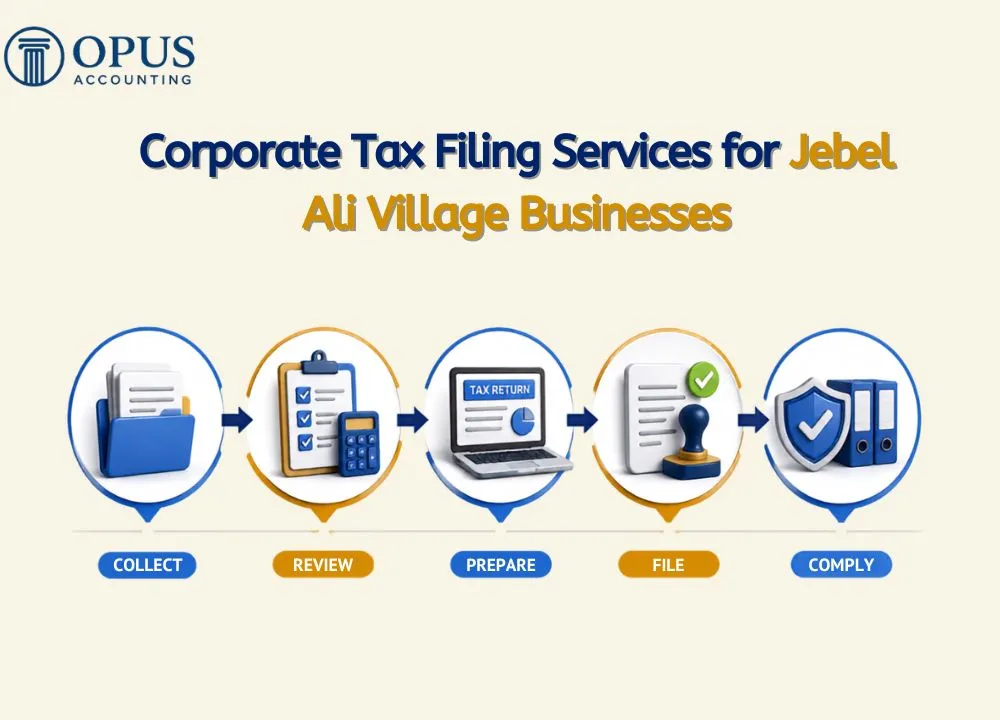
We provide comprehensive corporate tax filing services for Jebel Ali Village businesses covering every element of CT compliance:
JAFZA QFZP eligibility assessment and annual analysis. Qualifying income identification and non-qualifying income segregation. Substance documentation for JAFZA QFZP companies. FTA registration for both JAFZA and mainland entities. Annual CT return preparation for each entity. Intercompany transaction analysis between JAFZA and mainland entities. Transfer pricing documentation for related party transactions. Small Business Relief assessment for mainland entities. CT payment scheduling and advance payment management. FTA correspondence and audit support. Multi-entity consolidated tax reporting.
Businesses that also require accurate day-to-day financial records to support their CT filings can rely on our bookkeeping services for Jebel Ali Village, which maintain the transactional data that underpins every tax return.
JAFZA QFZP Analysis and Compliance
For JAFZA companies seeking to qualify as Qualifying Free Zone Persons, our JAFZA QFZP eligibility assessment covers every applicable condition:
Substance assessment: We assess whether your JAFZA entity has adequate substance, including employees engaged in qualifying activities, assets within the free zone, and adequate operating expenditure. Where substance is borderline, we advise on the steps needed to strengthen the substance position before the filing deadline.
Qualifying income analysis: We review every revenue stream of the JAFZA entity and classify each as qualifying or non-qualifying based on the applicable QFZP criteria. Revenue from transactions with mainland UAE clients is generally non-qualifying, while revenue from other free zone persons and overseas clients may qualify. This classification is central to our JAFZA QFZP eligibility assessment process.
De minimis threshold management: The non-qualifying revenue threshold, 5% of total revenue or AED 5 million, must not be breached to maintain QFZP status. We monitor this threshold continuously and alert clients when approaching the limit.
Audited financial statements for QFZP status: Maintaining QFZP status requires audited financial statements for each relevant tax period. Audited financial statements for QFZP status are not optional, they are a mandatory condition, and failure to obtain them in time can result in loss of the 0% rate for the entire period. Our audits and assurance services coordinate directly with your CT filing timeline to ensure audited financial statements for QFZP status are completed before the filing deadline.
Annual compliance management: QFZP status must be maintained on an ongoing basis, with conditions assessed annually and the QFZP election reflected correctly in each year’s CT return. We manage this annual reassessment as part of our standard corporate tax filing services for Jebel Ali Village businesses.
Intercompany Transactions Between JAFZA and Mainland Entities
Businesses that operate through both a JAFZA free zone entity and a mainland DED entity must pay careful attention to the tax implications of transactions between them. Proper transfer pricing documentation for related party transactions protects both entities from FTA challenge:
Service fee arrangements: If the JAFZA entity provides services to the mainland entity, or vice versa, the fees charged must be at arm’s length rates. Transactions that shift income from the higher-taxed entity to the lower-taxed entity will be subject to FTA scrutiny.
Intercompany supply arrangements: If goods are transferred between the JAFZA entity and the mainland entity as part of the business’s supply chain, the transfer prices must be consistent with what unrelated parties would pay.
Financing arrangements: Intercompany loans between JAFZA and mainland entities must carry arm’s length interest rates, which we calculate using appropriate market benchmarks aligned withOECD transfer pricing guidelines.
Our transfer pricing documentation for related party transactions covers all dealings between related entities, providing the arm’s length analysis and documentation that protects both entities in the event of FTA enquiry. For businesses needing VAT consulting alongside these transfer pricing arrangements, we ensure CT and VAT positions are aligned across all intercompany flows.
Multi-Entity Reporting and Audit Readiness
For business groups operating through several entities across JAFZA and the mainland, our multi-entity consolidated tax reporting brings CT positions together into a single, coherent picture for management, while individual entity filings remain fully compliant. Multi-entity consolidated tax reporting is particularly valuable for ownership groups that need to understand their aggregate CT exposure and plan cash flows around payment deadlines across multiple entities.
Where audited financial statements for QFZP status are required, our audits and assurance services coordinate directly with your CT filing timeline. Our financial reporting services ensure the underlying financial statements meet the standards that both auditors and the FTA expect. Businesses operating in the broader Jebel Ali corridor that need management-level visibility into their cost structures can also benefit from our Jebel Ali zone profitability analysis to align operational performance with tax planning.
Expert Corporate Tax Filing for Your Jebel Ali Village Business
Jebel Ali Village businesses navigate one of the UAE’s most commercially significant and regulatory complex business environments. Our expert corporate tax filing services for Jebel Ali Village businesses ensure your CT obligations are met correctly and your tax position is optimised within the law, whether you operate a single JAFZA entity, a mainland company, or a multi-entity group spanning both.
Contact Opus Accounting today for a free consultation and discover how our corporate tax filing expertise can protect and optimise your Jebel Ali Village business. Explore our full range of accounting services to see how we support businesses across Dubai, and for Legal Contract Drafting contact Omam Consultancy in Dubai.
FAQ’s | Corporate Tax Filing Services for Jebel Ali Village Businesses
1. Our JAFZA company earns most of its revenue from overseas clients. Does this qualify as qualifying income for QFZP purposes?
Revenue from overseas clients may qualify, but this depends on the nature of the service and delivery location. Our JAFZA QFZP eligibility assessment reviews each revenue stream individually and provides a definitive income classification before the CT return is filed.
2. We have both a JAFZA entity and a mainland entity that trade with each other. Does this create a transfer pricing issue?
Yes. These are related party transactions subject to transfer pricing rules under the UAE CT law. Our transfer pricing documentation for related party transactions service ensures pricing is at arm’s length and properly documented to withstand FTA review.
3. Our JAFZA company has not yet prepared audited financial statements. Is this a problem for CT purposes?
Yes. Audited financial statements for QFZP status are a mandatory condition. Without them, your entity cannot maintain the 0% qualifying rate. We advise on the audit timeline needed and coordinate with your auditor through our audits and assurance services to protect your QFZP position.
4. We are a mainland Jebel Ali Village business with revenues of AED 2 million. Do we qualify for Small Business Relief?
Potentially yes. Our Small Business Relief assessment for mainland entities confirms eligibility based on your revenue level and entity type, makes the election in your annual CT return, and ensures all applicable conditions are met to reduce your CT liability.
5. We operate three entities across JAFZA and the mainland. Can you manage tax reporting across all of them together?
Yes. Our multi-entity consolidated tax reporting brings CT positions from all entities into a single coherent view for management while ensuring each individual entity filing remains fully compliant with FTA requirements and deadlines.