
Dubai Investment Park First (DIP 1) is a well-established mixed-use development zone hosting a diverse commercial ecosystem of manufacturing, warehousing, logistics, food production, and trading businesses. These operationally intensive enterprises face corporate tax considerations that are distinctly different from standard service or retail businesses.
Production cost deductibility across complex manufacturing processes, IFRS 16 lease deductibility for significant warehouse and factory premises, loss carryforward planning for businesses navigating cyclical or seasonal demand, and group relief qualifying tax group structuring for multi-entity industrial groups all require specialized CT expertise that generic accounting firms rarely offer.
Our corporate tax filing services for Dubai Investment Park First businesses deliver the sector-specific tax compliance and planning that DIP 1’s industrial and commercial enterprises demand. We combine deep knowledge of UAE CT law with hands-on experience in the manufacturing, logistics, and trading cost structures that define the financial landscape of this dynamic zone.
Why DIP 1 Businesses Need Specialized Corporate Tax Expertise
The business types concentrated in Dubai Investment Park First create CT filing requirements that are fundamentally different from those of service-based or retail businesses operating elsewhere in Dubai. Understanding these differences is the starting point for effective corporate tax filing for Dubai Investment Park First businesses.
Manufacturing cost structures: DIP 1 manufacturers incur complex production costs spanning raw materials, direct labour, factory overheads, machinery depreciation, and quality control expenses. Production cost deductibility requires each of these cost categories to be correctly classified, documented, and claimed in the CT return. Errors in cost classification can result in legitimate deductions being missed or, conversely, in non-deductible costs being incorrectly claimed.
Significant leased premises: Industrial businesses in DIP 1 typically operate from large warehouse, factory, or logistics facilities under long-term lease agreements. The introduction of IFRS 16 has changed how these leases are accounted for, with implications for the CT deductibility of lease-related expenses. IFRS 16 lease deductibility requires careful analysis to ensure the correct treatment is applied in your CT return.
Capital-intensive operations: DIP 1 businesses invest significantly in production equipment, vehicles, and infrastructure. The depreciation of these assets directly reduces taxable income, but only if assets are correctly capitalised, categorised, and depreciated using IFRS-consistent policies.
Multi-entity structures: Many DIP 1 businesses are part of larger groups, with related entities in other UAE zones. Group relief qualifying tax group provisions allow losses and other tax attributes to be shared between qualifying group members, but strict conditions must be met. Accurate bookkeeping and financial record-keeping underpin this multi-entity compliance.
Growth-stage and cyclical businesses: Some DIP 1 businesses, particularly newer manufacturers and seasonal trading companies, generate losses in certain periods. Loss carryforward planning ensures these losses are preserved and utilised to reduce future tax liabilities when profitability returns.
Our Corporate Tax Filing Services for Dubai Investment Park First
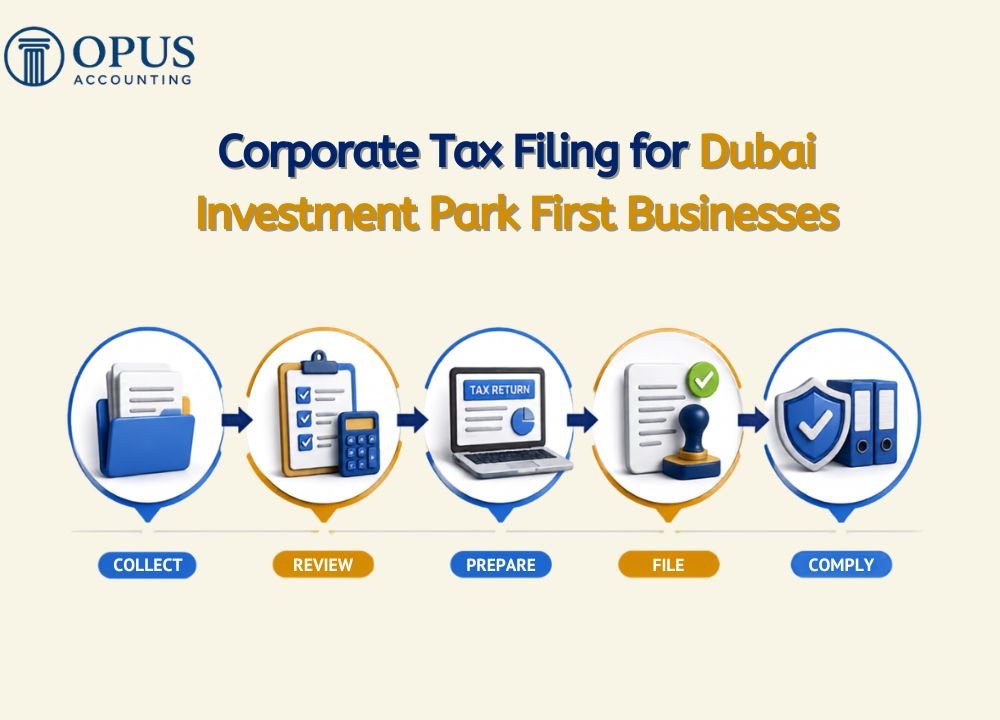
We provide comprehensive corporate tax filing for Dubai Investment Park First businesses covering every element of CT compliance and planning:
- FTA Corporate Tax Registration: Complete CT registration management for new and existing DIP 1 businesses.
- Taxable Income Calculation: Accurate determination of taxable profit from accounting net profit, incorporating all allowable deductions and adjustments specific to industrial and trading operations.
- Production Cost Deductibility Review: Comprehensive review of all manufacturing and production costs to ensure every legitimate production expense is correctly claimed as a deductible cost.
- IFRS 16 Lease Deductibility Analysis: Expert analysis of your lease arrangements to determine the correct CT treatment of right-of-use assets, lease liabilities, and associated depreciation and interest charges.
- Small Business Relief Eligibility Assessment: Determining whether your DIP 1 business qualifies for the 0% CT rate under the SBR provisions, including ongoing revenue monitoring against the AED 3 million threshold.
- Loss Carryforward Planning: Structuring your CT position to preserve and optimise the utilisation of tax losses carried forward from prior periods.
- Group Relief Qualifying Tax Group Assessment: Evaluating whether your DIP 1 entity and related UAE companies meet the conditions for forming a qualifying tax group, and implementing the election where beneficial.
- Fixed Asset Depreciation Schedule Review: Ensuring all capital assets are correctly capitalised and depreciated for CT purposes.
- Expense Deductibility Audit: Identifying and claiming every allowable deduction, from staff costs and rent to repairs, maintenance, and professional fees.
- Related Party Transaction Analysis: Ensuring intercompany transactions are correctly documented and reported in compliance with transfer pricing requirements.
- Annual CT Return Preparation and FTA Submission: Complete preparation, quality review, and timely submission of your corporate tax return to the UAE Federal Tax Authority.
- CT Payment Scheduling: Managing payment timelines to avoid late payment penalties.
Our corporate tax filing for Dubai Investment Park First businesses ensures every deduction is claimed, every obligation is met, and every filing is accurate.
Production Cost Deductibility for DIP 1 Manufacturers
Manufacturing businesses in Dubai Investment Park First incur layered production costs that must be correctly treated for corporate tax purposes. Production cost deductibility is one of the most technically demanding aspects of CT filing for industrial businesses, because the distinction between costs that are immediately deductible, costs that must be capitalised, and costs that are not deductible at all directly affects your taxable income.
Direct materials: Raw materials, components, and consumables used in production are deductible as cost of goods sold in the period the finished product is sold, not when the materials are purchased. For DIP 1 manufacturers holding significant inventory, this timing distinction is critical. The cost must include full landed cost: supplier price, freight, insurance, and customs duties. Proper cost accounting supports accurate production cost tracking.
Direct labour: Wages, benefits, and payroll-related costs for production workers are deductible. For CT purposes, the deductible amount must be consistent with WPS records and employment contracts. Production labour costs allocated to unsold inventory at year-end are capitalised as part of inventory value, not expensed immediately.
Factory overheads: Production-related overheads, including utilities, maintenance, depreciation of production equipment, quality control, and factory supervision, are absorbed into inventory cost under IAS 2. Only the portion attributable to goods sold during the period is deductible as part of COGS. Unabsorbed overheads due to abnormal idle capacity are expensed immediately and are generally deductible.
Depreciation of production equipment: Machinery, production lines, and specialist equipment are depreciated over their useful lives under IAS 16. The annual depreciation charge reduces taxable income, but only if the asset is correctly capitalised at its full acquisition cost (including installation, commissioning, and testing) and depreciated using an IFRS-consistent method.
Quality and compliance costs: Testing, certification, and regulatory compliance costs directly related to production are generally deductible as business expenses in the period incurred.
Our corporate tax filing for Dubai Investment Park First businesses ensures every category of production cost deductibility is correctly applied, maximising your allowable deductions while maintaining full compliance.
IFRS 16 Lease Deductibility for DIP 1 Industrial Premises
Most DIP 1 businesses operate from significant leased premises: factories, warehouses, logistics hubs, and commercial offices. Under IFRS 16, leases are no longer simply expensed as rental payments. Instead, the lessee recognises a right-of-use (ROU) asset and a corresponding lease liability on the balance sheet. This accounting treatment has direct implications for your corporate tax filing.
How IFRS 16 changes the CT picture: Under the old lease accounting standard (IAS 17), operating lease rental payments were simply expensed as incurred. Under IFRS 16, the expense profile changes: the ROU asset is depreciated over the lease term (a front-loaded expense), and the lease liability generates interest expense (also front-loaded). The total expense over the lease term is the same, but the timing changes, which means your annual taxable income is affected.
IFRS 16 lease deductibility under UAE CT law: The UAE CT law follows accounting net profit as the starting point for taxable income. This means the IFRS 16 depreciation and interest charges flow into your taxable income calculation. However, the law also provides for adjustments where accounting treatment diverges from tax treatment. Our expert analysis determines the correct IFRS 16 lease deductibility treatment for each of your lease arrangements.
Practical implications for DIP 1 businesses: Industrial businesses with large warehouse or factory leases may see materially different taxable income compared to the simple rental expense they would have reported under the old standard. Understanding and correctly applying IFRS 16 lease deductibility is essential for accurate corporate tax filing for Dubai Investment Park First businesses.
Lease modifications and renewals: If your DIP 1 lease is modified (e.g., rent renegotiation, term extension, premises expansion), the ROU asset and lease liability must be remeasured. These remeasurements affect both your balance sheet and your taxable income calculation.
Accurate financial reporting that correctly implements IFRS 16 is the foundation for getting lease deductibility right in your CT return.
Small Business Relief Eligibility for DIP 1 Businesses
Small Business Relief (SBR) provides a 0% CT rate for qualifying businesses with revenue below AED 3 million in the relevant tax period. For smaller DIP 1 businesses, particularly newer manufacturers, niche trading companies, and emerging operations, SBR can eliminate the CT liability entirely during the growth phase.
Small Business Relief eligibility conditions: The business must be a resident person (UAE-incorporated or effectively managed in the UAE), must not be a qualifying free zone person, and must have revenue below AED 3 million for the relevant tax period. The election must be made in the CT return for each period.
Revenue monitoring: Small Business Relief eligibility requires ongoing monitoring of your cumulative revenue against the AED 3 million threshold. For DIP 1 businesses experiencing growth, approaching this threshold triggers important planning considerations. Once exceeded, standard CT rates apply, and your business must maintain audited financial statements.
Strategic considerations: While SBR eliminates the CT liability, electing SBR has implications for loss carryforward. Losses incurred during SBR periods cannot be carried forward against future taxable income. For DIP 1 businesses with significant startup losses that expect future profitability, it may be more beneficial to forgo SBR and preserve losses for future offset through loss carryforward planning.
Our corporate tax filing for Dubai Investment Park First businesses includes detailed Small Business Relief eligibility assessment that considers both the immediate tax saving and the longer-term implications for your overall tax position.
Loss Carryforward Planning for DIP 1 Businesses
Manufacturing, warehousing, and trading businesses in Dubai Investment Park First may generate tax losses during certain periods, whether due to startup costs, capital-intensive expansion phases, seasonal demand troughs, or economic downturns. Loss carryforward planning is a critical element of long-term CT strategy for these businesses.
How loss carryforward works: Under UAE CT law, tax losses can be carried forward and offset against future taxable income, subject to certain conditions. The offset is limited to 75% of taxable income in any given period, meaning you cannot eliminate your entire CT liability using carried-forward losses alone.
Conditions for loss carryforward: To carry forward losses, the business must maintain continuity of ownership and continue the same or a similar business activity. Significant changes in ownership or business activity can restrict or forfeit carried-forward losses. For DIP 1 businesses undergoing restructuring or ownership changes, these conditions require careful planning.
Loss carryforward and SBR interaction: As noted above, losses incurred during periods where Small Business Relief eligibility is elected cannot be carried forward. For DIP 1 businesses with current losses but expectations of future profitability, the decision between electing SBR and preserving losses requires a forward-looking financial analysis that weighs the immediate tax saving against the future tax benefit of loss utilization.
Multi-entity loss management: Where DIP 1 businesses are part of a group, losses may be transferable between qualifying group members under the group relief provisions, subject to meeting the qualifying tax group conditions.
Our loss carryforward planning ensures your DIP 1 business preserves and optimises the utilisation of every available tax loss. Financial consultancy supports this planning with strategic modelling of future profitability scenarios.
Group Relief and Qualifying Tax Group for DIP 1 Entities
Many DIP 1 businesses are part of larger corporate groups, with related entities operating in other UAE zones or within DIP itself. The UAE CT law allows qualifying tax groups to be formed, enabling certain tax benefits to be shared between group members.
Group relief qualifying tax group conditions: To form a qualifying tax group, the parent company must hold at least 75% ownership (directly or indirectly) in each subsidiary, all entities must be UAE tax residents, all must have the same financial year end, and all must prepare financial statements using the same accounting standards. No entity in the group can be an exempt person or a qualifying free zone person benefiting from the 0% rate.
Benefits of group relief: Qualifying tax groups can transfer losses between group members, allowing a profitable DIP 1 entity to offset its taxable income against losses from a related group company (subject to the 75% offset cap). This can significantly reduce the group’s overall CT liability. Groups can also transfer assets between members without triggering taxable gains, and intercompany transactions within the group can be eliminated for CT purposes.
Practical considerations for DIP 1 groups: Forming a qualifying tax group requires careful assessment of ownership structures, financial year alignment, and the impact on each entity’s individual tax position. Our group relief qualifying tax group analysis evaluates whether forming a group is beneficial for your specific structure and implements the election where advantageous.
Documentation requirements: Tax groups must maintain detailed documentation of intercompany transactions, loss transfers, and compliance with qualifying conditions. Our corporate tax filing for Dubai Investment Park First businesses includes all documentation required to support your group relief position. Proper compliance and licensing records complement this documentation.
Sector-Specific CT Considerations for DIP 1 Business Types
Different business types within Dubai Investment Park First face distinct CT considerations:
Manufacturing businesses: Production cost deductibility across raw materials, direct labour, factory overheads, and equipment depreciation. Inventory valuation methods (FIFO, weighted average) directly affect COGS and taxable income. Work-in-progress accounting adds another layer of complexity.
Warehousing and logistics businesses: IFRS 16 lease deductibility for large warehouse premises, vehicle fleet depreciation, fuel costs, and labour-intensive operations with significant payroll deductibility. Contract-based revenue recognition timing affects when income becomes taxable.
Food production businesses: Production cost deductibility for perishable raw materials, waste and spoilage accounting treatment, strict shelf-life-related inventory write-downs, and compliance-related costs (Dubai Municipality approvals, HACCP certification) that are generally deductible.
Trading and wholesale businesses: Landed cost methodology for imported goods, inventory valuation and year-end stock count accuracy, foreign currency transaction treatment, and managing the CT impact of trade credit arrangements.
Professional service firms: Staff cost deductibility, project revenue recognition under IFRS 15, and managing the timing difference between accrual accounting and cash receipts.
Our corporate tax filing for Dubai Investment Park First businesses addresses each sector’s specific requirements, ensuring every business type files correctly and optimises its tax position. VAT compliance management complements this CT expertise, ensuring both tax obligations are managed as an integrated programme.
FAQ’s | Corporate Tax Filing for Dubai Investment Park First Businesses
1. Our DIP 1 factory spent AED 4 million on raw materials this year, but AED 800,000 worth remains as unsold finished goods inventory. How much is deductible?
Production cost deductibility applies only to the cost of goods actually sold during the tax period, not to the total materials purchased. The AED 800,000 of raw materials embodied in unsold inventory at year-end remains capitalised as an asset on your balance sheet and is not deductible until those goods are sold. Your deductible COGS includes the raw material cost, direct labour, and allocated factory overheads attributable to the units sold. Our corporate tax filing for Dubai Investment Park First businesses ensures this inventory-cost-of-sales matching is calculated correctly.
2. Our DIP 1 warehouse lease is AED 1.2 million per year. How does IFRS 16 change our CT treatment?
Under IFRS 16, your AED 1.2 million annual lease is no longer simply expensed as rent. Instead, you recognise a right-of-use asset and lease liability. Your P&L shows depreciation of the ROU asset and interest on the lease liability, replacing the straight rental expense. In early years of the lease, the combined depreciation and interest typically exceeds the cash rent paid, reducing your taxable income compared to the old treatment. IFRS 16 lease deductibility analysis determines the precise impact on your CT calculation each year.
3. Our DIP 1 business revenue is AED 2.5 million. Should we elect Small Business Relief?
Small Business Relief eligibility at AED 2.5 million revenue means you can elect for 0% CT. However, if your business is currently loss-making or marginally profitable, electing SBR means those losses cannot be carried forward against future taxable income. If you expect significant profitability in coming years, preserving current losses through loss carryforward planning may deliver a greater long-term tax benefit than the immediate SBR saving. We model both scenarios to determine the optimal strategy for your specific situation.
4. We have two DIP 1 companies under the same ownership. Can they form a qualifying tax group?
If both companies are UAE tax residents with the same financial year end, use the same accounting standards, and the parent holds at least 75% ownership in each, they can potentially form a group relief qualifying tax group. This would allow losses to be transferred between the entities and intercompany transactions to be eliminated for CT purposes. Our corporate tax filing for Dubai Investment Park First businesses includes full qualifying tax group assessment to determine whether forming a group benefits your specific structure.
5. How does production cost deductibility work for a food manufacturer with significant waste?
For food manufacturers, normal production waste is included in the cost of production and absorbed into finished goods cost, making it part of COGS and deductible when goods are sold. Abnormal waste (e.g., due to equipment failure, spoilage beyond normal levels, or quality defects) is expensed immediately and is generally deductible as a business expense in the period incurred. Our production cost deductibility analysis correctly classifies normal versus abnormal waste for CT purposes, ensuring both are treated correctly.
Expert Corporate Tax Filing for Your DIP 1 Business
Dubai Investment Park First businesses operate with the cost structures, asset bases, and operational complexities that make corporate tax filing genuinely challenging. From production cost deductibility and IFRS 16 lease deductibility through to Small Business Relief eligibility, loss carryforward planning, and group relief qualifying tax group structuring, every element of your CT position requires specialist expertise.
Our corporate tax filing for Dubai Investment Park First businesses delivers that expertise with accuracy, reliability, and a proactive approach that ensures your tax position is optimised throughout the year, not just at filing time.
Contact us today for a free consultation.