
Umm Suqeim is home to some of Dubai’s most prestigious hospitality, retail, and wellness businesses, enterprises that generate premium revenues from a discerning international clientele. The introduction of UAE Corporate Tax creates a significant new financial management requirement for these businesses, particularly given the complex revenue structures, significant capital investments, and related party arrangements that characterise premium market operations.
Understanding exactly how UAE CT applies to hospitality income, service charges, and multi-outlet structures is the foundation of correct tax compliance, which is why reliable Corporate Tax Filing Services for Umm Suqeim Businesses matter so much.
Our corporate tax filing service for Umm Suqeim businesses provides the expert, sector-specific guidance that premium hospitality, retail, and wellness enterprises need, ensuring accurate taxable income calculation, complete FTA compliance, and effective tax planning that reflects the specific financial characteristics of the premium market. This service is delivered through our broader corporate tax filing services, tailored specifically for Umm Suqeim’s premium business community.
Corporate Tax for Umm Suqeim’s Premium Business Community
Premium businesses in Umm Suqeim face UAE CT considerations that reflect the complexity of their operations.
Hospitality revenue structures matter because hotels, beach clubs, and luxury hospitality businesses generate revenue from multiple sources, including room revenue, food and beverage, spa, events, and ancillary services. Each revenue stream may have different income recognition timing under IFRS 15, and correctly aggregating and recognising all streams is essential for accurate CT compliance.
Service charge treatment is important since service charges collected from customers and distributed to employees are not income of the business, they pass through the business as a distribution to staff. Ensuring service charge flows are correctly reflected in financial statements to avoid inclusion in taxable income is a key part of our Corporate Tax Filing Services for Umm Suqeim Businesses.
Significant capital assets are common among luxury hospitality businesses, which carry significant capital asset bases including building fit-out, specialist equipment, and luxury furnishings. The depreciation of these assets is the primary mechanism for recovering their cost through tax deductions over time.
Multi-outlet structures are typical for many premium Umm Suqeim businesses that operate multiple revenue-generating outlets, such as hotel restaurants, beach clubs, and spas, within a single legal entity. Ensuring all income and expenses are correctly attributed is important for the overall taxable income calculation.
Our Corporate Tax Filing Services for Umm Suqeim
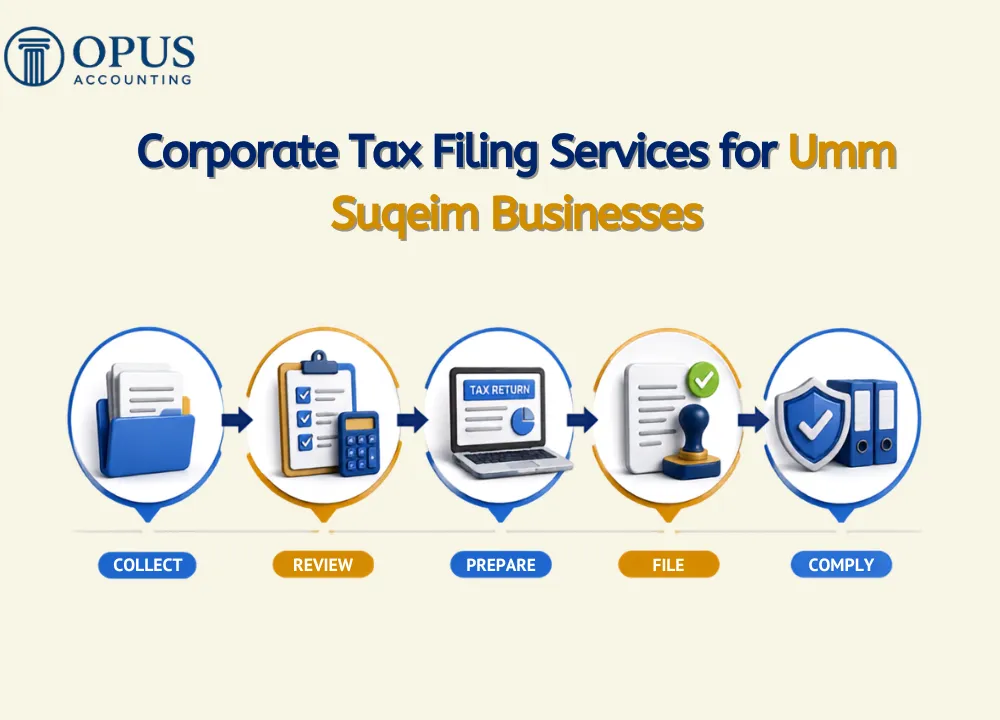
We provide a comprehensive Corporate Tax Filing Services for Umm Suqeim Businesses offering, covering:
- FTA corporate tax registration
- Hospitality revenue recognition and CT treatment, covering rooms, F&B, spa, and events
- Service charge CT treatment and financial statement review
- Hotel asset depreciation review, including fit-out, fixtures, and specialist equipment
- Multi-outlet income consolidation for single-entity returns
- Advance booking and deposit deferred income analysis
- Expense deductibility review, including entertainment limits and management fees
- Related party transaction analysis
- Annual CT return preparation and FTA submission
- CT payment scheduling
- FTA audit support for hospitality and premium retail businesses
- Tax planning for premium market business structures
Hospitality Income Recognition and CT Compliance
Luxury hospitality businesses in Umm Suqeim have specific revenue recognition obligations under IFRS 15 that directly affect their taxable income calculation, and this is a core focus of our Corporate Tax Filing Services for Umm Suqeim Businesses.
Room revenue from hotel room occupancy is recognised over the stay, not at booking or at check-in. Pre-paid bookings made months in advance create deferred income that is only recognised, and taxable, as the occupancy is delivered.
Food and beverage revenue is recognised when meals and beverages are served, generally coinciding with collection. However, advance event bookings, pre-paid meal packages, and F&B vouchers create timing differences.
Spa and wellness services revenue is recognised when the treatment is delivered. Pre-paid treatment packages and membership agreements require careful revenue recognition, matching income to the periods when services are actually performed.
Event and banqueting income from event deposits and advance payments creates deferred income until the event is held. Non-refundable deposits are recognised as income when the right to retain them is established.
Managing the complex revenue recognition requirements of a multi-service hospitality operation requires careful financial statement preparation, which we provide as part of the CT filing service, closely tied to our financial reporting services.
Capital Asset Management and CT Deductions
Premium hospitality and retail businesses in Umm Suqeim carry significant capital asset bases whose depreciation generates important annual CT deductions.
Hotel asset depreciation review covers the capital cost of luxury hotel fit-out, including custom furniture, specialist lighting, and premium FF&E, which is depreciated over the fit-out’s useful life, typically 5 to 10 years. The annual depreciation charge is a deductible expense that reduces taxable income.
Specialist equipment, including beach club equipment, spa treatment equipment, restaurant kitchen equipment, and entertainment systems, are capital assets that depreciate over their useful lives, each at an IFRS-consistent rate appropriate for the specific asset type.
Leasehold improvements, common for hospitality businesses that operate from leased rather than owned premises, are depreciated over the shorter of the remaining lease term and the improvement’s useful life.
We review all capital asset categories for our Umm Suqeim hospitality clients, confirm that IFRS-consistent depreciation policies are applied, and calculate the total annual depreciation deduction for CT purposes. You can review the applicable UAE Corporate Tax framework directly through the Federal Tax Authority.
Expert Corporate Tax Filing for Your Umm Suqeim Business
Umm Suqeim businesses operate at the pinnacle of Dubai’s commercial market. Our Corporate Tax Filing Services for Umm Suqeim Businesses ensure your CT compliance reflects that same premium standard, accurate, sophisticated, and optimally planned.
Contact Opus Accounting today for a free consultation. Our corporate tax filing services help businesses build better reporting, compliance, and financial control, and for Legal Contract Drafting contact Omam Consultancy in Dubai.
FAQ’s | Corporate Tax Filing Services for Umm Suqeim Businesses
1. We operate a luxury beach club in Umm Suqeim. Our revenue includes membership fees paid annually in advance. When is this income taxable?
Annual membership fees paid in advance create deferred income under IFRS. The fee is only recognised as income over the membership period, on a straight-line basis across the membership year. In the CT return, only the portion of membership fee income earned during the tax period is taxable, as part of our Corporate Tax Filing Services for Umm Suqeim Businesses.
2. Our Umm Suqeim hotel collects service charges and distributes them to staff. Is the service charge our income?
Service charges that are collected and distributed to employees are not the business’s income, they pass through the business as a distribution to staff. Provided the service charge is correctly reflected in the financial statements as a pass-through item rather than business income, it is not included in taxable income.
3. We have made significant investment in hotel room refurbishment. How is this treated for CT?
Hotel room refurbishment is a capital expenditure deducted through depreciation over the refurbished rooms’ useful life as part of our hotel asset depreciation review. The annual depreciation charge is a deductible expense. A complete refurbishment that significantly extends the asset’s life may be depreciated over a longer period than a cosmetic refresh.
4. Our Umm Suqeim business is part of a hotel group. Are there any group CT planning opportunities?
Yes. Qualifying corporate tax groups can transfer losses between group companies or file a single consolidated return. We assess whether your hotel group qualifies for tax group treatment through related party transaction analysis and advise on the most tax-efficient group structure for CT purposes, as part of our broader corporate tax filing services.
5. What happens if the FTA selects our business for a corporate tax audit?
Our FTA audit support service prepares and organises the documentation the FTA typically requests, including revenue recognition schedules, depreciation records, and related party transaction analysis, and we represent your business throughout the audit process to help resolve queries efficiently and accurately.