
Business Bay is Dubai’s premier corporate district, a high-rise commercial corridor along the Dubai Canal that hosts one of the highest concentrations of professional service firms, technology companies, consultancy practices, real estate businesses, and corporate headquarters in the UAE.
These are sophisticated businesses generating complex revenue streams, and UAE Corporate Tax applies to every one of them. Corporate tax filing for Business Bay companies requires expert understanding of how professional service revenue, subscription income, development cost capitalisation, group structures, and related party transactions translate into accurate taxable income computation and compliant FTA returns.
Opus Accounting provides dedicated corporate tax filing for Business Bay companies, built around the specific commercial activities and corporate structures that define this dynamic district. Whether you are a professional service firm managing project-based revenue, a SaaS company with subscription income, or a group with multiple Business Bay entities, our CT service ensures every return is accurate, every deduction is captured, and every compliance obligation is met.
Corporate Tax for Business Bay’s Commercial Ecosystem
Business Bay’s commercial diversity creates a range of CT compliance requirements, each reflecting the specific economics of the sector. Corporate tax filing for Business Bay companies must address every one of these scenarios with precision.
Professional service firms: Management consultancies, advisory practices, legal firms, and specialist consultancies generate revenue from project-based engagements, retainer arrangements, and advisory mandates. Professional service firm CT compliance requires accurate revenue recognition under IFRS 15, correct treatment of work-in-progress, and careful analysis of expense deductibility for partner compensation, business development costs, and professional indemnity.
Technology and SaaS companies: Software-as-a-service businesses, IT consultancies, and digital platforms generate subscription revenue that must be recognized over the service delivery period. SaaS subscription deferred income creates timing differences between cash collection and taxable income that must be managed correctly in the CT return.
Real estate businesses: Property developers, real estate agencies, and property management companies have sector-specific CT considerations around revenue recognition timing, development cost treatment, and commission income classification.
Corporate headquarters: Businesses using Business Bay as their UAE headquarters often manage inter-company transactions with subsidiaries, branches, or affiliates, creating transfer pricing and group structure considerations that directly affect the CT return.
Multi-entity groups: Business Bay hosts numerous groups with multiple UAE entities, creating opportunities for qualifying tax group assessment that can simplify CT compliance and enable loss transfers between group companies.
Our Corporate Tax Filing Services for Business Bay Companies
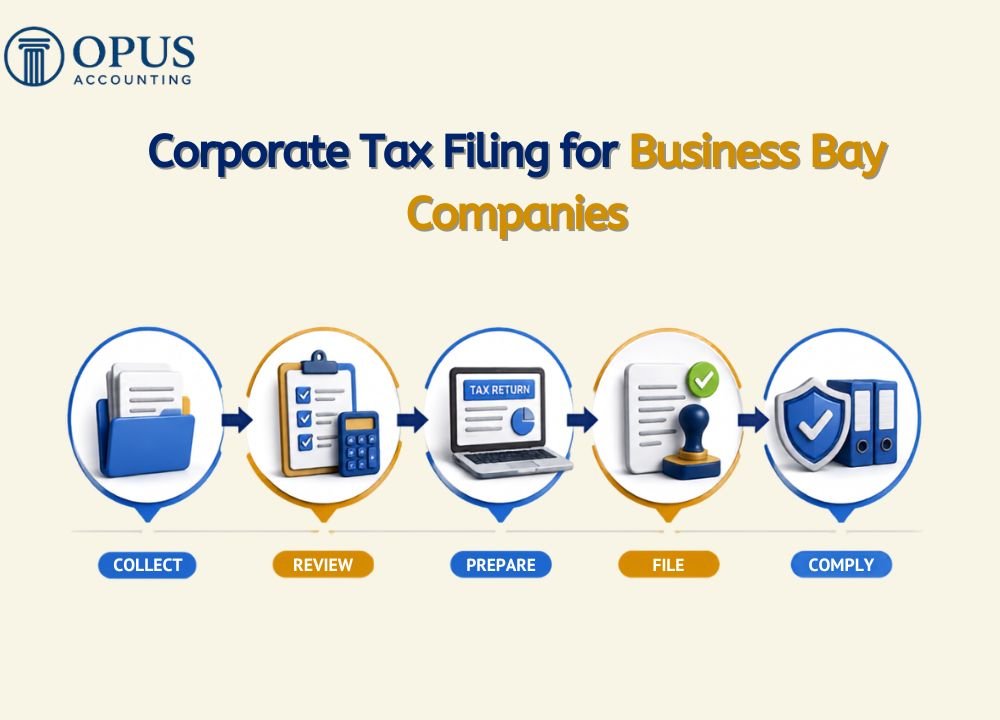
Opus Accounting provides comprehensive corporate tax filing for Business Bay companies covering every CT obligation:
- FTA corporate tax registration
- Professional service firm CT compliance, including IFRS 15 revenue recognition and WIP treatment
- SaaS subscription deferred income management and CT timing analysis
- Development cost capitalisation IAS 38 assessment and CT treatment
- Qualifying tax group assessment and election management
- Transfer pricing related party transactions documentation and arm’s length analysis
- Expense deductibility review covering entertainment, interest limitation, and partner compensation
- Small Business Relief eligibility assessment and election
- Annual CT return preparation and FTA portal submission
- CT payment scheduling and advance payment management
- FTA correspondence and audit support
- Multi-year CT planning, including loss carryforward management
- Coordination with your VAT compliance to ensure consistent positions across both filings
Professional Service Firm CT Compliance
Professional service firms represent one of the largest business categories in Business Bay, and their CT compliance requirements reflect the specific economics of knowledge-based work. Professional service firm CT compliance demands attention to several areas that do not arise in other sectors.
IFRS 15 revenue recognition: Professional service revenue is recognized as performance obligations are satisfied. For fixed-fee projects, this typically means recognizing revenue over the engagement period based on percentage of completion. For retainer arrangements, revenue is recognized as the retainer period elapses. For success-fee structures, revenue recognition depends on when the success condition is met. Each methodology produces different taxable income timing, and our corporate tax filing for Business Bay companies applies the correct IFRS 15 treatment to every engagement type.
Work-in-progress tax treatment: At any reporting date, professional firms hold work-in-progress (WIP), representing services delivered but not yet billed. WIP is recognized as revenue for accounting purposes when the performance obligation is satisfied, and this recognized revenue is part of taxable income even before the client is invoiced. Professional service firm CT compliance requires accurate WIP measurement and correct inclusion in taxable income.
Partner and director compensation: The CT treatment of compensation paid to practitioner-owners who are both shareholders and active service providers is a specific planning consideration. Salary payments are deductible; profit distributions are not. Structuring compensation to maximize legitimate deductions while maintaining commercial reasonableness is a key element of CT planning for Business Bay professional firms.
Business development and entertainment deductibility: Professional firms typically incur significant business development costs, including client entertainment, networking events, and hospitality. UAE CT limits the deductibility of entertainment expenses to 50% of the amount incurred. Our service identifies and correctly classifies every entertainment expense, ensuring the limitation is applied accurately without capturing non-entertainment costs in the restricted category.
SaaS Subscription Deferred Income and CT
Technology companies in Business Bay increasingly operate on subscription-based revenue models. SaaS subscription deferred income creates a specific CT timing consideration that must be managed correctly to avoid both overpaying and underpaying tax.
Revenue timing for CT: When a client pays an annual SaaS subscription upfront, the cash received is not all taxable income in the period of collection. Under IFRS 15, subscription revenue is recognized over the service delivery period. Your CT return must reflect revenue as recognized under IFRS, not as collected. SaaS subscription deferred income means that the portion of collected fees not yet recognized as revenue sits as a liability (deferred income) on your balance sheet and is excluded from taxable income until the service is delivered.
Multi-period subscription management: For SaaS companies with a mix of monthly, quarterly, and annual subscriptions, the deferred income position at any reporting date can be significant. We maintain detailed deferred income schedules that track every active subscription and ensure the CT return captures exactly the right amount of recognized revenue. Corporate tax filing for Business Bay companies with subscription models depends on this precision.
Upgrade, downgrade, and cancellation treatment: When clients change their subscription tier or cancel mid-term, the deferred income schedule must be adjusted accordingly. We process these changes as they occur, ensuring the CT return reflects the current service arrangement rather than the original contract terms.
Free trial and freemium considerations: SaaS companies offering free trials or freemium tiers with paid upgrades need to consider when and how conversion revenue is recognized for CT purposes. Our service ensures the correct treatment is applied from the point of conversion. Accurate bookkeeping is the foundation that SaaS subscription deferred income management depends on.
Development Cost Capitalisation: IAS 38 and Corporate Tax
Technology companies and professional service firms in Business Bay often invest significantly in developing proprietary software, platforms, methodologies, and tools. Under IAS 38 (Intangible Assets), certain development costs must be capitalised rather than expensed immediately, and this treatment has direct CT implications. Development cost capitalisation IAS 38 is one of the most technically demanding areas of CT compliance for knowledge-based businesses.
Research versus development phase: IAS 38 requires costs incurred during the research phase to be expensed as incurred, while costs in the development phase (once specific criteria are met) must be capitalised. Development cost capitalisation IAS 38 requires clear identification of when a project transitions from research to development, a judgement that must be documented and defensible.
Capitalisation criteria: Development costs qualify for capitalisation only when the business can demonstrate technical feasibility, intention to complete, ability to use or sell the asset, probable future economic benefits, availability of resources to complete, and reliable cost measurement. We work with your development team to assess each project against these criteria and document the position for CT purposes.
Amortisation and CT deduction: Once the developed asset is complete and available for use, the capitalised costs are amortised over its expected useful life. This amortisation charge, rather than the original development expenditure, becomes the deductible expense in each CT period. For Business Bay technology companies that capitalise significant development costs, this creates a timing difference between cash spent and CT deduction that can span several years.
Impairment and CT adjustment: If a capitalised project loses its commercial viability, the carrying amount must be tested for impairment. Any impairment charge is a deductible expense in the period it is recognized. We monitor capitalised development projects and flag impairment indicators, ensuring your CT return reflects the correct carrying value. Corporate tax filing for Business Bay companies with significant intangible assets requires this ongoing monitoring.
Qualifying Tax Group Assessment
Business Bay hosts numerous corporate groups with multiple UAE entities. Where two or more companies meet the qualifying conditions, they may elect to form a tax group for CT purposes. Qualifying tax group assessment determines whether a group election would benefit your Business Bay entities.
Eligibility criteria: A qualifying tax group requires common ownership (typically 95% or more), UAE tax residence for all group members, identical financial years, and preparation of financial statements using the same accounting standards. We assess your group structure against these criteria and advise on eligibility.
Benefits of tax group election: The primary benefits are simplified compliance (a single consolidated CT return rather than separate returns for each entity) and the ability to transfer losses between group members. If one entity is profitable while another is loss-making, the group election allows the loss to offset the profit, reducing the group’s overall CT liability. Qualifying tax group assessment quantifies the potential tax saving and weighs it against any administrative complexity.
Intra-group transaction treatment: Within a tax group, transactions between group members are typically eliminated on consolidation for CT purposes. This simplifies the transfer pricing obligation for intra-group transactions, although the arm’s length requirement still applies for any transactions with entities outside the group.
Election management: We manage the tax group election with the FTA, prepare the consolidated CT return, and maintain the documentation needed to support the group structure. Our corporate tax filing for Business Bay companies includes ongoing monitoring of group eligibility conditions to ensure the election remains valid.
Transfer Pricing for Related Party Transactions
Business Bay companies that are part of larger groups or that transact with connected parties face specific transfer pricing obligations. Transfer pricing related party transactions must be conducted at arm’s length, and the documentation supporting this must be maintained for FTA review.
Common related party scenarios in Business Bay: Management fees charged between group entities, inter-company service agreements, cost-sharing arrangements, intellectual property licensing between related parties, loans from shareholders or affiliated entities, and shared office or infrastructure costs. Each of these transfer pricing related party transactions requires arm’s length pricing and supporting documentation.
Arm’s length documentation: We prepare transfer pricing documentation that demonstrates the arm’s length character of each significant related party transaction. This includes identifying comparable transactions between unrelated parties, applying the appropriate transfer pricing methodology (comparable uncontrollable price, cost plus, resale price, or transactional net margin), and documenting the analysis. For businesses requiring broader financial consultancy around group structure optimization, our advisory team provides strategic support.
Master file and local file: Businesses with significant related party transactions may be required to prepare and maintain a Master File (describing the group’s global operations and transfer pricing policies) and a Local File (documenting the specific related party transactions of the UAE entity). We assess the requirements applicable to your Business Bay business and prepare the required documentation.
FTA audit readiness: Transfer pricing is one of the areas the FTA is most likely to scrutinize during a tax audit. Our corporate tax filing for Business Bay companies ensures that transfer pricing related party transactions documentation is complete, current, and readily available for any FTA review.
FAQ’s | Corporate Tax Filing for Business Bay Companies
1. We are a Business Bay management consultancy with AED 8 million in revenue and four partners. What are the key CT considerations?
Professional service firm CT compliance for a consultancy of your size involves several key areas: correct IFRS 15 revenue recognition for your engagements (percentage of completion for fixed-fee projects, time-based for retainers), accurate WIP measurement at each reporting date, careful structuring of partner compensation to maximize deductible salary versus non-deductible profit distribution, and correct treatment of entertainment expenses (50% deductibility limitation). Our corporate tax filing for Business Bay companies manages all of these elements.
2. Our SaaS company collects annual subscriptions in advance. How does this affect our CT return?
Annual subscriptions collected in advance create SaaS subscription deferred income. The full payment is not taxable in the collection period. Revenue is recognized over the twelve-month subscription term, and only the recognized portion is included in taxable income for each CT period. The unrecognized balance remains as deferred income on your balance sheet until the service is delivered. We maintain detailed deferred income schedules to ensure your CT return captures the correct revenue in each period.
3. Our tech company has spent AED 1.5 million developing a proprietary platform. Should we capitalise these costs?
If your development project meets the IAS 38 capitalisation criteria (technical feasibility, intention to complete, ability to use or sell, probable future economic benefits, available resources, reliable cost measurement), the development phase costs must be capitalised. Development cost capitalisation IAS 38 means the expenditure is not deductible immediately but is amortised over the platform’s useful life, creating annual CT deductions over several years rather than a single deduction in the year of spend. We assess each project against the criteria and manage the capitalisation and amortisation throughout.
4. We have three Business Bay companies under common ownership. Should we form a tax group?
Qualifying tax group assessment evaluates whether a group election would benefit your specific situation. If all three entities meet the eligibility criteria (95%+ common ownership, same financial year, UAE tax resident, same accounting standards), the potential benefits include filing a single consolidated CT return and the ability to offset losses in one entity against profits in another. We assess the financial impact, including any administrative considerations, and advise on whether election is beneficial.
5. We are growing rapidly. How do we ensure our CT compliance keeps pace?
Rapid growth creates specific CT challenges: increasing revenue may push you past the Small Business Relief threshold, new employees and contractors create additional deductible expenses that must be classified correctly, and expanding operations may involve new related party arrangements that require transfer pricing documentation. Our service is built to scale with growing businesses, adjusting the complexity and depth of CT management as your Business Bay company expands. For comprehensive cost analysis alongside CT compliance, our cost accounting team provides additional support.
6. Can Opus Accounting handle our VAT, bookkeeping, and corporate tax together?
Yes. We provide corporate tax filing for Business Bay companies alongside bookkeeping, VAT consulting, and financial reporting. Managing all of these together ensures consistency across every financial record and every regulatory filing, prevents conflicting positions between VAT and CT returns, and gives you a single point of contact for your complete financial compliance in Business Bay.
Expert Corporate Tax Filing for Your Business Bay Company
Business Bay companies operate at the forefront of Dubai’s commercial landscape, and the corporate tax compliance that supports these businesses must match that commercial sophistication. Our corporate tax filing for Business Bay companies delivers exactly that, covering professional service firm CT compliance, SaaS subscription deferred income, development cost capitalisation IAS 38, qualifying tax group assessment, and transfer pricing related party transactions. Every return is accurate, every deduction is captured, and every filing is on time.
Contact Opus Accounting today for a free consultation and discover how expert CT filing can protect and benefit your Business Bay company.