
Dubai International City is one of the UAE’s most commercially active trading communities, a diverse, multicultural hub where wholesale importers, retailers, food businesses and professional service providers generate significant VAT flows from high-volume activity.
Managing tax correctly in this environment, with its large import volumes, multi-supplier procurement networks and broad customer base, calls for both technical knowledge and the operational discipline to keep invoicing compliant and records accurate across every transaction. That is precisely what expert VAT & Indirect Tax Consulting for Dubai International City businesses is built to deliver.
Our VAT and indirect tax consulting service gives trading community businesses the comprehensive, practical VAT management they need, ensuring accurate compliance and maximum legitimate input tax recovery.
VAT for Dubai International City’s Trading Community
International City businesses mainly encounter VAT through the import-sell cycle that defines trading community commerce:
Import VAT on purchased goods: Goods imported from overseas carry 5% VAT on the customs value. This is the primary input VAT cost for most International City trading businesses, recoverable in the quarterly VAT return.
Output VAT on domestic sales: Sales to UAE customers carry 5% output VAT. Tax invoices must be issued for all VAT-registered customers, while simplified tax receipts are acceptable for sales to members of the public.
Cash flow management: The timing gap between paying import VAT and recovering it through the quarterly return can create a real cash flow challenge for high-volume importers. Managing that timing efficiently, whether through a Deferred Import VAT Arrangement or careful return scheduling, is an important consideration.
Export zero-rating: Sales to customers outside the UAE can be zero-rated, reducing or eliminating output VAT on international sales. Proper Export Zero-Rating Compliance means keeping the documentation that supports the zero-rating.
Our VAT and Indirect Tax Services for International City
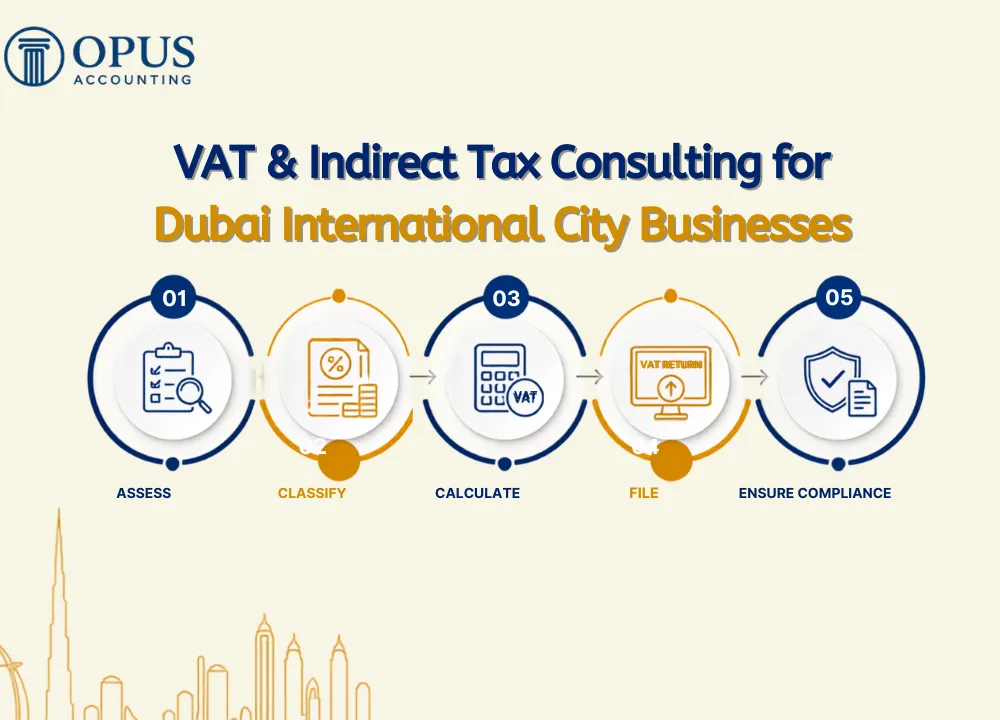
We provide a comprehensive VAT and indirect tax consulting service for Dubai International City businesses:
- VAT registration and compliance management
- Import VAT management, including recovery documentation and return treatment
- Export Zero-Rating Compliance and documentation
- Quarterly VAT return preparation and FTA submission
- Trading Business Tax Invoice Compliance
- Food and restaurant VAT compliance
- Input tax recovery review and optimisation
- Reverse charge for overseas service purchases
- Deferred Import VAT Arrangement assessment
- FTA Voluntary Disclosure Management
- VAT health check and historical compliance review
Trading Business Tax Invoice Compliance
For International City trading businesses making large-value supplies to other VAT-registered businesses, Trading Business Tax Invoice Compliance is a specific area of focus:
Full tax invoice requirements: Supplies to VAT-registered customers above AED 10,000 require full tax invoices meeting all FTA requirements: a unique sequential invoice number, supplier and customer name, address and TRN, supply description, date, quantity, unit price, discount (if applicable), taxable amount, VAT rate, VAT amount and total amount.
Simplified tax receipts: For supplies to unregistered customers (members of the public), simplified tax receipts with fewer required elements are acceptable.
Credit notes: Where supplies are cancelled, returned or adjusted after a tax invoice has been issued, a credit note (tax credit note) must be issued, reducing both parties’ VAT positions by the correct amount.
Electronic invoicing: UAE businesses are encouraged to adopt e-invoicing systems. We advise on Electronic Invoicing compliance and help International City businesses implement compliant electronic invoice systems, keeping their records accurate and audit-ready.
Food and Restaurant VAT Management
Restaurants and food businesses in International City, serving the community’s diverse culinary preferences, have their own VAT compliance requirements:
Standard-rated food supplies: Prepared food sold in restaurants, cafes and takeaway outlets is standard-rated at 5% VAT. The 5% applies to the full price, including any service charge or delivery fee charged to customers.
Zero-rated grocery items: Certain basic unprocessed food items are zero-rated. Businesses that sell both prepared food (5%) and qualifying grocery items (0%) must classify each product correctly, applying the right rate to every sale.
Imported food ingredient VAT: VAT paid on imported food ingredients used in food preparation is recoverable as input tax, reducing the net VAT cost of food production.
Delivery platform VAT: For restaurants using delivery aggregators, VAT applies to the full order value including delivery charges. The exact VAT accounting depends on whether the platform acts as a principal or agent in the transaction.
FAQ’s | VAT & Indirect Tax Consulting for Dubai International City Businesses
1. We are an International City trader importing AED 1 million of goods per month. Can we use a Deferred Import VAT Arrangement?
A Deferred Import VAT Arrangement lets you account for import VAT in your regular quarterly return rather than paying it at the border. Eligibility depends on your compliance history and application approval from the Federal Tax Authority. We assess your eligibility and manage the application if you qualify.
2. Our International City shop sells to both registered businesses and individual customers. Do we need different invoice types?
Yes. Sales to VAT-registered businesses above AED 10,000 require full tax invoices with all required elements, which falls under Trading Business Tax Invoice Compliance. Sales to individual customers can be made using simplified tax receipts with fewer required elements.
3. We have operated for 18 months but never issued correct VAT invoices to our business customers. What should we do?
This is a compliance issue that needs corrective action. We review your historical invoicing, assess the specific gaps and advise on the best remediation route, which may include issuing replacement invoices or FTA Voluntary Disclosure Management, depending on your circumstances.
4. Our restaurant has a zero-rated food section and a standard-rated prepared food section. How do we calculate VAT on mixed orders?
Each item in the order is categorised at its correct rate: zero-rated items carry 0% VAT and standard-rated prepared food carries 5% VAT. The invoice or receipt should show each category separately with its applicable VAT amount.
5. How does VAT & Indirect Tax Consulting help with export sales from International City?
Strong VAT and indirect tax consulting keeps your Export Zero-Rating Compliance in order, making sure every overseas sale is supported by the right documentation. That protects the zero-rating, reduces output VAT correctly and keeps you safe if the FTA ever reviews your returns.
Expert VAT Consulting for Your Dubai International City Business
International City businesses manage significant VAT flows every single day. Our expert VAT & Indirect Tax Consulting for Dubai International City businesses makes sure those flows stay accurate, efficient and fully compliant with Federal Tax Authority{target=”_blank” rel=”noopener”} requirements.
Explore our full range of VAT consulting services or browse all Opus Accounting services, then contact Opus Accounting today for a free VAT consultation and see how the right guidance keeps your trading business compliant, cash-flow smart and ready for growth.