
International City Phase 2 is a growing residential and commercial community in Dubai, a diverse and entrepreneurially active hub where wholesale importers, retailers, food businesses, and professional service providers generate VAT-able transactions from a high-volume commercial environment. For community businesses in this area, VAT compliance is a practical daily reality, charging VAT on supplies, recovering it on purchases, and filing accurate quarterly returns that correctly reflect every transaction.
Our expert VAT and indirect tax consulting for International City Phase 2 businesses provides the practical, accessible VAT management that every business type in this community needs, from straightforward quarterly return management to specialist advice on import VAT recovery and overseas supplier reverse charge obligations. This local support sits within our wider VAT and indirect tax consulting services in Dubai, tailored to the trading realities of this district.
UAE VAT for International City Phase 2 Businesses
International City Phase 2 businesses encounter UAE VAT primarily through their trading and service activities:
Trading and wholesale businesses: import goods subject to import VAT, charge 5% output VAT on domestic sales, and potentially zero-rate exports. The net VAT position depends on the balance of inputs and outputs, and high importers may be in persistent refund positions until goods are sold domestically.
Retail businesses: charge 5% VAT on retail sales to UAE customers, with standard input tax recovery on stock purchases, premises rent, and business expenses.
Food and restaurant businesses: charge VAT on prepared food and beverages. Zero-rating applies to certain basic unprocessed food items, and import VAT on food ingredients is recoverable.
Professional service businesses: charge VAT on professional services to UAE clients, with zero-rating potentially applying for services to qualifying overseas clients.
Our VAT and Indirect Tax Services for International City Phase 2
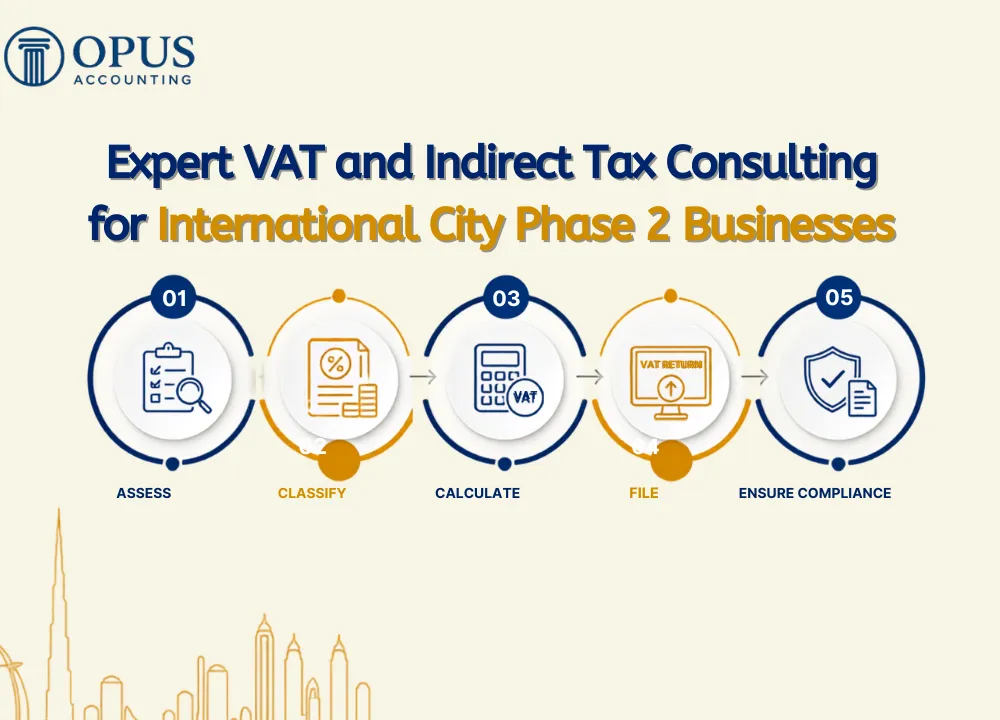
We provide a comprehensive VAT and indirect tax consulting service for International City Phase 2 businesses:
- VAT registration assessment and registration management
- Import VAT management for trading businesses
- Quarterly VAT return preparation and FTA submission
- Output VAT compliance, correct charging and invoicing
- Input tax recovery review
- Food and F&B VAT compliance
- Professional service VAT management
- Reverse charge mechanism for overseas purchases
- FTA voluntary disclosure management
- VAT health check for businesses with compliance concerns
- FTA query and audit support
Accurate day-to-day records make all of this far simpler, so many businesses pair this service with the same-community regulatory compliance support for International City Phase 2.
Import VAT for International City Traders
Many International City Phase 2 businesses import goods, from Asia, the Indian subcontinent, and elsewhere, creating specific import VAT management requirements:
Customs import VAT: VAT at 5% is levied on the customs value of imported goods at the UAE border. For businesses importing significant quantities, this is a substantial upfront cash cost that must be carefully managed.
Recovery in the VAT return: import VAT is recoverable as input tax in the VAT return for the period of importation, provided the imported goods are for use in making taxable supplies and the customs documentation is maintained.
Documentation requirements: recovery of import VAT requires maintaining the customs declaration (bill of entry) and evidence of VAT payment. Without this documentation, the FTA can disallow the recovery claim.
Deferred import VAT arrangements: eligible businesses can apply for deferred import VAT accounting, including import VAT in the regular VAT return rather than paying at the border. This improves cash flow by eliminating the timing gap between import VAT payment and recovery. We regularly set up deferred import VAT arrangements for trading businesses to protect working capital.
Restaurant and Food Business VAT
Restaurants and food businesses are central to International City Phase 2’s commercial community, and they have specific VAT compliance characteristics:
Prepared food standard rating: prepared food sold in restaurants, cafes, and takeaway outlets is subject to 5% VAT. This applies regardless of where the customer eats the food, so dine-in, takeaway, and delivery are all subject to VAT.
Zero-rated food items: certain unprocessed basic food items, specified in the UAE VAT Executive Regulations, are zero-rated. Businesses that sell both standard-rated prepared food and zero-rated basic food items must correctly classify each sale.
Food ingredient input VAT: VAT paid on food ingredients used in preparing restaurant food is recoverable as input tax, reducing the net VAT cost of running the business.
Simplified tax invoices: for retail and food businesses making supplies to members of the public rather than to VAT-registered businesses, simplified tax invoices or tax receipts are generally acceptable instead of full tax invoices.
FAQ’s | Expert VAT and Indirect Tax Consulting for International City Phase 2 Businesses
1. We are an International City wholesale trader who imports goods from China. The customs value on import is AED 2 million per month. How much import VAT do we pay, and can we recover it?
At 5% VAT on AED 2 million import value, you pay AED 100,000 VAT at import each month. This is fully recoverable as input tax in your quarterly VAT return, provided the goods are for use in making taxable supplies and customs documentation is maintained. The net VAT cost is nil, but the cash flow timing gap between payment and recovery is important to manage, which is where our import VAT management for trading businesses adds real value.
2. Our International City restaurant sells both dine-in food and groceries. Do they have different VAT rates?
Prepared dine-in food is standard-rated at 5%. Basic unprocessed grocery items may be zero-rated if they meet the specific zero-rating conditions in the UAE VAT regulations. Through our food and F&B VAT compliance service, we review your specific product range and advise on the correct VAT rate for each item.
3. We have been charging VAT but not filing returns. What should we do?
File the outstanding returns immediately. Late filing carries penalties from the Federal Tax Authority that increase over time. Through our FTA voluntary disclosure management service, we assess your historical VAT position, prepare the outstanding returns, and submit them, minimising penalty exposure through prompt action.
4. Our small International City Phase 2 business has revenues of AED 200,000 per year. Do we need to register for VAT?
At AED 200,000, you are below the mandatory registration threshold of AED 375,000. Voluntary registration is available above AED 187,500, and may be beneficial if you have significant business purchases on which you pay input VAT. For businesses below AED 187,500, registration is not available. We assess your specific position and advise on whether voluntary registration is worthwhile.
5. We buy services from overseas suppliers. How does the reverse charge mechanism affect us?
When you buy services from an overseas supplier, the reverse charge mechanism for overseas purchases usually requires you to account for both the output and input VAT on that supply in your own return, rather than the supplier charging you VAT. For most fully taxable businesses this is VAT-neutral, but it must be recorded correctly. We handle the reverse charge treatment as part of your quarterly return preparation.
Expert VAT Consulting for Your International City Phase 2 Business
International City Phase 2 businesses operate in a busy, commercially active community. Our expert VAT and indirect tax consulting for International City Phase 2 businesses ensures every VAT obligation is managed correctly, protecting compliance and maximising recovery.
Explore our full range of VAT and indirect tax consulting services, browse all Opus Accounting services, then contact us today for a free VAT consultation. For legal contract drafting, our partners at Omam Consultancy in Dubai provide specialist support.