
Bookkeeping Cost Dubai: Outsourced bookkeeping in Dubai typically costs between AED 500 and AED 5,000 per month for small and mid-sized businesses, with full-service packages covering VAT and corporate tax filing generally landing between AED 1,500 and AED 5,500 per month. Larger, more complex businesses can pay AED 8,000 to AED 15,000 or more.
That’s a wide range, and for good reason — bookkeeping isn’t a single, standardised service. Two businesses with similar revenue can have very different bookkeeping needs depending on transaction volume, industry, and how much compliance work sits on top of the core record-keeping.
This guide breaks down what actually drives that range, what should be included at each price point, and how outsourced pricing compares to hiring in-house. For the compliance side of what your bookkeeping needs to support, see our guide to the corporate tax return checklist.
Quick Answer
Basic bookkeeping starts around AED 500 to AED 1,000 per month for very small businesses with low transaction volumes. Most established SMEs pay AED 1,500 to AED 4,500 per month for bookkeeping plus VAT filing. Full-service packages adding corporate tax, payroll, and management reporting typically run AED 2,500 to AED 5,500 per month. Larger or higher-transaction businesses can pay AED 8,000 to AED 15,000-plus.
Why the Range Is So Wide
A first-time buyer of bookkeeping services often assumes price scales cleanly with company size or revenue. In practice, the workload — and therefore the cost — scales with something more specific: how much needs to be recorded, reconciled, and reported each month.
- A consultancy with 20 invoices a month and one bank account is genuinely cheap to keep current, regardless of how much revenue those 20 invoices represent.
- A retail or trading business with hundreds of transactions, multiple accounts, and inventory tracking costs considerably more, even at similar overall revenue.
- This is why comparing quotes purely on business size or revenue, without discussing actual transaction volume, tends to produce misleading comparisons.
How Providers Actually Structure Pricing
Most Dubai bookkeeping providers use one of a few common pricing structures, and knowing which one you’re being quoted helps you compare fairly:
- Flat monthly retainer, tiered by transaction volume band — the most common structure, where you’re quoted a fixed fee for up to a certain number of transactions per month, with a higher tier if you exceed it
- Per-transaction or per-hour pricing — less common for ongoing bookkeeping, but sometimes used for catch-up work or one-off projects
- Bundled packages — a single monthly fee covering bookkeeping plus a defined set of compliance services, often the best value if you need most of what’s bundled
- À la carte pricing — bookkeeping quoted separately from VAT filing, payroll, and other services, giving more control but requiring more comparison work to find the real total cost
Typical Pricing by Business Size
| Business Type | Typical Monthly Range | What’s Usually Included |
| Micro/startup (under 5 staff) | AED 500 – 1,500 | Basic bookkeeping, low transaction volume |
| Small business / SME | AED 1,500 – 4,500 | Bookkeeping, bank reconciliation, VAT filing |
| Full-service SME package | AED 2,500 – 5,500 | Bookkeeping, VAT, corporate tax, payroll, management accounts |
| Larger / complex business | AED 5,000 – 15,000+ | High transaction volume, multiple entities, CFO-level advisory |
These ranges reflect the current Dubai market broadly, not any single provider’s fixed price list — your actual quote depends heavily on the specific factors below.
What Actually Drives the Price
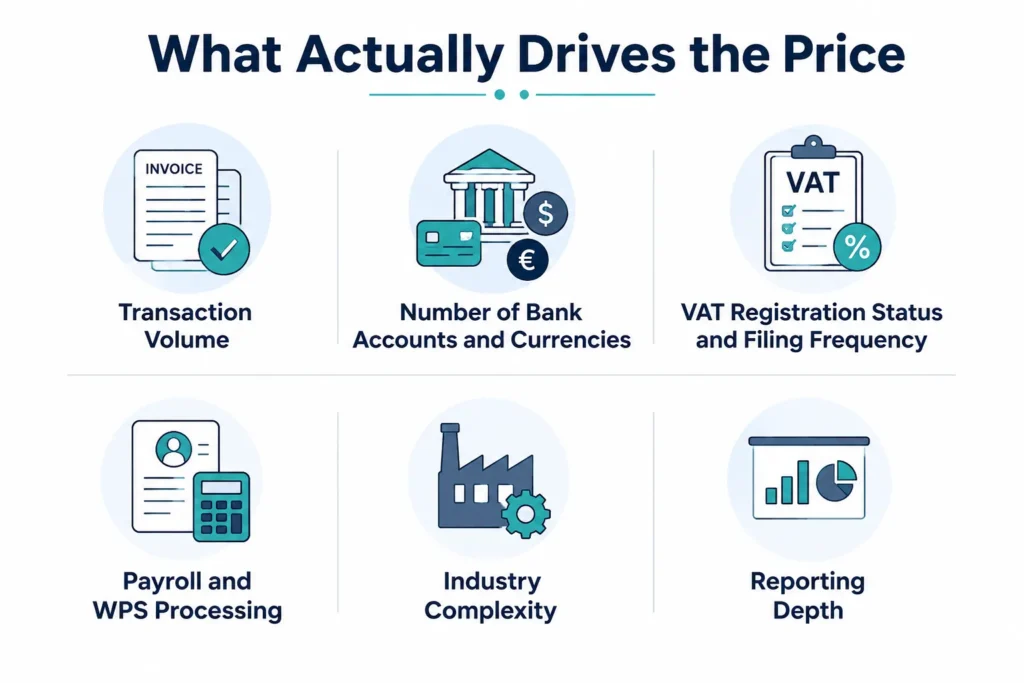
Two businesses of similar size can pay very different bookkeeping fees. The real cost drivers are worth understanding before you request quotes, since they’re what you should actually be discussing with any provider:
- Transaction volume — a business processing 500 invoices a month costs meaningfully more to keep current than one processing 30, regardless of overall revenue
- Number of bank accounts and currencies — more accounts to reconcile means more time, and multi-currency transactions add complexity beyond simple AED bookkeeping
- VAT registration status and filing frequency — VAT-registered businesses filing quarterly or monthly add a recurring compliance task on top of core bookkeeping
- Payroll and WPS processing — adding employees to the scope increases both the workload and the compliance risk being managed
- Industry complexity — inventory management, multi-entity structures, or project-based revenue recognition all add time beyond standard transaction processing
- Reporting depth — basic bookkeeping (recording transactions) costs less than bookkeeping plus full management reporting (P&L, balance sheet, cash flow analysis)
Of these, transaction volume tends to be the single biggest factor for most small businesses — it’s usually the first question a provider asks, and the main variable that determines which pricing tier you land in.
What Should Be Included at Each Price Point
A cheap quote that excludes core compliance items isn’t actually cheaper once you factor in the risk. A properly scoped bookkeeping package should include:
- Monthly transaction recording and categorisation
- Bank reconciliation for every account held
- VAT return preparation and FTA submission, if VAT-registered
- Basic financial statements — profit and loss, balance sheet
- Corporate tax return preparation, at minimum for the annual filing
- A clear point of contact and response time commitment, not just a mailbox that gets checked periodically
Anything below this baseline isn’t really a discount — it’s a different, incomplete service that will likely need supplementing, at extra cost, once a filing deadline or an FTA query exposes the gap.
In-House vs Outsourced: The Real Cost Comparison
The outsourcing decision usually comes down to this comparison, and the gap is larger than most business owners expect before they run the numbers side by side rather than just looking at salary alone.
| Cost Factor | In-House Accountant | Outsourced Bookkeeping |
| Monthly salary | AED 8,000 – 18,000 | Included in package fee |
| Visa, insurance, gratuity | Additional cost, often 20–30% on top of salary | Not applicable |
| Office space and software | Additional cost | Typically included |
| Coverage during leave/turnover | Gap in coverage | Continuous team coverage |
| Typical all-in monthly cost | AED 10,000 – 20,000+ | AED 500 – 5,500 for most SMEs |
For most small and mid-sized businesses, outsourcing costs 60% to 80% less than a single in-house hire once salary, visa, insurance, gratuity, and coverage gaps are all accounted for — and it comes with a team’s worth of expertise rather than one person’s, which matters when that one person goes on leave, gets sick, or leaves the company entirely.
When In-House Might Still Make Sense
- Very high transaction volume businesses where dedicated, full-time attention genuinely outweighs the cost difference
- Businesses needing daily, real-time financial visibility that’s harder to achieve with a periodic outsourced arrangement
- Larger organisations that combine bookkeeping with broader finance functions best kept in-house for strategic reasons
- Even in these cases, many businesses use a hybrid model — an in-house controller or finance manager supported by outsourced bookkeeping and compliance filing, combining dedicated internal oversight with the cost efficiency of outsourced transaction processing
Hidden Costs Worth Asking About Upfront
- Software licensing — some providers include accounting software in the fee, others charge it separately or expect you to hold your own subscription
- Onboarding or setup fees — a one-time charge for migrating historical data and setting up your chart of accounts, which some providers waive and others don’t
- Catch-up work — if your books are already behind when you engage a provider, bringing them current is usually priced separately from the ongoing monthly fee
- Audit support — if your business requires an annual audit, confirm whether liaising with your auditor is included or billed as an extra
- Ad hoc reporting — a specific report needed for a bank loan or investor, outside your standard package, may carry its own charge
None of these are necessarily unreasonable charges — but they should be disclosed upfront rather than discovered on an invoice partway through the engagement.
Red Flags in a Suspiciously Cheap Quote
The gap between a compliant service and cheap data entry has become more consequential as the Federal Tax Authority increases its audit activity. Watch for:
- A quote significantly below the AED 500–1,500 entry range for anything beyond a genuinely tiny, low-transaction business
- VAT and corporate tax filing excluded from the base price without being clearly flagged as a separate add-on
- No named point of contact, or a provider unwilling to confirm FTA registration and relevant credentials
- Vague scope language — “bookkeeping services” without specifying what’s actually recorded, reconciled, and reported
A missed filing deadline or an incorrect return can cost far more in penalties than the difference between a cheap and a properly scoped bookkeeping package — the cheapest quote isn’t always the lowest total cost.
Which Tier Is Right for Your Business?
Rather than starting from a budget and working backward, it’s usually more useful to start from your actual compliance obligations and let the tier follow:
- If you’re not yet VAT-registered and have a small, simple transaction volume, a basic bookkeeping package is likely sufficient for now.
- If you’re VAT-registered and filing quarterly, you need at minimum a package that includes VAT preparation and submission, not just transaction recording.
- If you have employees, payroll and WPS processing should be either included or clearly scoped as an add-on — this isn’t optional once you have staff on the books.
- If you’re approaching the AED 3 million Small Business Relief threshold or expect meaningful growth, it’s worth budgeting for the next tier up before you actually need it, rather than scrambling to upgrade mid-year.
Businesses that under-scope their bookkeeping package to save money in year one often end up paying more overall once catch-up work, corrections, or penalty exposure are factored in.
How to Get an Accurate Quote
- Have your approximate monthly transaction count ready — invoices, bills, and bank transactions combined
- Know your VAT registration status and filing frequency
- Clarify whether payroll and WPS processing need to be included
- Ask specifically what’s included versus what’s a separate charge — corporate tax filing, audits, and management reporting are common items that get quoted separately
- Compare at least two or three quotes on the same specific scope, rather than comparing headline monthly figures that may cover different services
FAQs | Bookkeeping Cost Dubai
Is the cheapest bookkeeping package actually the best value?
Not necessarily. The lowest-priced option often excludes VAT or corporate tax filing, or provides only basic transaction recording without reconciliation or reporting. Compare what’s actually included, not just the headline monthly fee.
Does bookkeeping cost more once a business is VAT-registered?
Generally yes — VAT registration adds a recurring quarterly or monthly filing obligation on top of core bookkeeping, which most providers price as either an add-on or a step up to a more comprehensive package tier.
Can I start with basic bookkeeping and add services later?
Yes — many businesses start with core bookkeeping and add VAT filing, payroll, or corporate tax support as they grow or as those obligations become relevant. Confirm with your provider whether scaling up is a simple package upgrade or requires a fresh engagement.
How much does it cost to fix bookkeeping that’s fallen behind?
Catch-up bookkeeping is typically priced separately from ongoing monthly packages, often based on the number of months or transactions needing reconstruction. This is usually more expensive per month than staying current, which is one of the strongest arguments for consistent monthly bookkeeping over reactive catch-up work.
Is bookkeeping cost tax-deductible for corporate tax purposes?
Yes — accounting and bookkeeping fees incurred wholly for business purposes are generally deductible business expenses for UAE corporate tax, reducing taxable profit accordingly.
Do free zone businesses pay different bookkeeping rates than mainland companies?
Pricing is generally driven by transaction volume and service scope rather than free zone versus mainland status specifically, though free zone entities pursuing QFZP status may need additional income classification work that some providers price as an add-on.
Should I choose a provider based on price alone if all my quotes look similar?
Price parity is a good starting point, but also weigh responsiveness, whether the provider is FTA-registered, the experience level of who’s actually handling your account, and whether they proactively flag compliance risks rather than just processing what you send them.
Do prices vary much between mainland Dubai and the free zones?
Bookkeeping pricing is driven mainly by transaction volume and scope of services rather than mainland versus free zone status specifically. Free zone entities may have additional QFZP-related classification work, which some providers price into a higher tier or as a separate add-on.
Key Takeaways
- Most Dubai SMEs pay AED 1,500 to AED 4,500 per month for bookkeeping plus VAT filing; full-service packages with corporate tax and payroll run AED 2,500 to AED 5,500.
- Transaction volume, VAT status, payroll, and reporting depth are the main factors driving price within any given business size.
- Outsourcing typically costs 60–80% less than a single in-house hire once salary, visa, insurance, and gratuity are all factored in.
- A suspiciously cheap quote often excludes core compliance items — confirm exact scope before comparing price alone.
- Ask about hidden costs upfront — onboarding fees, catch-up work, and audit support are common items left out of headline pricing.
- Getting an accurate quote requires knowing your transaction volume, VAT status, and payroll needs upfront.
Get a Clear, Accurate Bookkeeping Quote
The right bookkeeping cost for your business depends on your actual transaction volume, compliance obligations, and reporting needs — not a generic headline price.
Whether you’re comparing providers for the first time, questioning a quote that seems too good to be true, or trying to decide between in-house and outsourced, the same principle applies: know your actual scope before you compare price.
Our bookkeeping service scopes pricing to your specific business rather than a one-size-fits-all package. Contact Opus Accounting for a transparent, itemised quote.