
Al Quoz Industrial Area 2 is home to a concentrated community of manufacturing, fabrication, automotive, and wholesale trading businesses, enterprises that have operated in Dubai’s industrial heart for decades and that now face the corporate tax compliance obligations introduced by the UAE CT regime.
For industrial businesses, navigating corporate tax filing for Al Quoz Industrial Area 2 correctly requires understanding not just the headline tax rate but the specific expense deductibility rules, capital allowance provisions, and related party transaction requirements that shape the actual tax position of a manufacturing or trading enterprise.
Our Corporate Tax Filing for Al Quoz Industrial Area 2 provides the specialist expertise needed to calculate taxable income correctly for industrial businesses, ensuring every allowable deduction is claimed, every disallowed item is identified, and everyFTA submission is accurate and on time. (Link opens in new tab.)
Corporate Tax Filing for Al Quoz Industrial Area 2
Manufacturing and industrial businesses have specific corporate tax characteristics that differ from service or retail businesses. Achieving corporate tax readiness means understanding how each element of your industrial operations translates into the CT return.
Cost of goods sold deductibility: The cost of raw materials, direct labour, and production overhead consumed in manufacturing is deductible as a trading expense, reducing taxable income from gross revenue to gross margin. Correctly recording and documenting these costs in IFRS-compliant financial statements is the foundation of accurate CT compliance. Accurate inventory bookkeeping for trading businesses directly determines the COGS figure on your CT return, meaning any errors in stock records flow straight through to your taxable income.
Capital assets and depreciation: Industrial businesses invest heavily in machinery, equipment, tools, and facilities. The annual depreciation charge on these assets, calculated consistently with IFRS depreciation policies, is the deductible allowance for capital expenditure in each tax period. Correct depreciation treatment is a key element of corporate tax filing for Al Quoz Industrial Area 2 manufacturers.
Inventory accounting: The method used to value opening and closing inventory, whether FIFO, weighted average, or specific identification, directly affects the cost of goods deduction and therefore taxable income. Applying inventory accounting consistently and correctly is critical for CT compliance. Where your inventory bookkeeping for trading businesses uses one method but your financial statements reflect another, the FTA may challenge the resulting taxable income.
Operating lease deductibility: Many Al Quoz Industrial Area 2 businesses lease rather than own their premises. Operating lease payments are generally deductible as a business expense. Finance lease arrangements, common for industrial equipment, have specific accounting and tax treatment under IFRS 16 that must be applied correctly.
[IMAGE HERE: An Al Quoz Industrial Area 2 manufacturing workshop with heavy machinery and an accountant reviewing financial records on a tablet. Alt text: “Corporate tax filing for Al Quoz Industrial Area 2 manufacturing and trading businesses”]
Our Services of Corporate Tax Filingfor Al Quoz Industrial Area 2 Businesses
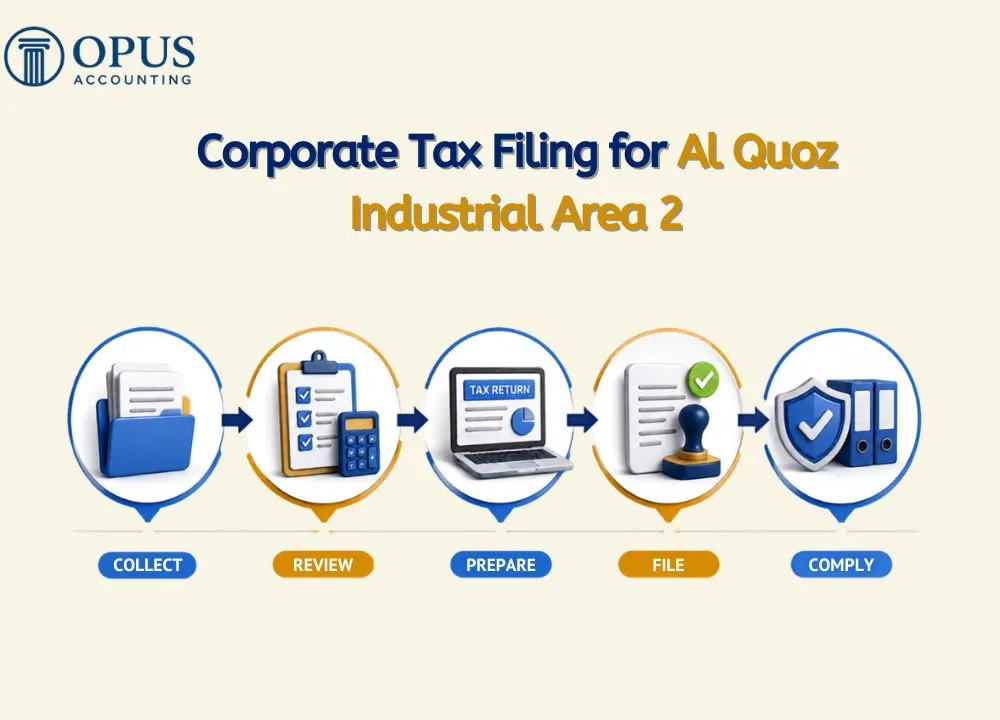
We provide comprehensive Corporate Tax Filing for Al Quoz Industrial Area 2 covering every CT obligation:
- FTA corporate tax registration
- Taxable income calculation from IFRS-compliant financial statements
- Small Business Relief eligibility and election management
- Capital allowance and depreciation review
- Inventory accounting and cost of goods review, including inventory bookkeeping for trading businesses consistency checks
- IFRS 16 lease accounting and CT treatment
- Expense deductibility review covering entertainment limits, interest caps, and related party transactions
- Related party transaction analysis and arm’s length documentation
- Annual CT return preparation and FTA portal submission
- CT payment scheduling and advance payment management
- FTA correspondence and audit support
- Multi-year CT planning for industrial businesses
- Coordination with your VAT compliance to ensure VAT transaction classification and FTA filing positions are consistent with your CT return
- Review of payroll costs to confirm deductibility of wages, benefits, and end-of-service provisions
Achieving full corporate tax readiness for your Al Quoz Industrial Area 2 business means every one of these elements is addressed before the filing deadline, not assembled under pressure at year-end.
IFRS 16 Lease Accounting and Corporate Tax
IFRS 16, the international accounting standard for leases, has significantly changed how lease arrangements are reflected in financial statements, and these accounting changes have important implications for UAE corporate tax. Our corporate tax filing for Al Quoz Industrial Area 2 businesses includes full IFRS 16 analysis.
Under IFRS 16, most leases that were previously treated as operating leases are now recognised on the balance sheet as right-of-use assets with associated lease liabilities. This creates a specific CT consideration:
Depreciation on right-of-use assets: The right-of-use asset is depreciated over the lease term, creating an annual depreciation charge that reduces taxable income.
Interest on lease liability: The finance charge component of the lease liability amortisation, recorded as interest expense under IFRS 16, is deductible as a finance cost, subject to the interest limitation rules.
The combined effect of IFRS 16 depreciation and finance charge replaces the operating lease rental deduction for leases captured by the standard. For industrial businesses with significant equipment and premises leases, correctly applying IFRS 16, and correctly reflecting its CT implications, is an important technical compliance requirement. These adjustments must also be reflected accurately in your year-end financial statements for audit, since your CT return is calculated from those audited figures.
We ensure that all leases in your Al Quoz Industrial Area 2 business are correctly classified, accounted for under IFRS 16 where applicable, and treated correctly for UAE CT purposes.
Related Party Transactions in Industrial Business Groups
Many industrial businesses in Al Quoz Industrial Area 2 operate within business groups, whether as a parent company with subsidiaries or a cluster of affiliated companies under common ownership. Related party transactions within these groups require specific transfer pricing attention. Our corporate tax filing for Al Quoz Industrial Area 2 businesses covers every common scenario.
Intercompany raw material supply: If an Al Quoz manufacturer purchases raw materials from a related party, the price must be consistent with arm’s length market rates. Under-pricing raw material sales or over-pricing purchases could artificially shift taxable income between entities. The accuracy of your inventory bookkeeping for trading businesses is directly relevant here, since your stock records must support the intercompany pricing declared in your CT return.
Intercompany services: Group management services, IT support, and other shared services provided within the group must be charged at arm’s length rates. We review intercompany service arrangements and document the arm’s length basis.
Intercompany financing: Loans between related entities, including shareholder loans and intercompany lending, must carry arm’s length interest rates. We calculate the appropriate arm’s length interest rate and ensure intercompany loan documentation reflects correct terms.
Master file and local file requirements: Businesses with significant related party transactions may be required to prepare and maintain a Master File and Local File as part of their transfer pricing documentation. We assess the requirements applicable to each Al Quoz Industrial Area 2 business and prepare the required documentation. For businesses needing support with regulatory compliance alongside their CT obligations, our team covers both.
[IMAGE HERE: An industrial business owner and accountant reviewing transfer pricing documentation and IFRS 16 lease schedules in an office. Alt text: “Year-end financial statements for audit and corporate tax filing for Al Quoz Industrial Area 2”]
FAQ’s | Corporate Tax Filing for Al Quoz Industrial Area 2 Businesses
1. Our Al Quoz Industrial Area 2 manufacturing business rents our factory from our parent company. Is the rent deductible for corporate tax?
Yes, rent paid to a related party is deductible, provided it is at an arm’s length market rate. If the rent is above or below what unrelated parties would charge for equivalent premises, the excess may be challenged by the FTA. We assess the arm’s length character of the intercompany rent and document the analysis as part of your corporate tax filing for Al Quoz Industrial Area 2.
2. We have an interest-bearing loan from our shareholder. How does this affect our CT position?
Interest paid on the shareholder loan is potentially deductible, but subject to two constraints: the interest must be at an arm’s length rate, and the net interest deduction is capped at 30% of EBITDA. We review the loan terms, assess the arm’s length interest rate, and calculate the allowable deduction within your CT return.
3. Our Al Quoz manufacturing business has a December year-end. When is our first CT return due?
For a December year-end business, the first tax period subject to UAE CT began on 1 January 2024. The tax return for that period is due by 30 September 2025. If your financial year started at a different date, the specific first period and filing deadline will differ. We confirm the correct dates for your specific business and ensure your corporate tax readiness well before the deadline.
4. Do we need to change our accounting software to comply with UAE corporate tax?
You do not necessarily need to change accounting software, but your financial statements must be IFRS-compliant, as CT is calculated from IFRS accounts. If your current accounting records are not IFRS-compliant, we advise on the adjustments needed before the first CT return is filed. Proper bookkeeping is the starting point for corporate tax readiness.
5. Our business handles both VAT and corporate tax obligations. Can you manage both?
Yes. We provide corporate tax filing for Al Quoz Industrial Area 2 businesses alongside VAT consulting support. Managing both ensures consistency between your VAT transaction classification and FTA filing positions and your CT return. Revenue figures, expense deductions, and related party transaction values should align across both filings, and our coordinated approach prevents the conflicting positions that commonly trigger FTA queries.
6. Are our payroll costs fully deductible for corporate tax?
Salaries, wages, benefits, gratuity accruals, and end-of-service provisions paid to employees are generally fully deductible as business expenses, provided they are incurred wholly and exclusively for business purposes. Accurate payroll bookkeeping and WPS compliance records serve as supporting documentation for these deductions. If your payroll records are incomplete or inconsistent, the deductibility of these costs could be questioned during an FTA review.
7. Do we need audited financial statements to file our corporate tax return?
While the UAE CT law does not universally mandate audited statements for all businesses, your CT return is calculated from IFRS-compliant financial statements, and many Al Quoz Industrial Area 2 businesses are required to prepare audited accounts by their trade licence conditions or other regulations. Preparing year-end financial statements for audit to the standard required for both regulatory compliance and CT filing is a core part of our service.
Expert Corporate Tax Filing for Your Al Quoz Industrial Area 2 Business
Industrial businesses in Al Quoz Industrial Area 2 have operated successfully in the UAE for years without corporate tax. Navigating this new landscape correctly from the outset is important for both compliance and financial planning. Our expert corporate tax filing for Al Quoz Industrial Area 2 covers every element that industrial businesses need, from inventory bookkeeping for trading businesses and IFRS 16 lease treatment to VAT transaction classification coordination, payroll bookkeeping and WPS compliance documentation, corporate tax readiness throughout the year, and year-end financial statements for audit. Every return we prepare is thorough, compliant, and built to withstand FTA scrutiny.
Contact Opus Accounting today for a free consultation and discover how expert CT filing can protect your Al Quoz Industrial Area 2 business.