
Dubai Festival City is one of Dubai’s most commercially diverse integrated destinations, a premium waterfront community combining luxury hotels, destination dining, major retail, entertainment attractions, and corporate offices in a single master-planned environment.
The businesses operating here, from internationally branded hotels and multi-outlet restaurant groups to specialty retailers and corporate service providers, generate complex revenue streams that demand equally sophisticated financial reporting.
Expert financial reporting for Dubai Festival City businesses is the discipline that transforms this complexity into the clarity needed for management decisions, investor communication, regulatory compliance, and sustainable profitability.
Opus Accounting provides dedicated financial reporting for Dubai Festival City businesses, built around the specific commercial activities and reporting obligations that define this unique destination. Our service ensures your financial statements are accurate, IFRS-compliant, sector-appropriate, and always ready to support VAT returns, corporate tax filings, lease compliance, and strategic decision-making.
Why Dubai Festival City Businesses Need Specialised Financial Reporting
Dubai Festival City’s commercial environment creates financial reporting requirements that go well beyond standard accounting. The businesses here operate within a destination ecosystem where hotel performance, restaurant profitability, retail metrics, and entertainment revenue are all interconnected, and where landlords, brand owners, franchisor partners, and regulatory authorities each require specific financial information in specific formats.
Financial reporting for Dubai Festival City businesses must address:
Multiple revenue stream classification: Hotels generate room revenue, F&B revenue, spa revenue, events revenue, and potentially management fee income. Restaurants manage dine-in, takeaway, delivery platform, and catering revenue. Retailers handle in-store sales, online sales, and concession income. Each stream requires separate recognition, tracking, and reporting.
Lease-linked reporting obligations: Many Festival City tenants operate under leases that include turnover rent provisions, requiring monthly or quarterly revenue certification to the landlord. Accurate turnover rent accrual depends on precise revenue reporting, and errors directly impact your lease cost.
Brand and franchisor reporting: Hotel operators reporting to international brand owners must comply with brand-standard financial reporting formats, including USALI for hotels. Restaurant franchisees must report to franchisors in the formats their agreements specify.
Regulatory compliance: UAE corporate tax compliance reporting, VAT return preparation, and DTCM hotel reporting all depend on the quality and classification accuracy of your underlying financial records.
Our financial reporting for Dubai Festival City businesses addresses all of these requirements within a single, integrated reporting framework.
Our Financial Reporting Services for Dubai Festival City
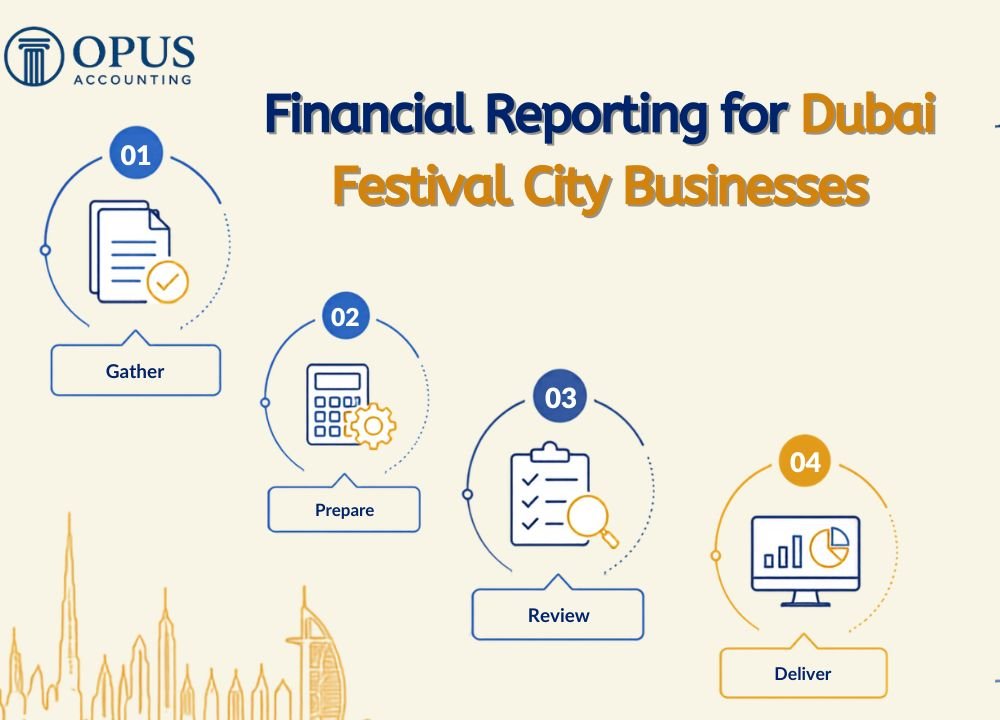
We provide comprehensive financial reporting for Dubai Festival City businesses covering every reporting obligation:
- IFRS-compliant monthly, quarterly, and annual financial statements
- USALI hotel departmental reporting for hotel operators
- IFRS 15 revenue recognition across multiple revenue streams
- Food and beverage cost tracking by outlet, menu category, and period
- Turnover rent accrual and landlord revenue certification
- UAE corporate tax compliance reporting and CT-ready financial statements
- Management accounts with sector-specific KPIs
- Departmental P&L reporting by revenue centre
- Cash flow forecasting and working capital reporting
- Multi-currency revenue and expense management
- Franchise and brand-owner reporting pack preparation
- Audit-ready year-end financial statement production
- Bookkeeping integration ensuring reporting data flows from accurate source records
This end-to-end service means your financial reporting for Dubai Festival City businesses is produced on a reliable schedule, with the accuracy and depth that each stakeholder requires.
USALI Hotel Departmental Reporting
Hotels operating in Dubai Festival City, whether internationally branded properties or independent luxury hotels, require financial reporting that follows the Uniform System of Accounts for the Lodging Industry (USALI). USALI hotel departmental reporting is the global standard for hotel financial performance measurement, and brand owners, management companies, and investors all expect to receive financial information in this format.
Departmental P&L structure: USALI structures hotel financial performance by operating department: Rooms, Food & Beverage, Spa, Telecommunications, Parking, and other operated departments. Each department reports revenue, direct costs, and departmental profit separately, giving management clear visibility into which departments are contributing to profitability and which are underperforming.
Undistributed operating expenses: Costs that cannot be attributed to a single department, such as administrative and general expenses, sales and marketing, property operations and maintenance, and utility costs, are reported as undistributed expenses in the USALI format. Our USALI hotel departmental reporting correctly classifies every expense according to the USALI chart of accounts.
Gross Operating Profit (GOP): USALI reporting culminates in GOP, the key performance metric for hotel operators, measuring the property’s operating performance before fixed charges, management fees, and ownership costs. Our financial reporting for Dubai Festival City businesses in the hotel sector produces this figure accurately each month, with full departmental support.
Owner and brand reporting: Hotel owners and international brand partners typically require monthly USALI-format reporting packages. We prepare these to the specific format and deadline required by each stakeholder, ensuring consistency between internal management accounts and external reporting submissions.
IFRS 15 Revenue Recognition for Festival City Businesses
Revenue recognition is one of the most technically demanding areas of financial reporting, and IFRS 15 provides the framework that all Dubai Festival City businesses must follow. IFRS 15 revenue recognition requires that income is recognized when performance obligations are satisfied, which creates specific considerations for each sector.
Hotel revenue recognition: Room revenue is recognized on the night of stay. Advance deposits and prepaid bookings are recorded as deferred income until the guest arrives. Package rates that bundle accommodation with F&B, spa, or other services must be disaggregated, with revenue allocated to each performance obligation based on standalone selling prices. IFRS 15 revenue recognition for hotels ensures that revenue is never overstated in one period at the expense of another.
Restaurant revenue recognition: Dine-in revenue is recognized at the point of service. Pre-paid dining experiences, gift vouchers, and loyalty programme obligations create deferred income that must be recognized as the obligation is fulfilled. Delivery platform revenue, where the platform takes a commission, raises questions about whether the restaurant is the principal or agent in the transaction, directly affecting how revenue is reported.
Retail revenue recognition: Standard retail sales are recognized at point of sale. Customer deposits on bespoke or special-order items, layaway arrangements, and gift cards all create deferred income obligations under IFRS 15. Return provisions and loyalty programmes further complicate the revenue recognition picture.
Entertainment venue revenue: Attractions, experiences, and entertainment businesses recognize revenue as the experience is delivered. Pre-sold tickets, season passes, and membership schemes create deferred income schedules that must be maintained accurately.
Our financial reporting for Dubai Festival City businesses applies the correct IFRS 15 revenue recognition methodology to every revenue stream, ensuring your financial statements accurately reflect economic reality in each reporting period.
Food and Beverage Cost Tracking
F&B operations, whether hotel restaurants, standalone dining concepts, or food retail outlets, require detailed cost tracking to manage profitability effectively. Food and beverage cost tracking provides the data needed to control your most significant variable cost category.
Cost of goods sold by outlet: We track food costs and beverage costs separately for each outlet, calculating the food cost percentage and beverage cost percentage that are the primary profitability metrics for F&B operations. This outlet-level food and beverage cost tracking reveals which venues are managing their costs effectively and which require operational attention.
Menu category analysis: Beyond outlet-level reporting, we break down COGS by menu category (starters, mains, desserts, alcoholic beverages, non-alcoholic beverages) to identify where margins are strongest and where cost pressures are emerging.
Waste and spoilage tracking: F&B waste directly erodes margins. Our reporting captures waste and spoilage data, enabling trend analysis and targeted reduction strategies. For hotel F&B operations, this data feeds directly into the USALI hotel departmental reporting for the Food & Beverage department.
Supplier cost monitoring: We track purchase prices from key suppliers over time, identifying cost increases early and supporting procurement negotiations with data. For multi-outlet operators, consolidated purchasing analysis identifies opportunities for volume-based savings.
Recipe costing support: For restaurants and hotel F&B operations that maintain recipe cost cards, our food and beverage cost tracking provides the actual ingredient costs needed to keep recipe costings current and menu pricing accurate.
Turnover Rent Accrual and Landlord Reporting
Many Dubai Festival City tenants operate under lease agreements that include turnover rent provisions, where the rent payable includes a percentage of revenue above a specified threshold (the natural breakpoint). Accurate turnover rent accrual is both a financial reporting requirement and a lease compliance obligation.
Monthly revenue tracking against breakpoint: We track your cumulative revenue against the turnover rent threshold on a monthly basis, identifying when (or whether) your revenue is likely to exceed the breakpoint and trigger turnover rent. This tracking enables accurate turnover rent accrual in your monthly accounts, reflecting the true occupancy cost in each period rather than recognizing the entire turnover rent charge in the period it is invoiced.
Landlord revenue certification: Many Festival City leases require periodic revenue certification to the landlord, either monthly or quarterly. We prepare accurate revenue certificates from your financial records, ensuring consistency between what you report to the landlord and what appears in your financial statements.
Turnover rent definition alignment: Lease agreements define “turnover” or “gross revenue” for rent calculation purposes, and this definition may differ from IFRS revenue recognition. Service charges collected and remitted, delivery platform commissions, and inter-outlet transfers may be included or excluded depending on the lease terms. We ensure your turnover rent accrual calculation uses the correct revenue definition as specified in your lease.
Year-end reconciliation: At the end of each lease year, a reconciliation between estimated turnover rent (accrued monthly) and actual turnover rent (calculated on final audited revenue) is required. Our financial reporting for Dubai Festival City businesses includes this reconciliation, with any adjustment clearly recorded.
UAE Corporate Tax Compliance Reporting
With Corporate Tax now in effect in the UAE, financial reporting for Dubai Festival City businesses must produce statements that directly support accurate CT computation. UAE corporate tax compliance reporting means your financial statements are structured to facilitate the calculation of taxable income, identification of deductible and non-deductible expenses, and correct treatment of related party transactions.
Revenue classification for CT: Different revenue streams may have different CT implications. Our reporting ensures revenue is classified with sufficient granularity to support accurate CT computation. UAE corporate tax compliance reporting begins at the bookkeeping level and flows through to the annual statements.
Expense deductibility analysis: Not all expenses are deductible for CT purposes. Entertainment costs, penalties, and certain related party payments face limitations. Our financial reports clearly flag non-deductible items, simplifying the CT adjustment process.
Related party disclosure: Festival City businesses that are part of larger groups or franchise structures often have significant related party transactions, including management fees, franchise fees, central purchasing arrangements, and intercompany charges. Our reporting identifies and discloses these transactions in accordance with both IFRS and CT requirements.
CT-ready financial statements: Our year-end financial statements are prepared to the standard required for corporate tax filing, with supporting schedules that align directly with the CT return format. For dedicatedcorporate tax filing support, our tax team works alongside the reporting function to ensure a seamless filing process
FAQ’s | Financial Reporting for Dubai Festival City Businesses
1. We operate a branded hotel in Dubai Festival City. Do you prepare USALI-format reporting?
Yes. USALI hotel departmental reporting is a core service for our hotel clients. We prepare full departmental P&L statements for Rooms, Food & Beverage, Spa, and all other operated departments, calculate undistributed operating expenses by USALI category, and produce Gross Operating Profit reporting each month. We also prepare the monthly owner and brand reporting packages in the format and to the deadlines your management agreement specifies.
2. Our restaurant sells gift vouchers and pre-paid dining experiences. How is this revenue recognized?
Gift vouchers and pre-paid dining experiences create deferred income under IFRS 15 revenue recognition. Revenue is recognized only when the voucher is redeemed or the dining experience is delivered. Unredeemed vouchers remain as a liability on your balance sheet until they are used or expire. Our financial reporting for Dubai Festival City businesses maintains a detailed deferred income schedule tracking every voucher and prepaid experience.
3. Our lease includes turnover rent above a certain revenue threshold. How do you handle this in monthly accounts?
We track your cumulative revenue against the lease breakpoint each month and calculate an appropriate turnover rent accrual that spreads the expected turnover rent charge across the year. This ensures your monthly P&L reflects a realistic occupancy cost rather than showing zero turnover rent for most of the year and a large charge when the threshold is crossed. Accurate turnover rent accrual is essential for meaningful monthly management accounts.
4. How does your financial reporting support our UAE corporate tax obligations?
UAE corporate tax compliance reporting is integrated into our financial reporting service. We classify revenue and expenses with the granularity required for CT computation, identify and flag non-deductible items, disclose related party transactions, and produce year-end financial statements that align directly with the CT return format. This means your tax filing process starts from clean, CT-ready data rather than requiring retrospective adjustments.
5. Our hotel F&B food cost percentage has been rising. Can your reporting help us identify why?
Yes. Food and beverage cost tracking at the granular level reveals the specific drivers of cost increases, whether that is rising supplier prices for particular ingredients, increased waste and spoilage, portion control issues, or changes in the sales mix toward lower-margin menu items. We provide the data your F&B management team needs to take targeted corrective action.
6. We are part of an international hotel group. Can you prepare reporting in both USALI format and IFRS format?
Yes. Many hotel operators need both formats: USALI hotel departmental reporting for operational management and brand reporting, and IFRS-compliant financial statements for statutory purposes, audit, and corporate tax filing. We prepare both from the same underlying data, ensuring consistency between the two formats while meeting the specific requirements of each.
Expert Financial Reporting for Your Dubai Festival City Business
Dubai Festival City businesses operate in one of Dubai’s most commercially demanding and diverse destinations. The financial reporting that supports these businesses must match that commercial sophistication. Our financial reporting for Dubai Festival City businesses delivers exactly that, covering USALI hotel departmental reporting, IFRS 15 revenue recognition, food and beverage cost tracking, turnover rent accrual, and UAE corporate tax compliance reporting. Every report is accurate, timely, and built to serve the specific stakeholders your business answers to.
Contact Opus Accounting today for a free consultation and discover how expert financial reporting can strengthen your Dubai Festival City business.