
Golf City, a prestigious lifestyle community nestled within Dubailand, is a vibrant hub built around the iconic Els Club golf course. This dynamic destination thrives on golf academies, pro shops, sophisticated food and beverage establishments, and diverse community enterprises.
These businesses cater to a discerning, sports-loving clientele, generating substantial revenues. However, the unique ecosystem of golf and sports businesses comes with distinctive financial reporting requirements.
From strongly seasonal revenue patterns and significant capital investments in course infrastructure to prepaid membership income and coaching programme revenue that demands correct deferral and recognition, navigating these complexities is crucial. Our expert financial reporting services provide the specialized financial expertise every Golf City business needs to thrive.
At Opus Accounting, we deliver golf business financial reporting services in Dubai that combine deep industry knowledge with IFRS expertise, giving golf academies, pro shops, club hospitality operators, and community businesses the financial clarity they need to succeed.
The Unique Financial Landscape of Golf and Lifestyle Businesses
Golf City businesses face financial reporting requirements that are inherently shaped by the seasonal, membership-based, and capital-intensive nature of golf and broader lifestyle services. Understanding these nuances is the first step toward robust golf business financial reporting in Dubai.
Golf Academies and Course Operators: Navigating Core Operations
For golf academies and course operators, financial clarity hinges on several key areas:
- Seasonal Membership Deferred Income Recognition: Annual memberships are often sold ahead of the peak season, requiring meticulous deferral and recognition over the full membership period in compliance with IFRS 15. Proper seasonal membership deferred income recognition prevents revenue misstatement and ensures balance sheet accuracy.
- Green Fee and Coaching Revenue Reporting: Accurate tracking of daily green fees, package deals, and coaching programme revenues is essential for understanding core business performance.
- Golf Course Infrastructure Depreciation: Golf courses are significant capital assets. Proper capitalization, golf course infrastructure depreciation schedules, and maintenance expense tracking are vital for long-term asset management.
- Investor Management Accounts with Golf-Specific KPIs: Stakeholders require tailored reports showcasing metrics like rounds played, membership retention rates, and operational efficiency ratios, all integral to effective golf business financial reporting services in Dubai.
Pro Shop Retail: Inventory and Margin Mastery
Golf pro shops, often stocking premium merchandise, have specific retail financial reporting needs:
- Merchandise Inventory Management: From clubs and apparel to balls and accessories, efficient inventory tracking, valuation, and turnover analysis are critical. Accurate bookkeeping underpins reliable inventory records.
- Pro Shop Inventory Landed Cost Reporting: For internationally sourced premium golf gear, accurately including freight, insurance, and customs duties in inventory valuation (landed cost) is essential for accurate gross margin calculation. Pro shop inventory landed cost reporting ensures your stock value and cost of goods sold reflect the true cost of procurement.
- Gross Margin Analysis for Premium Sports Retail: Understanding profitability by product category, brand, and seasonal sales trends helps optimize purchasing and pricing strategies.
Food and Beverage Operations: Hospitality Metrics That Matter
The club restaurant and bar contribute significantly to the overall business, demanding specialized financial insights:
- Club Restaurant and Bar Revenue Reporting: Granular reporting of F&B sales, distinguishing between member and guest revenue, and tracking various service points (e.g., casual dining, event catering).
- Food and Beverage Cost Analysis: Monitoring cost of goods sold, prime cost ratios, and waste management helps maintain profitability. Detailed cost management supports these analyses.
- Club F&B Management Accounts: Key Performance Indicators (KPIs) like average spend per cover, covers per day, and F&B profit margins provide crucial operational insights. Club F&B management accounts enable managers to identify trends, control costs, and optimize revenue across all hospitality service points.
Community Businesses: Simplicity and Compliance
Even for community-focused businesses within Golf City, robust financial practices are essential:
- Straightforward Management Accounts and Annual Financial Statements: Preparing clear, compliant financial statements is necessary for banking, investor relations, and regulatory purposes, including licensing and compliance requirements, ensuring all entities operate on a sound financial footing.
Comprehensive Golf Business Financial Reporting Services for Golf City
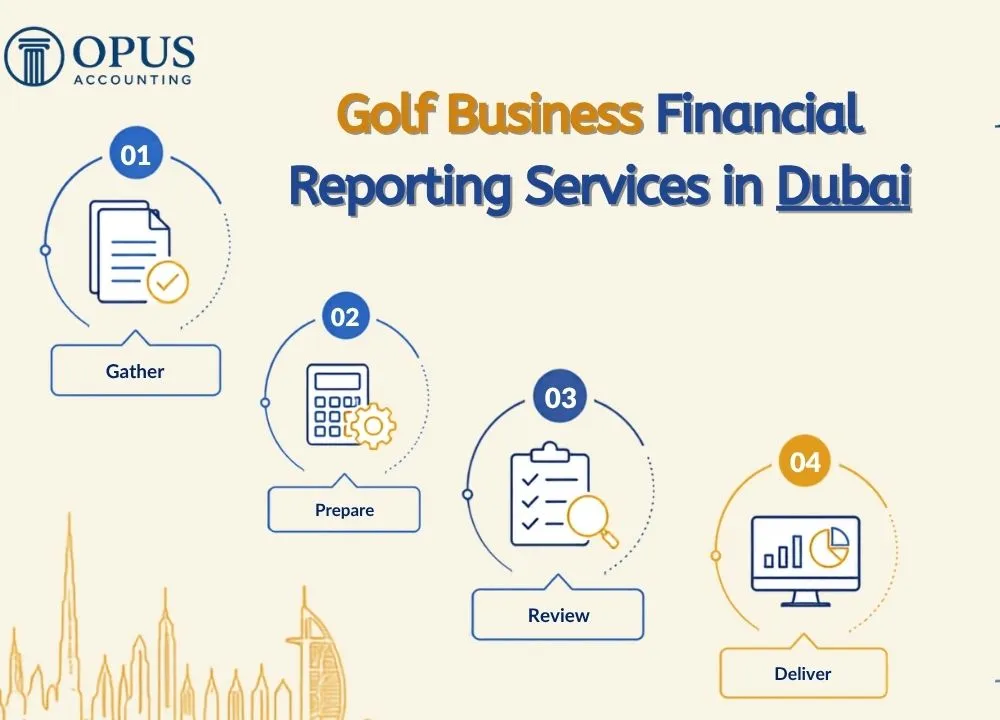
At Opus Accounting, we understand these specialized requirements deeply. We provide a comprehensive suite of golf business financial reporting services in Dubai tailored for Golf City businesses, ensuring accuracy, compliance, and strategic insights.
Our services include:
- IFRS-Compliant Annual Financial Statements: Preparation of robust financial statements for golf and lifestyle businesses, ensuring adherence to international standards and regulatory requirements.
- Seasonal Membership Deferred Income Recognition Reporting: Expert calculation and reporting of deferred revenue, vital for businesses with upfront membership fees, ensuring revenue is recognized over the service period in compliance with IFRS 15.
- Golf Course Infrastructure Depreciation Schedules: Detailed management of fixed assets, including proper capitalization of course improvements and accurate golf course infrastructure depreciation calculations, crucial for long-term asset planning.
- Green Fee and Coaching Programme Revenue Reporting: Granular tracking and reporting of all revenue streams from lessons, packages, and daily play, providing clear insights into operational performance.
- Pro Shop Inventory Landed Cost Reporting: Advanced inventory management, landed cost calculations, and detailed gross margin analysis to optimize retail profitability and stock levels.
- Club F&B Management Accounts: Specialized club F&B management accounts for food and beverage operations, including detailed cost analysis and performance metrics tailored to the hospitality sector.
- Monthly Management Accounts with Golf Industry KPIs: Timely and insightful monthly reports that go beyond standard figures, incorporating specific golf industry KPIs for benchmarking and strategic decision-making.
- Investor and Partner Reporting Packages: Customized financial reports designed to meet the specific information needs of investors and partners, fostering transparency and trust.
- Seasonal Cash Flow Forecasting: Critical planning tools to predict and manage cash flows through seasonal peaks and troughs, ensuring liquidity and operational stability. Expert financial consultancy complements this forecasting with strategic advisory.
- UAE CT-Ready Financial Statement Preparation: Ensuring all financial statements are meticulously prepared to comply with UAE Corporate Tax regulations, minimizing risks and facilitating smooth tax compliance as outlined by the UAE Federal Tax Authority .
Our golf business financial reporting services in Dubai are designed to give every Golf City enterprise complete financial visibility and confidence.
The Economic Rhythms of Golf Businesses: Seasonal Challenges
Golf businesses in Golf City operate with a strongly seasonal revenue profile that creates specific financial reporting challenges requiring expert handling.
Full-Season Membership Income Recognition: IFRS 15 in Practice
Annual memberships sold at the start of the October season often generate a year’s worth of income in a single transaction. Under IFRS 15, this income must be recognized ratably over the 12-month membership period. This creates a significant deferred income balance at the start of the season, which then unwinds monthly as the membership period elapses. Incorrect seasonal membership deferred income recognition can lead to misstated revenue, profitability, and balance sheet positions, underscoring the importance of precise golf business financial reporting services in Dubai.
Seasonal Management Account Benchmarking: Beyond the Prior Month
Monthly management accounts for seasonal golf businesses require a nuanced approach to benchmarking. Comparing October revenue against the immediately preceding August offers little analytical value due to seasonal fluctuations. Instead, meaningful performance insights come from benchmarking against the same month of the prior year (e.g., October 2025 vs. October 2024). This year-on-year comparison accounts for seasonality and provides a true measure of growth or decline.
Summer Cash Preservation Reporting: Navigating the Off-Season
During the low-revenue summer months, Golf City businesses must manage cash carefully. The surplus earned during the busy season must be preserved to fund the summer cost base. Cash flow forecasting that shows the projected monthly cash position through the summer, complete with burn rate analysis and the implied runway, is essential management reporting for seasonal businesses. This proactive approach prevents liquidity crises and supports sustainable operations.
Capital Investment Cycle: Strategic Planning for Growth and Maintenance
Golf businesses make significant capital investments in course maintenance, infrastructure renewal, and equipment replacement. These investments typically occur between seasons rather than during peak playing time. Financial reporting must correctly capitalize these investments through proper golf course infrastructure depreciation treatment, differentiate them from routine expenses, and provide forward-looking CapEx planning. This ensures sufficient funds are available for necessary investments without disrupting operational cash flow, thereby safeguarding the long-term value of the golf course.
Specialized Reporting for Pro Shop and F&B Operations
Beyond the core academy and green fee business, the golf club pro shop and food and beverage operations generate substantial revenues that require their own distinct financial focus within your golf business financial reporting services in Dubai.
Pro Shop Inventory and Margin: Precision in Retail
The pro shop carries premium golf merchandise, including clubs, clothing, balls, and accessories, often at premium price points. Monthly management accounts track vital metrics such as inventory turnover, gross margin by product category, and seasonal sales patterns. A critical accuracy consideration for inventory valuation is the completeness of import costs: freight, insurance, and customs on premium international golf merchandise. Excluding these from inventory undervalues stock and overstates cost of goods sold, distorting profitability. Proper pro shop inventory landed cost reporting under IAS 2 is paramount for accurate golf business financial reporting in Dubai.
Club F&B Performance: Driving Hospitality Profitability
The club restaurant and bar generate revenues from members, guests, and tournament participants. Monthly club F&B management accounts track specific hospitality metrics:
- Covers Per Day: Understanding daily customer traffic.
- Average Spend Per Cover: Insight into pricing and customer value.
- Food and Beverage Cost Percentage: Crucial for managing direct costs and profitability.
- Prime Cost Ratio: An overall measure of the most significant F&B costs (food, beverage, and labor).
Separate reporting of member F&B revenue versus non-member F&B revenue reveals the contribution of the wider community to the club’s food and beverage business. This segmentation is invaluable for targeted marketing and service optimization. Accurate payroll tracking supports the labor component of these club F&B management accounts.
Event Catering and Tournament Hospitality: Maximizing Special Occasions
Tournament days and club events generate concentrated F&B revenue. Event-specific P&L reporting, showing revenue and direct costs for each event, reveals the event hospitality contribution and enables event profitability optimization. This detailed analysis ensures that special occasions maximize both member experience and financial returns.
Retail Seasonal Buying: Managing Pre-Season Investment
The pro shop’s merchandise buying cycle, particularly purchasing new season stock before the October season, creates significant inventory investment that precedes the revenue. Cash flow reporting that clearly shows the timing of stock purchases relative to the revenue they are expected to generate is crucial for managing the seasonal cash flow cycle effectively. Pro shop inventory landed cost reporting ensures these pre-season investments are valued correctly from the moment stock arrives.
UAE CT-Ready Financial Statement Preparation for Golf Businesses
With the introduction of UAE Corporate Tax, golf business financial reporting services in Dubai must now incorporate comprehensive UAE CT-ready financial statement preparation. This involves structuring your financial statements to align with CT regulations, ensuring taxable income is calculated correctly, and maintaining documentation that supports your tax position.
For golf academies and course operators, UAE CT-ready financial statement preparation requires particular attention to seasonal membership deferred income recognition, as the timing of revenue recognition directly affects taxable income calculations. For pro shops, accurate pro shop inventory landed cost reporting ensures cost of goods sold is correctly stated for CT purposes. For F&B operations, club F&B management accounts must clearly distinguish deductible expenses from non-deductible items.
Opus Accounting ensures your financial records are audit-ready and CT-compliant, providing peace of mind throughout the tax filing process.
FAQs | Golf Business Financial Reporting Services in Dubai
1. Our Golf City academy sells annual memberships in September at AED 15,000. At our June year-end, how much is recognized and how much is deferred?
At June 30 year-end, each September membership is 10 months into its 12-month term (October to June). Therefore, ten-twelfths (AED 12,500) of the AED 15,000 membership fee is recognized as revenue for the period from October to June. The remaining two-twelfths (AED 2,500) represents deferred income at June 30, accounting for the July and August access entitlement. Accurate seasonal membership deferred income recognition ensures this deferred income balance is correctly calculated and disclosed in your financial statements to comply with IFRS 15.
2. We are planning to invest AED 2 million in course irrigation improvements over the summer. How does this appear in financial reporting?
The AED 2 million irrigation investment is considered capital expenditure. It will be capitalized as a course infrastructure asset on your balance sheet and depreciated over its estimated useful life, which for irrigation infrastructure typically ranges from 15 to 25 years. Golf course infrastructure depreciation means your income statement will show an annual depreciation charge rather than the full investment cost being expensed immediately. The initial AED 2 million investment will appear in the investing section of your cash flow statement, reflecting the outflow of cash for asset acquisition.
3. Our Golf City pro shop imports merchandise from the US and Europe. We have been reporting inventory at purchase price only. How should we report it?
Under IAS 2, inventory must be valued at its full landed cost. Pro shop inventory landed cost reporting includes the purchase price plus all direct costs incurred in bringing the inventory to its present location and condition, such as freight, insurance, and customs duty. For premium golf merchandise with significant international shipping and customs costs, excluding these from inventory undervalues your stock and overstates your cost of goods sold, leading to inaccurate gross margins. We recommend recalculating inventory values to include all landed costs and establishing a systematic landed cost methodology for all future periods.
4. We have two investors in our Golf City academy who want quarterly financial reports. What do these include?
Quarterly investor reports provide a comprehensive overview of the academy’s financial health and operational performance. These typically include a detailed Profit & Loss statement showing membership revenue by tier, green fee revenue, coaching revenue, F&B revenue, pro shop revenue, direct costs, overheads, and EBITDA. They also include a summary Balance Sheet highlighting cash position, deferred income balance, and key liabilities; a Cash Position and Seasonal Runway Analysis; key Membership Analytics covering active members by tier, new enrollments, and cancellations; green fee rounds played versus capacity; and management commentary explaining significant performance variances and strategic initiatives.
5. How does seasonal membership deferred income recognition affect our cash flow reporting?
Seasonal membership deferred income recognition creates a disconnect between cash receipts and recognized revenue. When memberships are sold in September, you receive cash upfront, but revenue is recognized monthly over the 12-month membership period. Your cash flow statement shows the full cash receipt in September, while your income statement shows only one-twelfth of the membership fee as revenue each month. This means your cash position may appear strong when deferred income obligations are high. Our golf business financial reporting services in Dubai ensure both the cash flow and income implications are clearly presented so management understands the true financial picture.
8. How does UAE CT-ready financial statement preparation apply to a seasonal golf business?
UAE CT-ready financial statement preparation for seasonal golf businesses requires particular care around revenue timing. Seasonal membership deferred income recognition must align with CT rules so that taxable income reflects revenue earned during the tax period, not cash collected. Golf course infrastructure depreciation must use IFRS-consistent methods that the FTA accepts. Pro shop inventory must be valued at full landed cost. We structure your financial statements to ensure every element meets CT requirements while optimizing your tax position.
Expert Golf Business Financial Reporting for Your Success
Golf City businesses are driven by a passion for sport and a commitment to quality. At Opus Accounting, we bring that same commitment to excellence to your financial management. Our expert golf business financial reporting services in Dubai are designed to demystify the complexities of the golf industry, providing you with clear, accurate, and actionable financial insights.
With Opus Accounting, you gain a strategic partner dedicated to optimizing your financial performance, ensuring compliance, and empowering your business to achieve its full potential in Dubai’s dynamic golf market.
Contact us today for a free consultation and discover how our specialized golf business financial reporting expertise can elevate your operations.