
Dubai Production City (formerly International Media Production Zone) is a dedicated free zone for media, printing, publishing, packaging, and content production businesses. This specialised cluster creates a commercial environment where production costs, job profitability, and resource utilisation are the metrics that determine business success.
For the print houses, packaging manufacturers, media production companies, and publishing businesses operating here,managerial & cost accounting for Dubai Production City businesses is the financial discipline that provides the granular cost intelligence these operations demand.
Opus Accounting provides dedicated managerial and cost accounting for Dubai Production City businesses, built around the specific production processes, cost structures, and profitability drivers of the media and print production sector. Our service delivers the job-level, process-level, and client-level cost visibility that production businesses need to price accurately, produce efficiently, and grow profitably.
Why Production City Businesses Need Specialised Cost Accounting
Dubai Production City businesses operate in a cost environment fundamentally different from standard service or trading businesses. Raw materials (paper, ink, substrates, packaging board) are a major cost component subject to global commodity price movements.
Production equipment represents significant capital investment with utilisation rates that directly affect unit costs. Labour is a mix of skilled operators and support staff, with productivity varying significantly across job types. Waste is an inherent part of the production process, but the difference between acceptable and excessive waste can define the margin on every job.
Standard financial accounting tells you whether the business is profitable overall. Managerial & cost accounting for Dubai Production City businesses tells you why, at the level of individual jobs, clients, product types, and production processes. That granularity is what separates production businesses that manage their margins proactively from those that discover problems only when annual results arrive.
Our Cost Accounting Services for Dubai Production City
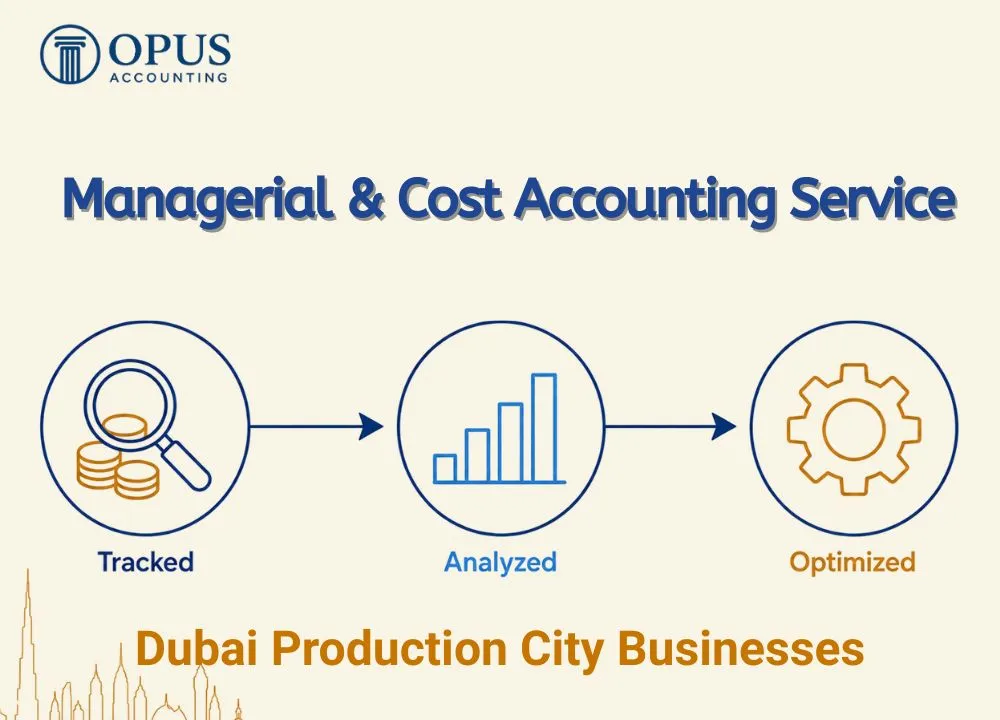
Opus Accounting provides comprehensive managerial & cost accounting for Dubai Production City businesses covering every element of production cost management:
- Job costing for print and packaging operations
- Media production project budgeting and variance analysis
- Material yield and waste tracking by job, product, and production line
- Press utilisation and idle capacity cost measurement
- Client profitability analysis across accounts and product categories
- Standard cost development and variance reporting
- Direct and indirect cost allocation
- Make versus buy analysis for outsourced production processes
- Monthly management accounts with production KPIs
- Bookkeeping integration ensuring cost data flows from accurate source records
- Corporate tax support, ensuring cost classifications align with CT deductibility
- Financial reporting aligned with management and regulatory requirements
Job Costing for Print and Packaging
Print and packaging businesses in Dubai Production City produce work on a job-by-job basis, where every print run, packaging order, or finishing job is a discrete cost unit. Job costing for print and packaging tracks every cost element against each individual production order, providing the true cost and true margin for every job your business completes.
Material costing per job: Every sheet of paper, litre of ink, metre of substrate, and piece of packaging board consumed on a job is tracked and costed. For businesses running multiple paper grades, ink types, or substrate specifications, accurate material costing requires systematic tracking at the stock keeping unit level. Job costing for print and packaging at this precision ensures your quoted prices reflect actual material consumption, not estimates that may be significantly out of date.
Direct labour costing: The hours each press operator, finishing operator, or packaging line worker spends on a specific job are tracked and costed at the applicable labour rate (including basic salary, allowances, and employer costs). For multi-shift operations common in Production City print houses, this means tracking time allocation across jobs within each shift accurately.
Machine hour costing: Press time and finishing equipment time are allocated to each job based on actual machine hours consumed. The machine hour rate incorporates equipment depreciation, maintenance, power, and allocated facility costs, giving a complete picture of the production cost attributable to each job.
Setup and makeready costs: Print jobs incur setup costs (plate mounting, colour calibration, substrate loading) that are distinct from running costs. We capture setup time and material separately, enabling analysis of the setup cost impact on short-run versus long-run economics. For packaging businesses producing frequent short runs, setup costs can represent a significant proportion of total job cost.
Job profitability reporting: Once all cost elements are captured, we produce job-level profitability reports showing revenue, total cost, and gross margin for every job. This reveals which jobs, product types, and clients are genuinely profitable. Managerial & cost accounting for Dubai Production City businesses starts with this visibility.
Media Production Project Budgeting
Media production companies in Dubai Production City, including video production houses, content studios, post-production facilities, and digital media agencies, manage their costs on a project basis. Media production project budgeting provides the financial framework for controlling costs across the project lifecycle.
Pre-production budget development: We help media production businesses build detailed project budgets before production begins, covering crew costs, talent fees, equipment hire or allocation, location costs, post-production estimates, and project management overhead. Accurate pre-production budgets prevent the scope creep and cost overruns that erode project margins.
Production cost tracking: During production, actual costs are tracked against the budget in real-time or near-real-time, with variances identified and flagged as they occur. Media production project budgeting that includes live cost tracking gives producers the information they need to make mid-project decisions about scope, resources, and delivery timelines before costs escalate beyond recovery.
Post-production cost allocation: Post-production often involves shared resources (editing suites, colour grading stations, audio mixing facilities) used across multiple projects. We allocate these shared resource costs to individual projects based on actual utilisation, ensuring each project bears its fair share of production infrastructure costs.
Project profitability analysis: At project completion, we produce a comprehensive profitability analysis comparing actual costs against the original budget, with variance explanations. Over time, this data builds a reliable database of project cost benchmarks that improves future media production project budgeting accuracy and strengthens your financial planning capabilities.
Material Yield and Waste Tracking
In print and packaging production, raw materials are the largest variable cost, and the yield achieved from those materials directly determines margin. Material yield and waste tracking is the cost accounting discipline that measures how efficiently your production processes convert raw materials into finished, saleable product.
Yield percentage measurement: We calculate the yield percentage for each job, product type, and production line, measuring the proportion of raw material input that becomes finished product versus the proportion that becomes waste. Material yield and waste tracking at this level identifies where material efficiency is strong and where improvement opportunities exist.
Waste categorisation: Not all waste is the same. Setup waste (produced during makeready), running waste (produced during the production run), and finishing waste (produced during cutting, folding, or binding) each have different causes and different reduction strategies. We categorise waste by type and production stage, enabling targeted waste reduction programmes.
Variance reporting against standards: Once standard yield rates are established for each product type, we report actual yield against standard, highlighting jobs or production runs where waste exceeded acceptable levels. These variances are investigated and reported in your monthly management accounts, creating accountability and driving continuous improvement.
Cost impact quantification: We translate waste percentages into financial values, showing exactly how much excess waste costs your business in dirham terms each month. This makes the business case for waste reduction investment (such as press upgrades, operator training, or substrate specification changes) concrete and measurable. Managerial & cost accounting for Dubai Production City businesses makes this connection between operational performance and financial impact explicit.
Press Utilisation and Idle Capacity Cost
Printing presses, packaging lines, and post-production suites represent significant capital investment. The degree to which this equipment is productively utilised directly affects unit costs and overall profitability. Press utilisation and idle capacity cost measurement provides the data needed to manage this critical asset.
Utilisation rate calculation: We measure the proportion of available production hours that are spent on revenue-generating work (productive time) versus non-productive time (maintenance, setup, waiting for materials, idle time). Press utilisation and idle capacity cost analysis distinguishes between planned downtime (scheduled maintenance) and unplanned downtime (breakdowns, material shortages, order gaps), each of which requires a different management response.
Idle capacity cost quantification: When production equipment sits idle, the fixed costs associated with that equipment (depreciation, facility allocation, insurance) continue to accumulate without generating revenue. We calculate the cost of idle capacity in dirham terms, showing management exactly how much unused capacity is costing the business each month.
Capacity planning support: Understanding your current utilisation rates enables better capacity planning. If your presses are consistently running at 85% or above, additional capacity investment may be justified. If utilisation is below 70%, the priority shifts to sales volume growth or equipment rationalisation. Our managerial & cost accounting for Dubai Production City businesses provides the utilisation data that supports these strategic decisions.
Shift pattern optimisation: For print houses running multiple shifts, we analyse utilisation by shift to determine whether each shift is generating sufficient productive output to justify its cost. This analysis sometimes reveals that consolidating production into fewer, more efficiently managed shifts improves both utilisation and profitability.
Client Profitability Analysis
Dubai Production City businesses typically serve a portfolio of clients, and not every client contributes equally to profitability. Client profitability analysis goes beyond revenue ranking to reveal the true margin contribution of each client relationship after accounting for all direct and allocated costs.
Revenue versus margin ranking: A client that generates AED 500,000 in annual revenue but demands complex, low-margin work with frequent revisions may contribute less profit than a client generating AED 200,000 from straightforward, high-margin production. Client profitability analysis reveals these differences, which are invisible in a simple revenue report.
Client-specific cost allocation: We allocate all job costs (materials, labour, machine time, setup, delivery) to the client that commissioned the work, building a complete cost picture for each client relationship. For clients that require significant account management, proofing cycles, or revision rounds, these indirect costs are also captured.
Service level cost analysis: Some clients require premium service levels, expedited turnaround, specific quality certifications, or dedicated production scheduling. These service requirements carry costs that should be reflected in pricing. Our client profitability analysis quantifies the cost of service differentiation, supporting informed pricing decisions and client negotiation.
Portfolio management: By understanding which clients are genuinely profitable and which are marginal or loss-making, you can make informed decisions about where to invest sales effort, where to renegotiate pricing, and where to potentially reduce exposure. This strategic perspective is a core deliverable of our managerial and cost accounting for Dubai Production City businesses, linking operational cost data to commercial decision-making.
For a broader view of how client profitability connects with payroll cost management and overall business performance, our integrated service ensures every cost element is captured.
FAQ’s | Managerial & Cost Accounting for Dubai Production City Businesses
1. We are a print house producing both short-run digital and long-run offset work. Can job costing handle both production methods?
Yes. Job costing for print and packaging applies to both digital and offset production, with the cost structure configured to reflect the different economics of each method. Digital jobs typically have lower setup costs but higher per-unit running costs, while offset jobs have higher setup costs (plates, makeready) but lower per-unit costs on longer runs. We track costs by production method, enabling accurate margin analysis for each and supporting informed decisions about which jobs to route to which production method.
2. Our media production company runs multiple projects simultaneously. How do you track costs across overlapping projects?
Media production project budgeting for concurrent projects requires each project to be set up as a separate cost centre, with every cost (crew time, equipment allocation, facility usage, consumables) allocated to the correct project. Where shared resources are used across projects, we allocate costs based on actual utilisation. Monthly reports show each project’s cost position against budget, with variances highlighted for management attention.
3. We know our paper waste is too high, but we do not know which jobs or processes are causing the problem. Can you help?
Yes. Material yield and waste tracking at the job level identifies exactly where waste is generated. We measure waste by production stage (setup, running, finishing), by job type, and by production line, revealing whether the problem is concentrated in specific job types, specific equipment, or specific operators. This granular data enables targeted corrective action rather than broad, unfocused cost reduction efforts.
4. How does press utilisation analysis work for a business with both printing presses and finishing equipment?
We measure press utilisation and idle capacity cost separately for each major equipment category (presses, die-cutters, laminators, binding equipment, and so on). Each piece of equipment has its own utilisation profile, and the cost of idle capacity is calculated based on the fixed costs specific to that equipment. This equipment-level visibility ensures investment and rationalisation decisions are based on accurate data for each asset category.
5. How does your cost accounting service support our corporate tax filing?
Your cost of goods sold, inventory valuation, depreciation schedules, and overhead classifications all feed into your taxable income calculation for corporate tax. Managerial and cost accounting for Dubai Production City businesses ensures these figures are accurate, consistent, and aligned with FTA requirements. Inaccurate cost records mean inaccurate taxable income, which creates compliance risks.
6. Can your service also cover our bookkeeping and financial reporting alongside cost accounting?
Yes. Our managerial and cost accounting for Dubai Production City businesses works alongside our bookkeeping and financial reporting services. Managing all three together ensures your cost data, financial records, and management reports are consistent, accurate, and produced from a single integrated source.
Expert Cost Accounting for Your Dubai Production City Business
Production City businesses compete on quality, turnaround, and price, and the financial management that supports those operations must deliver the cost visibility needed to excel on all three fronts. Our managerial and cost accounting for Dubai Production City businesses provides that visibility, covering job costing for print and packaging, media production project budgeting, material yield and waste tracking, press utilisation and idle capacity cost, and client profitability analysis. Every metric is designed to connect operational performance with financial outcomes, giving you the intelligence to price accurately, produce efficiently, and grow profitably.
Contact Opus Accounting today for a free consultation and discover how expert cost accounting can strengthen your Dubai Production City business.