
Month-End Close Checklist UAE: A proper month-end close turns a month of transactions into accurate, trustworthy numbers you can actually use — for VAT filing, for corporate tax planning, and for knowing how the business is really doing.
Many small businesses treat this as an occasional catch-up task rather than a defined monthly process, which is exactly why quarter-end and year-end filings so often turn into a scramble. A consistent close each month is the single biggest thing that makes every subsequent deadline easier.
This checklist walks through every step in order. For the VAT-specific reconciliation this feeds into, see our guide to VAT reconciliation.
Quick Answer
A complete month-end close covers eight core steps: bank reconciliation, accounts receivable review, accounts payable review, accruals and prepayments, fixed asset and depreciation updates, payroll reconciliation, VAT control account tie-out, and final management reports with a review sign-off. Most small businesses can complete this within 5 to 10 business days after month-end.
What Month-End Close Actually Is
At its core, month-end close is the process of confirming that a month’s worth of financial activity has been recorded completely and accurately, then locking that period so the numbers become a reliable, final record rather than a moving target.
- It’s not the same as simply entering transactions as they happen — that’s ongoing bookkeeping, and it’s the input to close, not the close itself.
- Close is the review, correction, and finalisation step that happens after the month’s raw data is in, catching what routine data entry alone would miss.
- A business that only does the first without the second often discovers errors months later, when they’re far harder and more expensive to trace back.
Why Month-End Close Matters for Small Businesses
It’s tempting to treat month-end close as a formality that only matters for larger businesses with boards and investors reviewing numbers each month. For a UAE SME, it matters just as much, for more immediate, practical reasons:
- Accurate monthly numbers are what feed into your quarterly VAT return — a messy close means a rushed, error-prone VAT filing
- Corporate tax is calculated on annual profit, but that annual figure is only as good as the twelve monthly closes that built it
- Cash flow decisions — hiring, spending, expansion — are only as good as the numbers behind them, and stale or unreconciled figures lead to decisions based on incomplete information
- A consistent close process each month is far less work than reconstructing a full year’s books under deadline pressure
- Lenders, investors, and potential buyers all expect clean, current monthly financials — a business that can’t produce them quickly signals weaker financial discipline, regardless of how the underlying business is actually performing
The Complete Month-End Close Checklist
| Step | What It Covers |
| 1. Bank reconciliation | Match every bank transaction against your accounting records |
| 2. Accounts receivable review | Confirm outstanding customer invoices and chase overdue balances |
| 3. Accounts payable review | Confirm outstanding supplier bills and upcoming payment obligations |
| 4. Accruals and prepayments | Record expenses incurred but not yet billed, and costs paid in advance |
| 5. Fixed assets and depreciation | Update the asset register and post the month’s depreciation charge |
| 6. Payroll reconciliation | Confirm payroll figures match WPS submissions and accounting entries |
| 7. VAT control account tie-out | Confirm output and input VAT for the month reconcile correctly |
| 8. Management reports and sign-off | Generate P&L and balance sheet, then review before finalising |
Step 1: Bank Reconciliation
Start here, since every other step depends on the underlying transaction data being accurate. Our bookkeeping service treats this as the foundation of the entire close — everything downstream inherits whatever errors exist at this stage:
- Match every transaction on your bank statement against a corresponding entry in your accounting records
- Investigate any unmatched items — a bank charge not yet recorded, a payment recorded twice, or a transaction posted to the wrong period
- Confirm the reconciled bank balance in your accounting system matches the actual statement balance exactly, not approximately
- Do this for every business bank account, not just the primary one — secondary accounts are easy to overlook
Step 2: Accounts Receivable Review
- Confirm every invoice issued during the month is recorded and reflects the correct amount and date
- Review the aged receivables report and flag anything significantly overdue for follow-up
- Identify any invoices that may need to be written off as genuinely uncollectible, which also has VAT bad debt relief implications
- Check that customer payments received during the month have been correctly matched against the right invoices
Step 3: Accounts Payable Review
- Confirm every supplier bill received during the month is recorded, even if payment hasn’t been made yet
- Review upcoming payment obligations to plan cash flow for the following month
- Check for any duplicate supplier invoices, which can otherwise inflate both expenses and input VAT claims
- Confirm any early-payment discounts or credit terms have been applied correctly
Step 4: Accruals and Prepayments
This is where a lot of the real accounting judgement in month-end close happens — matching costs and revenue to the period they actually relate to, not just when cash moved. Get this step wrong and profit figures become unreliable even when every individual transaction was recorded correctly.
- Accrue for expenses incurred during the month but not yet invoiced by the supplier — a common example is a utility bill that arrives after month-end for services already used
- Release the appropriate portion of any prepaid expenses — insurance, licences, or rent paid in advance — into this month’s costs
- Review last month’s accruals to confirm they’ve been properly reversed once the actual invoice arrives, avoiding a double-count
- Build a running accruals schedule rather than treating each month’s accruals as a fresh exercise — this makes the reversal check far faster and less error-prone
Step 5: Fixed Assets and Depreciation
Fixed assets are easy to overlook in a monthly close since they don’t move as frequently as bank transactions, but letting the register drift out of date creates real problems by year-end.
- Update the fixed asset register for any purchases or disposals during the month
- Post the month’s depreciation charge according to your business’s depreciation policy
- Confirm any asset disposals have removed the asset from the register and recorded any gain or loss correctly
- This step directly feeds into your corporate tax depreciation and capital allowance calculations later in the year
Step 6: Payroll Reconciliation
Payroll touches both your cash position and your compliance obligations, which makes it worth its own dedicated check rather than folding it into general expense review.
- Confirm the payroll figures posted to your accounting system match what was actually processed through WPS
- Check that any new hires, terminations, or salary changes during the month are correctly reflected
- Reconcile any outstanding employee advances, reimbursements, or end-of-service accruals
- Confirm employer costs — end-of-service gratuity accrual, in particular — are being tracked, not just gross salary
Step 7: VAT Control Account Tie-Out
This step overlaps directly with the broader VAT reconciliation process, but doing it monthly rather than only at quarter-end catches issues while they’re still fresh and easy to trace, well before the pressure of an actual filing deadline:
- Confirm the month’s output VAT matches your sales records at the correct rate
- Confirm input VAT claimed has valid, matching supplier invoices
- Flag any reverse charge transactions from the month specifically, so they aren’t missed when the quarterly return is eventually prepared
Step 8: Management Reports and Sign-Off
- Generate the profit and loss statement and balance sheet for the month once all the above steps are complete
- Compare this month’s figures against the prior month and against budget or expectations, investigating any unexplained swings
- Have a second person review the reports before they’re treated as final, even briefly
- Lock the period in your accounting system once finalised, preventing accidental changes to closed data
A Realistic Timeline
| Business Day | Focus |
| Day 1–2 | Bank reconciliation and transaction matching |
| Day 3–4 | Accounts receivable and payable review |
| Day 5–6 | Accruals, prepayments, and fixed asset updates |
| Day 7 | Payroll reconciliation and VAT control account tie-out |
| Day 8–10 | Management reports, review, and sign-off |
Smaller, lower-transaction businesses can often compress this into 3 to 5 days; more complex operations with multiple bank accounts, inventory, or payroll complexity may need the fuller window.
Who Should Own the Close Process?
- In a small business, this often falls to the same person handling day-to-day bookkeeping, but close should still be treated as a distinct, deliberate phase rather than an extension of routine data entry
- A second reviewer — even the business owner doing a final sanity check — catches errors the preparer is less likely to notice in their own work
- For businesses using an outsourced bookkeeping provider, confirm explicitly that month-end close is part of the service, not just transaction recording — this is a common scope gap worth clarifying upfront
- Whoever owns the process should have a clear, written checklist to work through each month, rather than relying on memory of what was done last time
Common Month-End Close Mistakes
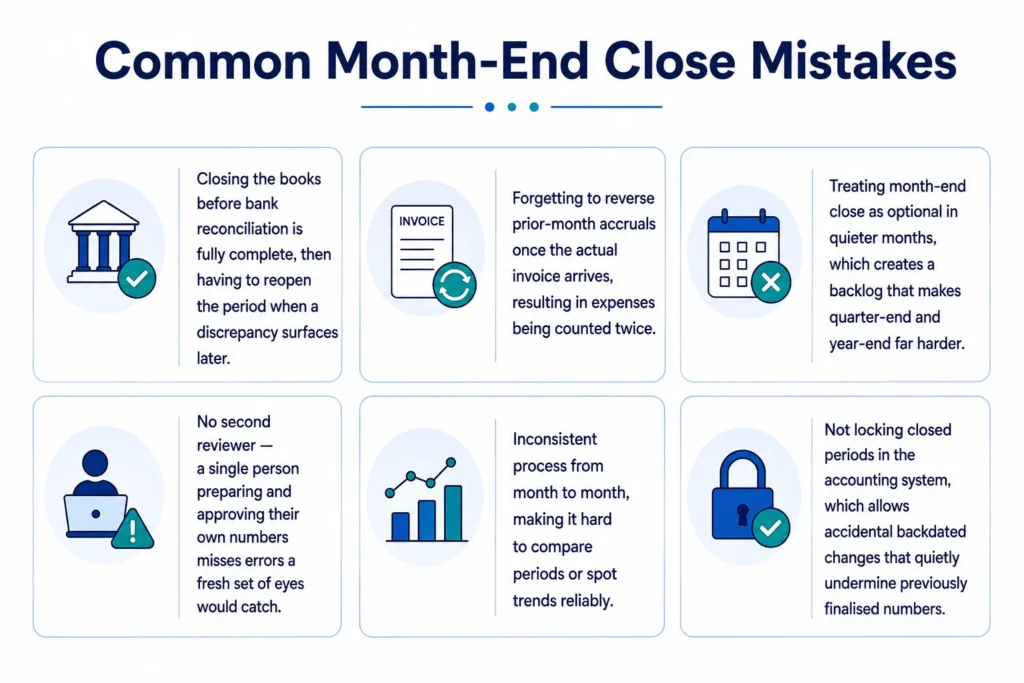
- Closing the books before bank reconciliation is fully complete, then having to reopen the period when a discrepancy surfaces later
- Forgetting to reverse prior-month accruals once the actual invoice arrives, resulting in expenses being counted twice
- Treating month-end close as optional in quieter months, which creates a backlog that makes quarter-end and year-end far harder
- No second reviewer — a single person preparing and approving their own numbers misses errors a fresh set of eyes would catch
- Inconsistent process from month to month, making it hard to compare periods or spot trends reliably
- Not locking closed periods in the accounting system, which allows accidental backdated changes that quietly undermine previously finalised numbers
FAQs | Month-End Close Checklist UAE
How long should month-end close realistically take for a small business?
Most small businesses can complete a proper close within 5 to 10 business days after month-end, depending on transaction volume and complexity. Businesses with fewer than 50 monthly transactions can often finish in 3 to 5 days.
Do I need accounting software to do this properly, or can a spreadsheet work?
A spreadsheet can work for a very small, low-volume business, but accounting software makes reconciliation, accruals tracking, and report generation considerably faster and less error-prone as transaction volume grows.
What’s the difference between month-end close and VAT reconciliation?
Month-end close is the broader monthly process covering all aspects of the books — VAT reconciliation is one specific component within it, focused narrowly on confirming your output and input VAT figures are accurate for that month.
Should accruals and prepayments really matter for a small business, or is that overkill?
They matter more than most small business owners assume — without them, monthly profit figures can swing significantly based purely on invoice timing rather than actual business performance, which makes month-to-month comparisons unreliable.
What happens if I skip month-end close for a few months?
The work doesn’t disappear — it accumulates. Reconstructing several months of unreconciled transactions at once, often under deadline pressure for a VAT or corporate tax filing, takes considerably longer and is more error-prone than staying current each month.
Does month-end close need to happen even if my business had a quiet month with few transactions?
Yes. A quiet month is actually the easiest time to close quickly and stay current — skipping it because there’s little to do is exactly how a backlog starts building, and it tends to catch up with the business during a busier period.
Can month-end close be automated, or does it always need manual review?
Modern accounting software automates parts of the process — bank feed matching, recurring accrual templates, automatic depreciation schedules — but the review and sign-off step still benefits from human judgement, particularly for anything unusual or outside the normal pattern.
Key Takeaways
- A complete month-end close covers eight steps: bank reconciliation, receivables, payables, accruals, fixed assets, payroll, VAT tie-out, and final reporting.
- Bank reconciliation should happen first, since every other step depends on accurate underlying transaction data.
- Most small businesses can complete a proper close within 5 to 10 business days after month-end.
- Doing VAT reconciliation monthly, not just at quarter-end, catches errors while they’re still easy to trace.
- A second reviewer, even briefly, catches errors a single preparer working alone is likely to miss.
- Consistency matters more than speed — the same process every month makes each close faster and more reliable over time.
- A quiet month is the easiest time to stay current — skipping close because there’s little to do is how a backlog starts.
Build a Reliable Month-End Close Process
A consistent, complete month-end close is the foundation everything else in your finances builds on — accurate VAT filing, informed corporate tax planning, and financial decisions based on real numbers rather than guesswork.
Whether you’re setting up this process for the first time, tightening up an existing one, or catching up after a few months of falling behind, the same principle applies: work through the same steps, in the same order, every single month.
Our bookkeeping and financial reporting services build this process into every month, not just at filing deadlines. Contact Opus Accounting to get a reliable close process running.