
In-House vs Outsourced Bookkeeping: An in-house bookkeeper or accountant in Dubai typically costs AED 8,000 to 18,000 a month once salary, visa, insurance, and gratuity are all counted. A comparable outsourced package typically runs AED 500 to 5,000 a month for most SMEs. That gap is real, but it isn’t the whole story.
This decision comes up at a predictable point in most UAE businesses’ growth — usually when the founder has been doing the books personally and it’s no longer sustainable, or when an early hire’s role has quietly expanded into full bookkeeping without a formal decision ever being made. Getting the comparison right at that point avoids years of paying for the wrong model.
This guide compares both options properly — cost, risk, control, and scalability — rather than just the headline numbers. For the detailed outsourced pricing breakdown, see our guide to bookkeeping costs in Dubai.
Quick Answer
For most UAE SMEs, outsourcing is meaningfully cheaper than an in-house hire — often 60% to 80% less once every cost is included. In-house makes more sense at genuine scale, where transaction volume is high enough that a full-time hire’s cost per transaction becomes competitive, or where daily, in-person finance involvement is a real operational need.
Why the Comparison Is Usually Done Wrong
Most cost comparisons between in-house and outsourced bookkeeping fail at the first step — comparing a base salary figure against a full outsourced package price, without adjusting either side to reflect the true, full cost.
- A salary advertised at AED 7,000 a month looks cheap next to an outsourced quote of AED 3,000, until visa, insurance, gratuity, and overhead are added to the in-house side.
- An outsourced quote that excludes VAT and corporate tax filing looks artificially cheap next to an in-house hire who happens to already cover both.
- A fair comparison requires putting both options on equal footing — same scope of work, same total cost including every component, not just the headline number each side presents.
The Full Cost of an In-House Hire
A job advertisement salary is only the starting point. The real monthly cost includes several items that don’t appear in that headline number, and most first-time hiring business owners underestimate the total by a wide margin:
| Cost Component | Typical Range |
| Base salary (bookkeeper to mid-level accountant) | AED 6,000 – 12,000/month |
| Visa sponsorship and processing | AED 3,000 – 7,000, one-time plus renewal |
| Health insurance | AED 3,000 – 8,000/year |
| End-of-service gratuity accrual | Roughly 1 month’s salary per year of service |
| Office space, equipment, software licences | AED 1,000 – 3,000/month, allocated |
| Leave cover / backup during absence | Variable — often unaddressed until needed |
Adding these together, a bookkeeper on a AED 7,000 base salary can realistically cost the business AED 10,000 to 12,000 a month once every component is included — considerably more than the number on the job offer.
The gratuity line is worth calling out specifically, since it’s the most commonly forgotten cost. It doesn’t appear as a monthly cash outflow, but it’s a real, accruing liability under UAE labour law that needs to be funded eventually — treating it as a future problem rather than a current cost understates the true monthly burden.
The Full Cost of Outsourcing
Outsourced bookkeeping pricing is more straightforward, since most of the overhead is absorbed into the provider’s fee rather than billed separately. This is one of the underrated advantages of outsourcing — cost predictability, without the layered, sometimes-hidden components that make up a true in-house cost:
- A single monthly fee, typically AED 500 to 5,000 for most SMEs, scaling with transaction volume and services included
- No visa, insurance, or gratuity costs — these simply don’t apply to a service contract
- No office space or software licence costs in most cases, since the provider supplies their own
- No leave-cover problem — a firm has backup capacity built in, rather than a single point of failure if one employee is unavailable
Side-by-Side: The Real Numbers
Putting the full cost of each option next to each other, rather than comparing a base salary against a headline outsourced fee, makes the actual gap clear:
| In-House | Outsourced | |
| Typical monthly cost | AED 8,000 – 18,000 | AED 500 – 5,000 |
| Typical annual cost | AED 96,000 – 216,000 | AED 6,000 – 60,000 |
| Includes VAT/CT filing expertise? | Only if separately trained or hired for it | Usually included in comprehensive packages |
| Scales down in quiet periods? | No — fixed cost regardless of workload | Often yes, tied to transaction volume |
| Backup if the person is unavailable | Business owner’s responsibility to arrange | Provider’s responsibility to arrange |
Beyond Cost: Risk and Quality Differences
| Factor | In-House | Outsourced |
| Coverage during leave or resignation | Business owner’s problem to solve | Provider’s team covers gaps |
| Breadth of expertise | Limited to what one hire knows | Access to specialists across VAT, CT, payroll |
| Quality consistency | Depends entirely on that individual | Backed by firm-level review processes |
| Onboarding a replacement | Full recruitment cycle if they leave | Handled internally by the provider |
A single in-house hire is a single point of failure in a way an outsourced firm generally isn’t — if that person is out sick during a filing deadline, the business owner is the backup plan by default.
Where In-House Genuinely Wins
Cost isn’t the only factor, and outsourcing isn’t automatically right for every business. In-house has real, legitimate advantages in specific situations:
- At high transaction volumes, a full-time hire’s cost per transaction can become competitive with, or cheaper than, an outsourced package priced on the same volume
- Businesses needing real-time, in-person financial decision support — daily cash position checks, immediate ad hoc analysis — may value physical presence in a way remote service doesn’t fully replicate
- A dedicated in-house hire builds deep, specific institutional knowledge of the business over time, which can be valuable for complex, evolving operations
- Some larger businesses prefer direct employment for governance or control reasons, independent of the cost comparison
Where Outsourcing Genuinely Wins
For the large majority of UAE SMEs, the advantages of outsourcing go beyond just the monthly fee comparison:
- For most SMEs under roughly 500 monthly transactions, outsourcing is materially cheaper on a true like-for-like cost basis
- Access to broader expertise — VAT, corporate tax, financial reporting — without hiring separate specialists for each area
- No single point of failure — illness, resignation, or leave doesn’t leave the business without bookkeeping coverage
- Faster to start and easier to scale up or down as the business grows or contracts, without a hiring or termination process each time
- Compliance accountability sits with a firm whose business depends on getting FTA filings right, rather than resting entirely on the business owner if an in-house employee makes an error
- No recruitment cost or time investment — sourcing, interviewing, and onboarding a qualified in-house hire can take weeks to months, while an outsourced arrangement typically starts within days
A Decision Framework
Rather than treating this as an abstract debate, it’s more useful to match your business’s actual profile against a practical starting recommendation:
| If Your Business Looks Like… | Consider… |
| Under 20 employees, moderate transaction volume | Outsourcing — cost and flexibility usually win clearly |
| Rapid growth, uncertain future headcount needs | Outsourcing — avoids over- or under-hiring while scaling |
| High transaction volume, stable and predictable operations | Compare both carefully — the cost gap narrows at scale |
| Complex, multi-entity structure needing daily oversight | A hybrid model — in-house for daily tasks, outsourced for compliance and specialist filings |
The Hybrid Model Worth Considering
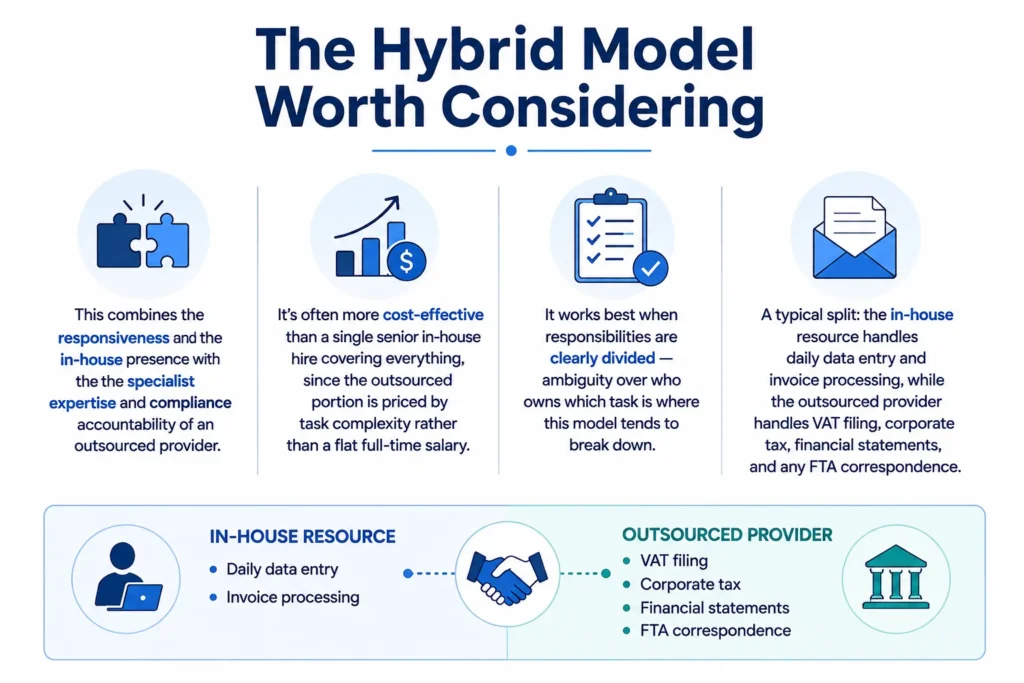
Many growing UAE businesses land on neither extreme — they keep a junior in-house resource for day-to-day data entry and use an outsourced firm for VAT, corporate tax, financial reporting, and technical compliance.
- This combines the responsiveness of an in-house presence with the specialist expertise and compliance accountability of an outsourced provider
- It’s often more cost-effective than a single senior in-house hire covering everything, since the outsourced portion is priced by task complexity rather than a flat full-time salary
- It works best when responsibilities are clearly divided — ambiguity over who owns which task is where this model tends to break down
- A typical split: the in-house resource handles daily data entry and invoice processing, while the outsourced provider handles VAT filing, corporate tax, financial statements, and any FTA correspondence
This model tends to suit businesses in the growth phase between a straightforward small operation and a large enough business to justify a full internal finance team — genuinely useful as a stepping stone rather than a permanent compromise, though some businesses find it works well long-term too.
Signs It’s Time to Reconsider Your Current Model
- If your in-house bookkeeper is consistently behind on reconciliations or filings, the issue may be workload mismatch rather than performance — worth checking transaction volume against realistic capacity before assuming a different hire would fix it
- If you’re paying for a full-time role but VAT and corporate tax complexity has grown beyond what one generalist can confidently handle, a hybrid or fully outsourced model may close the expertise gap faster than additional training
- If you’re currently outsourced but transaction volume has grown to the point where the outsourced fee is approaching in-house cost levels, it’s worth running the comparison again rather than assuming the original decision still holds
- If compliance errors have occurred more than once, the root cause is worth investigating properly — whether that points toward better in-house support, a provider change, or a hybrid model depends on where the specific breakdown happened
Making the Switch Without Disruption
Whichever direction you’re moving, a clean transition protects continuity of your financial records:
- Document the current state of your books clearly — what’s reconciled, what’s outstanding, and any open items — before handing over to a new arrangement
- Time the transition around a natural period boundary where possible, such as a quarter-end or year-end, rather than mid-period
- Keep access to historical records and prior filings even after switching, since these remain relevant for years under standard record-keeping requirements
- Overlap the old and new arrangement briefly if possible, rather than a hard cutover with no handover window
FAQs | In-House vs Outsourced Bookkeeping
Is outsourcing always cheaper, no matter the business size?
Not always — at very high transaction volumes, the cost per transaction for a full-time in-house hire can become competitive with outsourced pricing. For the large majority of UAE SMEs, though, outsourcing remains meaningfully cheaper on a full-cost basis.
Who’s liable if my outsourced provider makes a filing error?
Ultimate legal responsibility for accurate filing sits with the business as the taxable person, but a licensed provider carries professional accountability and typically has processes designed to catch errors before filing — a meaningfully different risk profile than a single in-house employee working without review.
Can I switch from in-house to outsourced without disrupting my books?
Yes, with a proper handover — historical records, current reconciliation status, and any open items should be transferred clearly. Most outsourced providers have an onboarding process specifically designed for this transition.
Does an outsourced provider replace the need for any in-house finance function at all?
For most SMEs, yes — a good outsourced provider covers the full bookkeeping and compliance function. Larger or more complex businesses sometimes retain a junior in-house role for day-to-day tasks alongside outsourced specialist support, as described in the hybrid model above.
How do I know when my business has outgrown outsourcing?
Watch transaction volume and complexity rather than headcount alone — a business with hundreds of transactions daily, multiple entities, or genuinely real-time finance needs is the profile where an in-house comparison becomes worth running properly, rather than assumed.
Is it common for UAE SMEs to use a hybrid model rather than choosing one or the other?
Yes — it’s an increasingly common middle path as businesses grow past the point where a single in-house generalist can comfortably cover everything, but before they’re large enough to justify a full internal finance department.
Does switching providers or bringing bookkeeping in-house affect my FTA compliance history?
Your compliance history and TRN remain with the business regardless of who’s doing the bookkeeping — switching arrangements doesn’t reset or affect your filing history with the FTA, provided the transition itself doesn’t cause a missed deadline.
Key Takeaways
- An in-house hire’s true cost includes salary plus visa, insurance, gratuity, and overhead — typically AED 8,000 to 18,000 a month all-in.
- Outsourced bookkeeping for most SMEs runs AED 500 to 5,000 a month, with less hidden overhead.
- Outsourcing wins on cost and flexibility for most SMEs under roughly 500 monthly transactions.
- In-house can make sense at high transaction volume or where daily, in-person finance involvement is a genuine operational need.
- A single in-house hire is a single point of failure in a way an outsourced firm generally isn’t — coverage during leave or turnover is a real, practical difference.
- A hybrid model — junior in-house support plus outsourced specialist compliance — is a practical middle ground for growing businesses.
- Whichever direction you’re moving, a documented handover protects continuity of your financial records during the transition.
Get a Clear Comparison for Your Business
The right answer depends on your specific transaction volume, complexity, and growth plans — not a generic rule that applies to every business the same way.
Our bookkeeping service can model both options against your actual numbers. Contact Opus Accounting for a free comparison.