
Bookkeeping Mistakes UAE: Most FTA audits don’t start with suspicion of fraud — they start with a pattern in the data that doesn’t add up. The mistakes on this list are the ones that create exactly that pattern, and nearly all of them are avoidable with routine reconciliation.
None of these are exotic errors requiring sophisticated schemes to occur. They’re the ordinary, everyday slips that happen when bookkeeping is treated as data entry rather than a disciplined process with built-in review — a missed reverse charge transaction, a duplicated invoice, a bank deposit that never got matched to a sale.
This guide covers what actually draws FTA attention, and how to catch these issues yourself first. For the reconciliation process that catches most of them, see our guide to VAT reconciliation.
Quick Answer
The bookkeeping mistakes that most commonly trigger UAE tax audits are reverse charge omissions, input VAT claims without valid tax invoices, duplicated or missing invoices, mismatches between bank records and filed figures, inconsistent related-party transaction reporting, and revenue recognised in the wrong period. Most of these are caught by the FTA’s automated cross-referencing against supplier filings, customs data, and prior-period patterns — not by manual investigation.
Audits Are Mostly Data-Driven, Not Suspicion-Driven
A common misconception is that audits target businesses the FTA has specific reason to distrust. In practice, most reviews are triggered by data patterns that any business could produce entirely by accident:
- Automated systems flag inconsistencies at scale, long before any human reviewer looks at a specific business’s filings
- A business with genuinely clean, well-reconciled books is statistically far less likely to surface in these automated checks, regardless of size or industry
- Understanding this changes the right response: the goal isn’t to avoid looking suspicious, it’s to make sure the underlying data genuinely reconciles, because that’s what the systems are actually checking
How the FTA Actually Spots These Issues
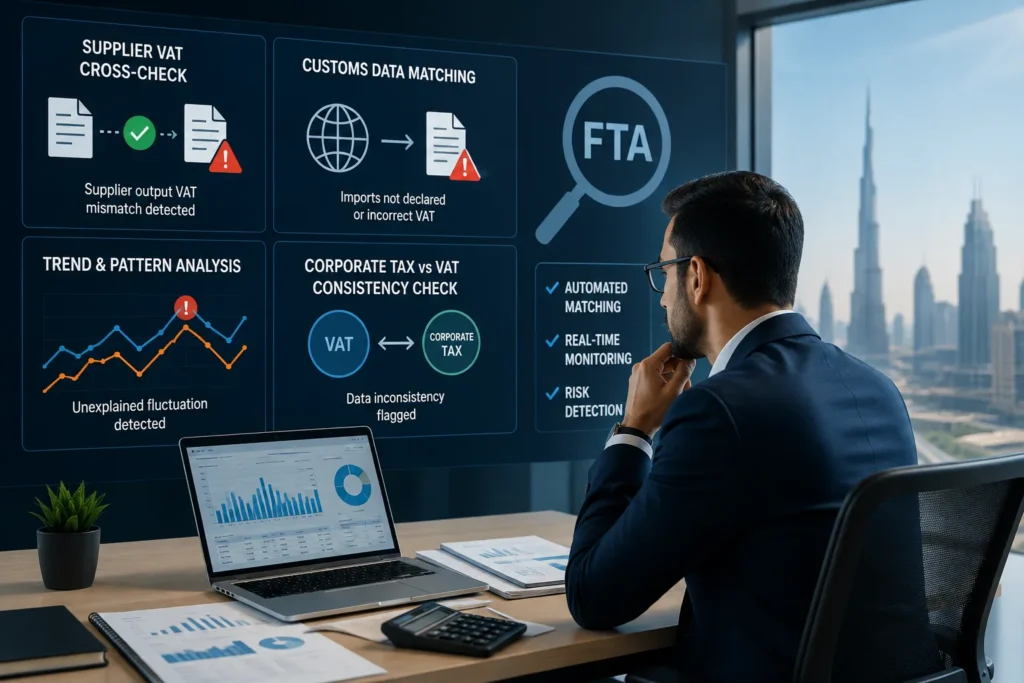
Understanding the detection mechanism explains why some errors draw attention faster than others:
- VAT figures are cross-referenced against supplier filings — if you claim input VAT from a supplier who didn’t report the matching output VAT, the mismatch is visible without any manual review
- Customs data is matched against reverse charge and import VAT declarations, so imported goods or services that don’t appear correctly on a return stand out
- Year-on-year and period-on-period patterns are compared automatically — a sudden, unexplained swing in revenue, expenses, or VAT position draws more scrutiny than steady, explainable trends
- Corporate tax figures are checked against VAT-reported revenue for consistency, since the two should broadly align even though they’re calculated differently
Mistake 1: Missing Reverse Charge Transactions
This is consistently the single most common trigger, across nearly every industry that buys services or goods from overseas. See our full breakdown in Q3 VAT filing mistakes:
- Overseas supplier invoices for services — software subscriptions, consulting, marketing — often get processed as simple expenses without the reverse charge VAT being declared
- Customs records showing imported goods with no corresponding reverse charge entry on the VAT return is one of the most visible mismatches in the FTA’s data
- The irony: correctly handled reverse charge is usually cash-neutral, since output and input VAT offset in the same return — the omission costs nothing to avoid but everything to get caught on
- This mistake tends to recur across multiple periods once it starts, since the same category of overseas purchase — a recurring software subscription, for example — gets the same incorrect treatment every month until someone catches the pattern
Mistake 2: Input VAT Claims Without Valid Tax Invoices
- Claiming VAT based on a bank payment or informal receipt, rather than a compliant tax invoice showing the supplier’s TRN and VAT breakdown
- The FTA can directly cross-check a claimed input VAT amount against the supplier’s own output VAT filing — if the supplier never reported that sale, the claim is flagged automatically
- Claiming VAT on non-deductible categories — entertainment, certain vehicle costs — is functionally the same error: a claim that won’t survive cross-referencing
Mistake 3: Duplicated or Missing Invoices
Invoice-level errors are particularly visible to an auditor because they’re easy to test systematically — pull a sample, check for sequence gaps, check for duplicate numbers, and the pattern either holds up or it doesn’t.
- The same supplier invoice claimed twice across different periods inflates both expenses and input VAT — an error that compounds every time it’s repeated
- Sales invoices issued but not recorded in the accounting system understate revenue and output VAT, creating a mismatch against bank deposits that don’t have a corresponding recorded sale
- Sequential invoice numbering gaps are a specific pattern auditors look for — a missing invoice number in a sequence raises the question of where that invoice went
Mistake 4: Bank Records That Don’t Match Filed Figures
This is exactly what a proper month-end close process is designed to catch before it ever reaches a filed return — bank reconciliation is the single check that catches the widest range of underlying errors:
- Revenue reported on a VAT return that doesn’t align with bank deposits over the same period is one of the most straightforward mismatches to spot from the outside
- VAT payments filed as made, but not appearing in the actual bank records, suggest either a payment failure or a filing that wasn’t followed through on
- Unexplained large cash transactions, if the business handles cash, are a specific area of increased scrutiny, since they’re harder to independently verify
Mistake 5: Inconsistent Related-Party Transactions
Related-party dealings draw a disproportionate amount of audit attention relative to how much of a typical business’s total activity they represent, precisely because pricing between related parties is easier to manipulate than pricing with an independent third party.
- Transactions between related UAE entities, or between a UAE business and an overseas related party, need to be priced and documented on an arm’s-length basis
- Inconsistent treatment of the same related-party relationship across VAT and corporate tax filings — different values, different classifications — is a common inconsistency that draws review
- Missing transfer pricing documentation for related-party transactions above the applicable thresholds leaves the pricing basis unsupported if questioned
Mistake 6: Revenue Recognised in the Wrong Period
Timing errors are subtler than a missing invoice, but they distort the numbers just as much, and they’re a specific area auditors trained on service and construction businesses know to look for.
- Recording revenue when cash is received rather than when the underlying supply actually took place shifts income between tax periods, which can misstate both VAT and corporate tax figures
- For businesses with long-term contracts or milestone billing, inconsistent revenue recognition from month to month makes trend analysis unreliable and draws closer attention
- Credit notes and refunds not reflected in the correct period they relate to distort both the period they should have hit and the period they were incorrectly recorded in
Mistake 7: Personal and Business Expenses Mixed Together
- Business accounts used for personal spending, even occasionally, make it harder to demonstrate that claimed deductions and input VAT genuinely relate to business activity
- This is a particular risk for freelancers and sole establishment owners, where the line between personal and business finances is inherently less distinct than for a company structure
- Even where the amounts are small, a pattern of mixed transactions undermines confidence in the overall record-keeping, which can extend scrutiny to areas that would otherwise look clean
- Separating personal and business banking entirely, even for a very small business, removes this risk almost completely and makes reconciliation considerably simpler as a side benefit
Mistake 8: Incomplete Documentation Retention
- Both VAT and corporate tax require records to be retained for extended periods — generally 5 years for VAT, at least 7 years for corporate tax
- Being unable to produce supporting documentation when requested during an audit is treated as seriously as the underlying transaction being wrong, since an unsupported figure can’t be verified either way
- Digital record-keeping with proper backups reduces the risk of documentation being lost to a hardware failure or an employee departure taking institutional knowledge with them
- A clear, organised filing system — by period and transaction type — dramatically reduces the time needed to respond to an FTA information request, which itself reflects well on the overall quality of the business’s record-keeping
What Actually Happens If These Trigger a Review
Not every trigger on this list leads to the same outcome — the FTA’s response scales with how isolated or systemic the underlying issue turns out to be:
| Trigger Severity | Typical FTA Response |
| Minor, isolated discrepancy | A clarification request, often resolved by providing documentation |
| Recurring pattern across periods | A more formal review of multiple filing periods |
| Material, unexplained mismatch | A full audit, potentially extending the standard look-back period |
Most triggers on this list start businesses somewhere in the top row — a request for clarification is a normal, manageable event, not automatically a crisis. It only escalates when the underlying records can’t actually support the figures filed, or when the same issue keeps recurring across multiple periods without being addressed.
A Simple Self-Audit Before You File
Running a short internal check against these exact patterns before filing catches most of what an actual FTA review would look for:
- Pull a sample of overseas supplier invoices from the period and confirm reverse charge was applied correctly to each one
- Spot-check a handful of input VAT claims against their supporting tax invoices, confirming the supplier TRN and VAT amount are both present and correct
- Scan your sales invoice sequence for gaps, and investigate any that appear
- Compare total VAT-reported revenue for the period against total bank deposits, and investigate any unexplained difference
- Review related-party transactions for the period and confirm the treatment is consistent with how the same relationship was reported in prior periods
This kind of internal self-audit takes a fraction of the time a real FTA review would, and it’s the single most effective way to catch these issues while they’re still cheap and easy to fix.
FAQs | Bookkeeping Mistakes UAE
Does one small mistake automatically trigger a full audit?
Not usually. A single, isolated discrepancy typically results in a clarification request rather than a full audit. Recurring or unexplained issues tend to escalate scrutiny.
If I catch and fix a mistake myself, does that protect me from an audit?
Self-correcting through a voluntary disclosure before the FTA identifies the issue independently generally results in a significantly better outcome — both in cost and in how the business is viewed going forward — than being caught first.
Are these mistakes more common in certain industries?
Reverse charge omissions are especially common in service businesses using overseas software and consultants. Revenue timing issues are more common in real estate, construction, and businesses with long-term contracts. Cash-handling businesses face more scrutiny around unexplained cash transactions.
Can good accounting software prevent all of these mistakes on its own?
Software reduces the risk significantly when configured correctly. However, it doesn’t replace judgement on classification, related-party pricing, or revenue recognition timing — these still need a knowledgeable person reviewing the output.
How often should reconciliation happen to catch these issues before filing?
Monthly, ideally as part of a proper month-end close, rather than only at VAT filing deadlines. Catching an error within the month it occurred is far easier than reconstructing what happened several months later.
Does the size of my business affect how closely these patterns are monitored?
Automated cross-referencing applies broadly regardless of business size, since it’s built into the FTA’s systems rather than targeted case by case. Larger businesses may face additional scrutiny simply due to transaction volume and materiality, but smaller businesses aren’t exempt from the same automated checks.
If my supplier made an error on their invoice, am I still responsible for the mismatch?
The FTA will typically still flag the mismatch regardless of which party’s records are at fault. It’s worth following up with suppliers on any invoice discrepancies you notice, since an unresolved mismatch on their end can still surface as a question on your own filing.
Key Takeaways
- Most FTA audit triggers come from automated cross-referencing against supplier filings, customs data, and prior-period patterns — not manual suspicion.
- Reverse charge omissions and unsupported input VAT claims are the two most common triggers.
- A single isolated error typically means a clarification request, not a full audit — patterns are what escalate scrutiny.
- Related-party transactions, revenue timing, and documentation retention all deserve specific, deliberate attention, not just routine transaction entry.
- Personal and business expenses mixed together undermine confidence in record-keeping even when individual amounts are small.
- Monthly reconciliation, built into a proper month-end close, catches nearly all of these issues before they ever reach a filed return.
Catch These Mistakes Before the FTA Does
Every mistake on this list is avoidable with a consistent reconciliation process — none of them require anything beyond routine diligence to catch.
Whether you’re setting up a review process for the first time, want a second opinion on your current bookkeeping, or are trying to understand why a filing drew an FTA query, the underlying fix is always the same: check the patterns this guide describes before they become someone else’s discovery.
Our bookkeeping and financial reporting services are built specifically to catch these before they reach a filed return. Contact Opus Accounting for a bookkeeping review.