
Q3 VAT Return: For most UAE businesses filing quarterly, the Q3 2026 VAT return covers July, August, and September — and it’s due by 28 October 2026. Missing it, or filing it with one of a handful of recurring errors, triggers penalties that are entirely avoidable with a bit of preparation.
Q3 carries a particular risk that other quarters don’t always share: it’s the quarter right before many businesses shift focus to year-end planning and, for calendar-year filers, the corporate tax deadline that follows shortly after in Q4. VAT can quietly slip in priority exactly when it shouldn’t.
This guide covers the exact Q3 deadline, the filing mechanics, and the mistakes that show up most often in FTA reviews. For how VAT compares to corporate tax more broadly, see our guide to corporate tax vs VAT in the UAE.
Quick Answer
The Q3 2026 VAT return, covering 1 July to 30 September, is due by 28 October 2026 for businesses on a quarterly filing cycle. Businesses with annual taxable turnover above AED 150 million file monthly instead. Filing and payment are due on the same date, and a return is required even with zero activity for the quarter.
Who Files Quarterly vs Monthly?
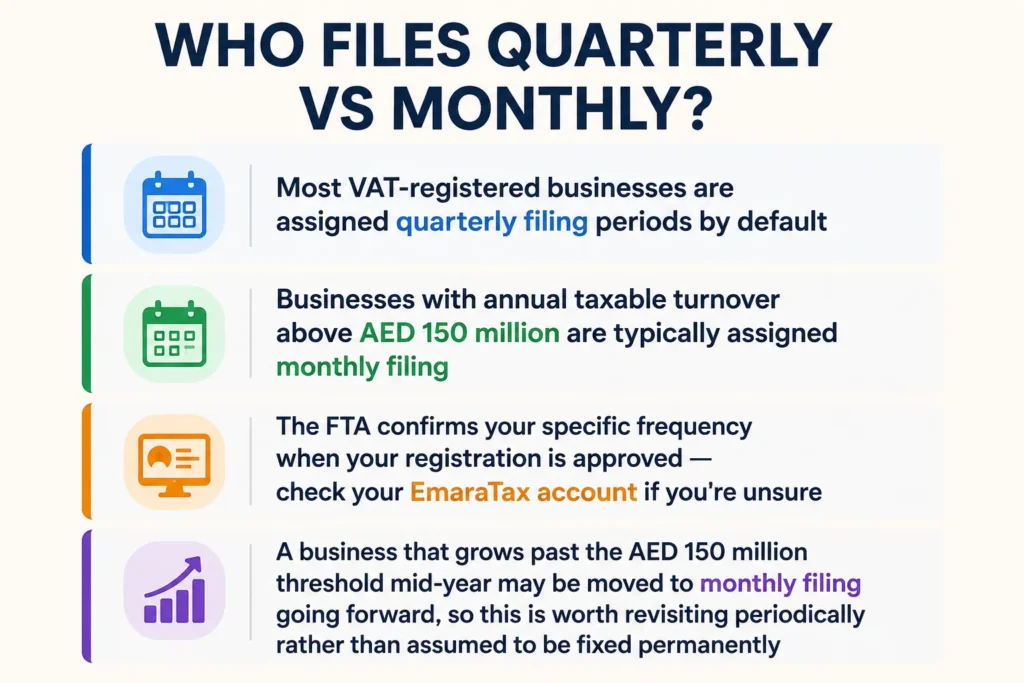
Your filing frequency is assigned by the FTA at registration and isn’t something you choose freely:
- Most VAT-registered businesses are assigned quarterly filing periods by default
- Businesses with annual taxable turnover above AED 150 million are typically assigned monthly filing instead
- The FTA confirms your specific frequency when your registration is approved — check your EmaraTax account if you’re unsure which applies to you
- A business that grows past the AED 150 million threshold mid-year may be moved to monthly filing going forward, so this is worth revisiting periodically rather than assumed to be fixed permanently
Q3 2026 Key Dates
| Milestone | Date |
| Q3 tax period begins | 1 July 2026 |
| Q3 tax period ends | 30 September 2026 |
| Return and payment due | 28 October 2026 |
If 28 October falls on a weekend or public holiday in a given year, the deadline moves to the last business day before it, not the next business day after — worth double-checking against the FTA calendar each quarter rather than assuming a fixed rule.
What Goes Into the Q3 Return
Every VAT return, including Q3, reports the same core figures. Our bookkeeping service keeps these current throughout the quarter rather than reconstructed at filing time:
- Output tax — the 5% VAT charged on standard-rated sales during July, August, and September
- Input tax — the 5% VAT paid on business purchases and expenses eligible for recovery in the same period
- Zero-rated supplies — exports, international transport, and other qualifying categories, reported separately even though no VAT is charged
- Exempt supplies — certain financial services and bare land, sitting outside the VAT calculation entirely
- Reverse charge transactions — VAT self-accounted on imported goods and services during the quarter
- Adjustments — bad debt relief, credit notes, and corrections carried from a prior period where applicable
Mistake 1: Getting the Reverse Charge Mechanism Wrong
This is consistently one of the most common — and most penalised — VAT errors in the UAE, and it’s a recurring theme in almost every FTA review we see.
- Under reverse charge, the UAE buyer, not the overseas supplier, is responsible for accounting for VAT on imported goods and services.
- Omitting a reverse charge transaction from the return means the return itself is incorrect, not just incomplete — this can trigger administrative penalties even without any deliberate underreporting.
- From 1 January 2026, businesses no longer need to generate a self-invoice for reverse charge transactions under Federal Decree-Law No. 16 of 2025 — supplier documentation and customs records are retained instead, but the VAT still needs to be correctly declared on the return.
- Common trigger: services from an overseas software vendor, consultant, or platform, where the business forgets the reverse charge applies simply because no local invoice with VAT was received.
- Because both the output and input side of reverse charge VAT are generally recorded in the same return, a correctly handled transaction is often cash-neutral — which makes the omission even more frustrating, since the mistake itself typically costs nothing to fix correctly, only to fix late.
Mistake 2: Claiming Input VAT Without a Valid Tax Invoice
- Input VAT recovery requires a compliant tax invoice showing the supplier’s TRN, the VAT amount, and the required invoice details — a receipt or informal invoice generally isn’t sufficient on its own.
- The FTA’s systems cross-reference supplier VAT filings against customer input tax claims, making mismatched or unsupported claims highly visible during review, not just during a formal audit.
- Claiming VAT on non-business expenses, or expenses without a clear business purpose, is treated the same way — disallowed on review, with penalties following.
Mistake 3: Miscalculating Mixed Supply Recovery
- Businesses making both taxable and exempt supplies — common in real estate, education, healthcare, and holding company structures — can’t automatically recover all input VAT on overhead costs.
- A partial recovery calculation, apportioning input VAT between taxable and exempt activity, is required, and getting this wrong is a frequent source of FTA correction.
- This is a Q3-specific risk for businesses whose activity mix shifted during the quarter — the apportionment needs recalculating each period, not assumed to carry over unchanged from Q2.
Mistake 4: Wrong VAT Base or Rate Calculation
- Confusing VAT-inclusive and VAT-exclusive pricing is a simple but costly error — a product priced at AED 1,000 inclusive of VAT carries AED 47.62 of VAT, not AED 50.
- Applying the standard 5% rate to a genuinely zero-rated or exempt supply, or vice versa, misstates both output tax and the overall return.
- These errors compound across every transaction of the same type during the quarter, so a single pricing misunderstanding can affect a large number of invoices at once.
Mistake 5: Missing Adjustments
- Bad debt relief — VAT already paid on an invoice that’s since become genuinely uncollectible — is often simply forgotten rather than actively claimed.
- Credit notes issued during the quarter need to be reflected in the return, not left as an outstanding item carried informally outside the VAT calculation.
- Corrections carried from a prior period, where the error was small enough to adjust in the next return rather than requiring a formal disclosure, need to be included precisely, not estimated.
What These Mistakes Actually Cost
The five mistakes above aren’t equally minor — the FTA’s response scales with the type and materiality of the error:
| Mistake Type | Typical Consequence |
| Reverse charge omission | Incorrect return penalty, plus additional VAT payable with interest |
| Unsupported input VAT claim | Disallowed claim, added back to VAT payable, potential penalty on top |
| Mixed supply over-recovery | Reassessment of recoverable input tax across the affected periods |
| Rate/base miscalculation | Corrected output VAT, potentially across multiple invoices of the same type |
The common thread: none of these are treated as isolated, one-off adjustments. The FTA’s systems cross-reference figures against supplier filings, customs data, and prior-period patterns, so an error in one area often surfaces related questions about the surrounding transactions too.
What to Do If You Find an Error After Filing
How you fix a Q3 error depends on its size, following current Federal Tax Authority thresholds:
| Error Size | How to Correct It |
| AED 10,000 or less in tax difference | Generally correctable directly in the next VAT return |
| More than AED 10,000 in tax difference | Requires a formal Voluntary Disclosure (VAT211) for the original period |
Filing a Voluntary Disclosure before the FTA identifies the error independently generally results in a materially better outcome than waiting to be caught — self-correction is treated as good-faith compliance, while a discovered error invites closer scrutiny of the surrounding periods too.
Why Q3 Specifically Deserves Extra Attention
- Q3 covers the summer months for many businesses, when staff availability for review and reconciliation can be reduced due to leave schedules — plan the filing timeline around this rather than assuming normal capacity.
- For businesses with seasonal revenue patterns, Q3 figures can look meaningfully different from Q2 or Q1, which is exactly the kind of swing that draws FTA attention if it isn’t well explained by the underlying business activity.
- Q3 sits just before many businesses shift focus to Q4 planning and, for calendar-year filers, the corporate tax deadline — it’s easy for VAT review quality to slip at exactly this point in the year.
- Reverse charge transactions tend to spike in Q3 for businesses that increase overseas software, marketing, or consulting spend ahead of year-end — precisely the category most commonly missed.
Preparing Before Quarter-End, Not After
The businesses that file Q3 cleanly almost always share one habit: they review VAT treatment as transactions happen, not in a single push after 30 September.
- Flag reverse charge transactions at the point of booking the invoice, rather than trying to identify them retroactively from a full quarter of purchase records.
- Reconcile input VAT claims against supplier invoices monthly within the quarter, rather than all at once in October.
- Keep a running note of any credit notes or bad debt situations as they arise, rather than reconstructing them from memory at filing time.
- Review the mixed-supply apportionment calculation each month if your activity mix is genuinely changing, rather than only at quarter-end.
This spreads the review workload across three months instead of compressing it into the days before 28 October — which is exactly when errors are most likely to slip through unnoticed.
A Q3 Filing Checklist
- Confirm the tax period in EmaraTax matches your internal records — July through September for a standard quarterly filer
- Enter output figures from reviewed sales schedules, not draft revenue reports still subject to change
- Enter input figures only after confirming each material claim has a valid, compliant tax invoice
- Review reverse charge transactions specifically — imported services are the single most commonly missed category
- Post adjustments (bad debt relief, credit notes) as a separate, clearly documented step
- Check the net VAT position against your general ledger before submitting, not after
- Run a brief independent review, even a quick second pair of eyes, before final submission
FAQs | Q3 VAT Return
What happens if I file the Q3 return with no sales or purchases at all?
A nil return is still required by the same 28 October deadline. Failing to file a nil return on time triggers the same late-filing penalty as missing a return with actual VAT activity.
Can I get a refund if my input VAT exceeds my output VAT for Q3?
Yes — if recoverable input tax exceeds output tax for the period, you can claim the difference as a refund from the FTA. Refund claims must generally be made within 5 years from the end of the relevant tax period; balances unclaimed beyond that period expire.
Do I still need to worry about self-invoicing for reverse charge imports in Q3 2026?
No — the self-invoicing requirement was removed from 1 January 2026. You retain supplier documentation and customs records instead, but the VAT still needs to be correctly declared as a reverse charge transaction on the return itself.
What penalty applies if I file the Q3 return a few days late?
Late VAT filing carries a penalty starting at AED 1,000 for a first offence, rising to AED 2,000 for repeat offences within 24 months, alongside a 14% per annum late-payment penalty on any unpaid VAT, calculated monthly.
I found a Q3 error worth AED 15,000 after filing. What do I do?
Since this exceeds the AED 10,000 correction threshold, it needs a formal Voluntary Disclosure (VAT211) for the Q3 period specifically, rather than being folded into your Q4 return.
Does my Q3 filing frequency ever change without me requesting it?
Yes — if your annual taxable turnover crosses the AED 150 million monthly-filing threshold, the FTA can move you from quarterly to monthly filing going forward. Check your EmaraTax account periodically rather than assuming your frequency is fixed indefinitely.
How do I know if a specific overseas purchase needs reverse charge treatment?
Generally, if you’re a UAE VAT-registered business purchasing goods or services from a supplier not registered for UAE VAT, and the supply would have been taxable if made by a UAE supplier, reverse charge applies. Reviewing every overseas invoice against this test during the quarter, rather than only at filing time, catches most of these before they become a Q3 filing gap.
Is there any benefit to filing the Q3 return earlier than the 28 October deadline?
Filing early doesn’t change the deadline itself, but it does give more time to catch and correct errors within the AED 10,000 threshold before the return is locked in, and avoids the last-minute rush that tends to produce the exact mistakes covered in this guide.
Key Takeaways
- Q3 2026 covers 1 July to 30 September, with the return and payment due 28 October 2026 for quarterly filers.
- Reverse charge omissions, unsupported input VAT claims, and mixed-supply recovery errors are the most common and most penalised mistakes.
- Self-invoicing for reverse charge imports was removed from 1 January 2026 — retain supplier documentation instead, but still declare the VAT correctly.
- Errors under AED 10,000 can generally be corrected in the next return; larger errors need a formal Voluntary Disclosure for the original period.
- A nil return is still required even with zero activity for the quarter.
- Q3’s summer timing and pre-year-end pressure make it a quarter worth watching more closely, not less, for review quality.
File Your Q3 Return Without the Common Errors
The mistakes that cause the most FTA scrutiny are the same ones every quarter — reverse charge, unsupported input claims, and missed adjustments. Catching them before submission is far cheaper than correcting them afterward.
Whether Q3 is a routine filing for your business or one where activity shifted meaningfully from prior quarters, the same discipline applies: review reverse charge transactions specifically, confirm every input claim has a valid tax invoice, and don’t let the summer schedule compress the review process.
Our VAT compliance support, alongside our financial reporting service, reviews your Q3 figures line by line before filing. Contact Opus Accounting to get your Q3 return filed accurately and on time.