
Al Sufouh 2 sits at the edge of Dubai’s knowledge economy, bordering Dubai Internet City, Media City, and Knowledge Park, and home to a dense cluster of technology companies, media businesses, and digital ventures operating under TECOM free zone licences.
These businesses have corporate tax profiles quite different from a conventional company, shaped by free-zone QFZP status, technology revenue, R&D investment, intercompany structures, and growth-stage losses. Handling these correctly is exactly what specialist corporate tax filing Al Sufouh 2 delivers.
Technology and media businesses in Al Sufouh 2 face some of the more technically demanding corporate tax questions in the UAE. As free-zone entities, many can benefit from the Qualifying Free Zone Person regime, but only if their qualifying income is correctly classified and the conditions are met.
R&D investment raises deduction questions. Group structures require transfer-pricing documentation. And growth-stage businesses often carry losses that must be planned for. Our corporate tax filing Al Sufouh 2 is built around exactly these realities, and it forms part of our widercorporate tax filing services in Dubai.
Why Al Sufouh 2 Technology Businesses Need Specialist Corporate Tax Support
The corporate tax position of an Al Sufouh 2 technology or media business is shaped by features that generic tax guidance does not address. As a TECOM free-zone entity, it may qualify for the 0% QFZP rate, but only if its income is correctly categorised between qualifying and non-qualifying, and its substance and conditions are met.
Technology revenue, licensing, subscriptions, services, must be classified correctly for QFZP purposes. R&D spend raises questions of deductibility. Group and intercompany arrangements require arm’s length transfer-pricing documentation. And fast-growing, pre-profit businesses accumulate losses that, handled correctly, hold real future value.
Each of these has a direct bearing on the corporate tax position, and mishandling any can mean a lost tax advantage or an incorrect filing. A general corporate tax approach does not engage with QFZP classification, R&D deductions, or growth-stage loss planning at the level these businesses need. Our corporate tax filing Al Sufouh 2 brings the specialist knowledge these technology and media businesses require, grounded in reliable data from strong bookkeeping for Al Sufouh 2 businesses.
Our Corporate Tax Services for Al Sufouh 2
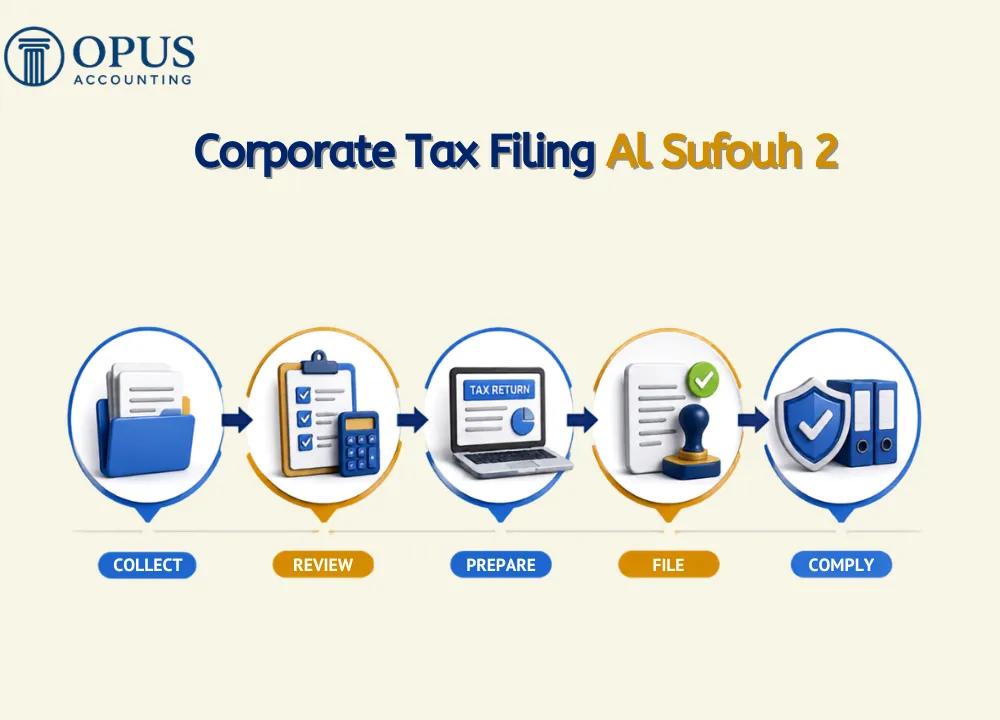
We provide a comprehensive, specialist corporate tax service for Al Sufouh 2 technology and media businesses:
- TECOM QFZP eligibility assessment
- Qualifying income classification for technology revenue
- Intercompany transfer pricing documentation
- Research and development cost deductions
- Loss utilisation planning for growth stage businesses
- Taxable income calculation and deductible expense review
- Corporate tax registration and return preparation
- FTA submission and compliance
- CT liability forecasting and provisioning
- Coordination with financial reporting and bookkeeping
Getting these right protects both compliance and potentially valuable tax advantages, and it works alongside our financial advisory for Al Sufouh 2.
QFZP Status and Qualifying Technology Income
At the heart of corporate tax for Al Sufouh 2’s TECOM free-zone businesses is the Qualifying Free Zone Person regime:
TECOM QFZP eligibility assessment: a Qualifying Free Zone Person can benefit from a 0% corporate tax rate on qualifying income, but only if the strict conditions are met, adequate substance in the free zone, correct income categorisation, and satisfaction of the regulatory requirements. Our TECOM QFZP eligibility assessment evaluates your entity against the current Federal Tax Authority conditions and confirms whether QFZP status is available and how to maintain it.
Qualifying income classification for technology revenue: not all income earned by a technology business is automatically qualifying income for QFZP purposes. Software licensing, subscriptions, services, and other revenue streams may be treated differently, and classifying them correctly is essential to preserving the 0% rate where it applies.
Our qualifying income classification for technology revenue maps your income streams and determines which qualify and which do not, so your filing correctly reflects your position and protects the benefit.
Getting QFZP status and income classification right is the single most valuable element of corporate tax planning for an eligible Al Sufouh 2 technology business.
R&D Deductions and Transfer Pricing
Two further areas are central to corporate tax for Al Sufouh 2’s technology and media businesses:
Research and development cost deductions: technology businesses invest significantly in research and development, and the treatment of R&D costs for corporate tax, how and when they are deductible, needs to be handled correctly to ensure you claim the deductions you are entitled to.
Our research and development cost deductions service ensures your R&D spend is treated correctly in your corporate tax calculation, optimising your deductible position within the rules.
Intercompany transfer pricing documentation: technology and media groups frequently have transactions between related entities, licensing, management charges, shared services, and intercompany funding, and under UAE corporate tax these must be conducted and documented on an arm’s length basis.
Our intercompany transfer pricing documentation reviews your related-party transactions, tests them against the arm’s length principle, and prepares the documentation needed to support your filing and withstand FTA scrutiny.
Handling both correctly is essential for a technically accurate and optimised corporate tax position.
Loss Utilisation for Growth-Stage Businesses
Many Al Sufouh 2 technology businesses are in a growth phase and operating at a loss, which carries specific corporate tax planning value:
Loss utilisation planning for growth stage businesses: fast-growing, pre-profit technology businesses often accumulate losses as they invest in growth, and under UAE corporate tax, losses can generally be carried forward to offset future taxable profits, subject to the rules.
Capturing and planning the use of these losses correctly is valuable, they can significantly reduce tax in the profitable years to come. Our loss utilisation planning for growth stage businesses ensures your losses are correctly calculated, documented, and planned for future use, so you preserve their full value as your business matures toward profitability.
Handling growth-stage losses well protects real future tax value for an Al Sufouh 2 technology business.
FAQ’s | Corporate Tax Filing Al Sufouh 2
1. We are a TECOM free-zone tech company in Al Sufouh 2. Do we automatically get the 0% corporate tax rate?
No, the 0% rate applies only to qualifying income of a Qualifying Free Zone Person that meets the strict conditions, including adequate substance and correct income categorisation. Our TECOM QFZP eligibility assessment evaluates your entity against the current Federal Tax Authority conditions and confirms whether QFZP status is available and how to maintain it, so you benefit from the 0% rate only where you genuinely qualify.
2. We earn income from software licensing, subscriptions, and services. Is it all qualifying income?
Not necessarily. Different technology revenue streams, licensing, subscriptions, services, may be treated differently for QFZP purposes. Our qualifying income classification for technology revenue maps each of your income streams and determines which qualify for the 0% rate and which do not, so your filing correctly reflects your true position and preserves the qualifying benefit wherever it legitimately applies.
3. We invest heavily in R&D. Can we deduct those costs?
The treatment of research and development costs for corporate tax, how and when they are deductible, needs to be handled correctly to ensure you claim what you are entitled to. Our research and development cost deductions service ensures your R&D spend is treated correctly in your corporate tax calculation, optimising your deductible position within the rules, which matters greatly for an R&D-intensive technology business.
4. We have transactions between our group companies. Do we need transfer-pricing documentation?
Yes. Under UAE corporate tax, transactions between related parties, licensing, management charges, shared services, and intercompany funding, must be conducted and documented on an arm’s length basis. Our intercompany transfer pricing documentation reviews your related-party transactions, tests them against the arm’s length principle, and prepares the documentation your filing needs to withstand FTA scrutiny.
5. We are growing fast and making losses. Does that matter for corporate tax?
Yes, in a helpful way. Under UAE corporate tax, losses can generally be carried forward to offset future taxable profits, subject to the rules, so your growth-stage losses can reduce your tax in profitable years to come, if they are correctly captured and planned. Our loss utilisation planning for growth stage businesses ensures your losses are properly calculated, documented, and planned for future use, preserving their valuable benefit as you approach profitability.
Expert Corporate Tax Filing for Your Al Sufouh 2 Business
The technology and media businesses of Al Sufouh 2 have technically demanding corporate tax profiles, spanning TECOM QFZP status, qualifying income classification, R&D deductions, transfer pricing, and growth-stage losses. Our corporate tax filing Al Sufouh 2 brings the specialist analysis these businesses need, ensuring an accurate filing that preserves every advantage you are genuinely entitled to.
Explore our full range of corporate tax filing services, browse all Opus Accounting services, then contact us today for a free consultation. For VAT matters, our Al Sufouh 2 VAT consulting team can support you, and for broader guidance, our financial advisory for Al Sufouh 2 is here to help. For legal contract drafting, our partners at Omam Consultancy in Dubai provide specialist support.