
Corporate Tax Filing Services Dubai International City
Corporate Tax Filing Services Dubai International City: traders need to go well beyond standard CT compliance, because trading businesses face rules — gross margin taxation, inventory valuation, related party pricing — that don’t apply the same way to service businesses.
Dubai International City is one of the UAE’s most commercially active trading communities. In this diverse, multi-cultural hub, wholesale importers, retailers, food businesses, and professional service providers generate trading income from a high-volume commercial environment.
For these businesses, UAE Corporate Tax introduces a new compliance framework that must be navigated correctly — with specific CT considerations for trading businesses, including cost of goods accounting, inventory valuation, and the treatment of supplier and customer credit arrangements.
Our corporate tax filing service for Dubai International City businesses provides the expert guidance and practical compliance support that trading community businesses need to meet their CT obligations accurately and efficiently. If your trading records also need cleaning up before CT filing can begin, our bookkeeping services are built to feed directly into this process.
Corporate Tax for Dubai International City Trading Businesses
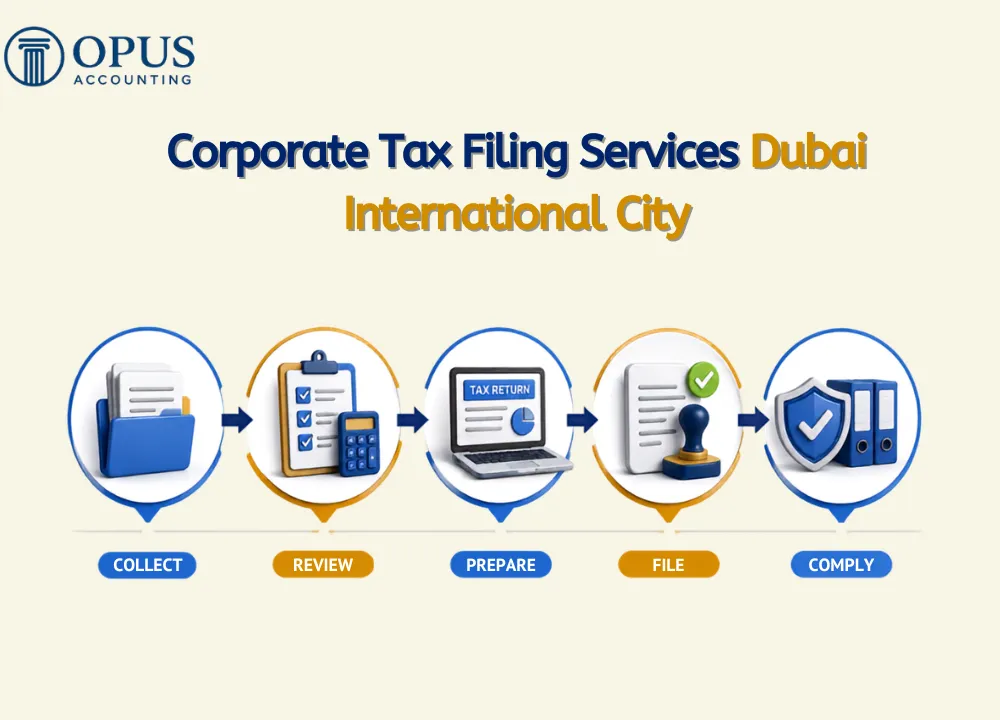
Trading businesses in Dubai International City have CT characteristics specific to the economics of wholesale and retail commerce:
Gross margin taxation: Trading businesses are taxed on their gross margin — revenue less the cost of goods sold — as the primary measure of economic value added. Getting the COGS calculation right is fundamental to correct taxable income determination.
Inventory valuation method: The method used to value closing inventory — FIFO, weighted average, or specific identification — directly affects the cost of goods deduction and therefore taxable income. The inventory method must be applied consistently and disclosed in the financial statements.
Currency effects: Many Dubai International City businesses trade in multiple currencies — paying suppliers in USD or Euros and selling to customers in AED. Foreign exchange gains and losses on trading transactions are generally included in taxable income.
Credit terms and income timing: Businesses that sell on credit must recognise income when the performance obligation is satisfied (goods delivered) — not when payment is received. Managing the timing difference between income recognition and cash collection is important for CT return accuracy.
Our Corporate Tax Filing Services Dubai International City Businesses Rely On
We provide a comprehensive corporate tax filing service for Dubai International City businesses:
- FTA corporate tax registration
- Small Business Relief assessment and election for eligible traders
- Taxable income calculation from trading records
- IFRS-compliant financial statement preparation
- Inventory valuation review and consistency check
- Cost of goods sold analysis
- Foreign exchange gain/loss CT treatment
- Expense deductibility review
- Related party supplier/customer analysis and arm’s length review
- Annual CT return preparation and FTA submission
- CT payment scheduling
- FTA query support
Businesses whose IFRS-compliant financial statements need to be built or tightened up before CT filing can also draw on our Financial Reporting service — the two are designed to work together rather than as separate, disconnected engagements.
Inventory and COGS for Trading Businesses

For wholesale and retail trading businesses in Dubai International City, inventory accounting is the most critical element of CT compliance — because it directly determines the cost of goods deduction and therefore taxable income.
Key inventory accounting considerations:
Consistency of inventory method: UAE CT requires the inventory method to be applied consistently from period to period. A business that has historically used FIFO must continue with FIFO — changing methods for CT purposes is not permitted without good justification.
Year-end stock count: An accurate physical inventory count at the tax period end is essential for correct COGS calculation. Businesses without systematic stock management procedures may find their inventory figures — and therefore their taxable income — are unreliable.
Slow-moving and obsolete inventory: Provisions for slow-moving or obsolete inventory that reduce the carrying value of stock create a tax-deductible expense — but only if the provision is based on a genuine assessment of realisable value. We advise on the FTA-acceptable basis for inventory provisions.
Inventory shrinkage: Unrecorded stock losses — due to theft, damage, or administrative error — that are identified and adjusted at the period end are deductible as a business cost, provided there is adequate documentation of the loss.
Related Party Transactions in Trading Groups
Many Dubai International City traders are part of trading groups — purchasing from related overseas suppliers, selling through related domestic distributors, or sharing facilities with affiliated companies. These related party arrangements require careful CT treatment:
Related party supplier pricing: If an International City trader purchases goods from a related overseas supplier, the purchase price must be consistent with arm’s length market rates. Under-pricing by a related supplier effectively transfers profit overseas, which the FTA will examine.
Related party customer pricing: Sales to related domestic or overseas customers must also be at arm’s length rates. Artificially depressed selling prices to related parties reduce the trader’s taxable income inappropriately.
Shared facility costs: If an International City business shares warehouse space, staff, or other facilities with a related party, the cost sharing arrangement must reflect a genuine arm’s length allocation of the shared costs.
We review all related party arrangements for our International City trading clients and document the arm’s length basis as part of the annual CT filing service.
FAQS | Corporate Tax Filing Services Dubai International City
We are an International City wholesale trader. Our revenues are AED 4 million. Can we still claim any relief?
At AED 4 million, you are above the Small Business Relief threshold. However, you only pay 9% CT on taxable income above AED 375,000 — the first AED 375,000 of taxable income is still at 0%. For a trading business with AED 4 million revenue, the actual tax depends on your net margin and allowable deductions.
We have been valuing our inventory using a manual estimate rather than a formal method. Is this acceptable for CT purposes?
No. CT requires a consistent, documented inventory valuation method that complies with IFRS. We review your inventory valuation approach and advise on the most appropriate IFRS-compliant method for your business.
We buy from a related family business overseas. Is this a transfer pricing issue?
Yes — purchases from related parties (including family businesses) are subject to arm’s length requirements. The purchase price must be consistent with what you would pay an unrelated supplier for the same goods. We assess the arm’s length character of the arrangement and document the analysis.
How do we handle foreign exchange gains on our trading transactions for CT purposes?
Foreign exchange gains that arise on trading transactions — differences between the exchange rate at invoice date and the rate at payment date — are included in taxable income. Foreign exchange losses are deductible. We ensure these are correctly captured in your financial statements and CT return.
Expert Corporate Tax Filing for Your Dubai International City Business
Dubai International City businesses have operated in a tax-free environment for years. Navigating UAE CT correctly — understanding the trading-specific rules, claiming all available deductions, and meeting every compliance obligation — requires expert guidance.
Contact us today for a free consultation, and for legal contract drafting, Omam Consultancy in Dubai can help.