
Dubai Festival City is a distinctive waterfront destination built around a major retail and entertainment mall, luxury hotels, waterfront dining, and a growing commercial community.
The businesses here, mall retail tenants and large hotels in particular, have corporate tax profiles shaped by features a standard filing approach does not address: turnover rent, retail gross margins, advance group bookings, hotel loyalty programmes, and related-party structures. Handling these correctly is exactly what specialist corporate tax filing Dubai Festival City delivers.
For a Festival City Mall retailer, taxable profit depends on how gross margin is calculated and how turnover rent is treated. For a Festival City hotel, it depends on how advance bookings and loyalty-programme liabilities are accounted for, and how related-party transactions are priced.
These are specific, technical questions with a direct bearing on the tax return. Our corporate tax filing Dubai Festival City is built around exactly these realities, and it forms part of our widercorporate tax filing services in Dubai.
Why Dubai Festival City Businesses Need Specialist Corporate Tax Support
The corporate tax position of a Dubai Festival City business is shaped by features that generic tax guidance does not engage with. A mall retailer’s taxable profit rests on accurate gross margin calculation and on the correct treatment of turnover rent, a significant cost with specific deductibility considerations. A hotel’s position is shaped by how it recognises advance group-booking income, how it accounts for the liability created by its loyalty programme, and how it prices transactions with related entities.
Each of these has a direct effect on taxable profit, and mishandling any of them can lead to an incorrect filing and exposure with the Federal Tax Authority. A general corporate tax approach simply does not address turnover-rent deductibility, loyalty-programme liabilities, or hotel deferred income at the level these businesses require. Our corporate tax filing Dubai Festival City brings the specialist knowledge these retail and hospitality businesses need, grounded in reliable data from strong bookkeeping for Dubai Festival City businesses.
Our Corporate Tax Services for Dubai Festival City
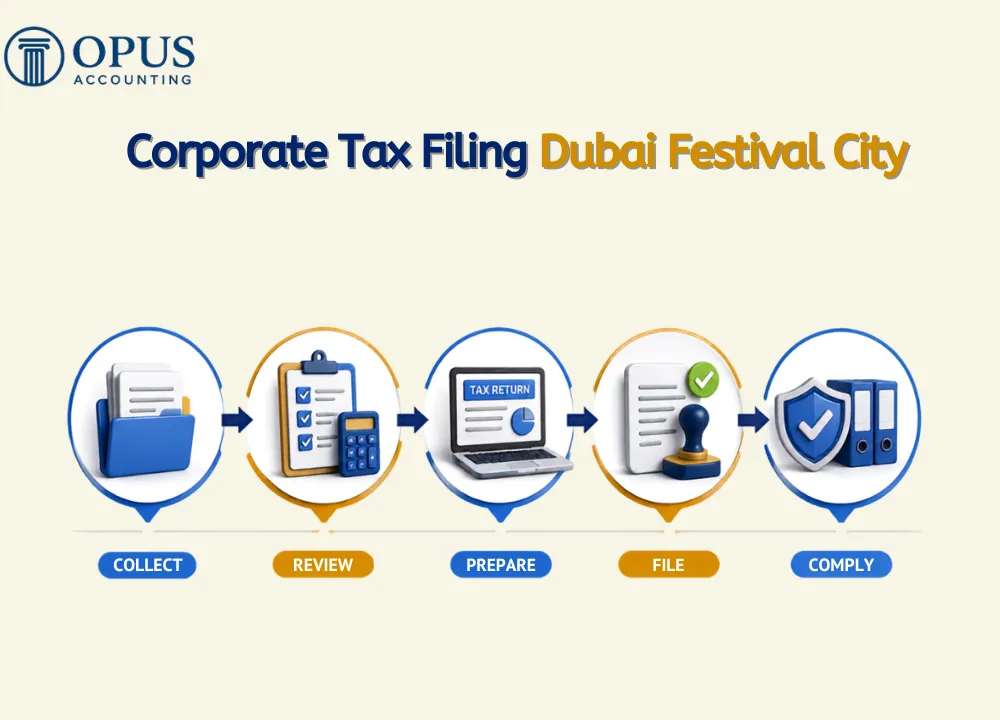
We provide a comprehensive, specialist corporate tax service for Dubai Festival City businesses:
- Retail tenant gross margin calculation
- Turnover rent CT deductibility
- Advance group booking deferred income
- Hotel loyalty programme liability accounting
- Related party transaction analysis
- Taxable income calculation and deductible expense review
- Corporate tax registration and return preparation
- FTA submission and compliance
- CT liability forecasting and provisioning
- Coordination with financial reporting and bookkeeping
Getting these right protects both compliance and accurate taxable profit, and it depends on disciplined cost and margin analysis in Dubai Festival City.
Retail Corporate Tax: Gross Margin and Turnover Rent
For Festival City Mall retail tenants, two features drive the corporate tax calculation:
Retail tenant gross margin calculation: taxable profit for a retailer begins with an accurate gross margin, revenue less the correct cost of goods sold, which depends on proper inventory valuation and cost recording. Our retail tenant gross margin calculation ensures your gross margin is calculated accurately and consistently, so your taxable profit is correctly stated rather than distorted by inventory or cost errors.
Turnover rent CT deductibility: mall leases commonly include turnover rent, rent linked to sales above a threshold, which is a significant cost for a retail tenant. Its treatment for corporate tax, as a deductible business expense, needs to be handled correctly and supported by proper records. Our turnover rent CT deductibility service ensures your turnover rent is correctly treated and deducted in your corporate tax calculation, in line with Federal Tax Authority rules, so you claim the deduction you are entitled to.
Getting both right is fundamental to an accurate corporate tax position for a Festival City Mall retailer.
Hotel Corporate Tax: Deferred Income and Loyalty Liabilities
For the major hotels of Dubai Festival City, corporate tax is shaped by the specific way hospitality income and obligations arise:
Advance group booking deferred income: hotels frequently receive payment for group bookings, events, and conferences well in advance of the stay or event. This income should be recognised when it is earned, when the stay or event takes place, not when the cash is received, and treating it correctly is essential to an accurate taxable profit. Our advance group booking deferred income service ensures advance income is recognised in the correct period, so your taxable profit reflects genuine performance rather than the timing of payments.
Hotel loyalty programme liability accounting: loyalty programmes create a real liability, the obligation to provide future rewards, free nights, or benefits that guests have earned, and accounting for this liability correctly affects both the financial statements and the corporate tax position. Our hotel loyalty programme liability accounting ensures the liability created by your loyalty programme is accounted for correctly, so your taxable profit properly reflects the obligations you have built up.
Handling both correctly is essential for an accurate corporate tax filing for a Festival City hotel.
Related-Party Transactions Across the Group
Many Dubai Festival City businesses, particularly hotels and larger operations, sit within groups with connected entities:
Related party transaction analysis: transactions between related parties, management charges, shared services, intercompany arrangements, must, under UAE corporate tax, be conducted and documented on an arm’s length basis.
Our related party transaction analysis reviews your intercompany transactions, tests them against the arm’s length principle, and prepares the documentation needed to support your filing and withstand FTA scrutiny. This is particularly important for hotels and multi-entity operations, where the group structure has a real effect on the overall tax position.
Getting related-party transactions right is essential for any Festival City business operating within a group.
FAQ’s | Corporate Tax Filing Dubai Festival City
1. We are a retailer in Festival City Mall with turnover rent. Is that deductible for corporate tax?
Turnover rent is a business cost, and its treatment for corporate tax, as a deductible expense, needs to be handled correctly and supported by proper records. Our turnover rent CT deductibility service ensures your turnover rent is correctly treated and deducted in your corporate tax calculation, in line with Federal Tax Authority rules, so you claim the deduction you are legitimately entitled to. We also ensure your retail gross margin is calculated accurately, since that is where your taxable profit begins.
2. Our hotel takes payment for group bookings months in advance. How is that taxed?
Advance group-booking income should be recognised when it is earned, when the stay or event actually takes place, not when the cash is received. Recognising it too early overstates your taxable profit in the wrong period. Our advance group booking deferred income service ensures this income is recognised in the correct period, so your taxable profit reflects genuine performance and your corporate tax position is accurate.
3. We run a hotel loyalty programme. Does that affect our corporate tax?
Yes. A loyalty programme creates a real liability, the obligation to provide the future rewards and benefits guests have earned, and accounting for this liability correctly affects both your financial statements and your taxable profit. Our hotel loyalty programme liability accounting ensures the liability is accounted for correctly, so your taxable profit properly reflects the obligations you have built up rather than overstating your position.
4. We have transactions between our hotel and other companies in our group. Do we need to do anything special?
Yes. Under UAE corporate tax, transactions between related parties, management charges, shared services, and intercompany arrangements, must be conducted and documented on an arm’s length basis. Our related party transaction analysis reviews your intercompany transactions, tests them against the arm’s length principle, and prepares the documentation your filing needs to withstand FTA scrutiny, which is especially important for group hotel operations.
5. How do you make sure our retail taxable profit is calculated correctly?
It begins with an accurate gross margin. Our retail tenant gross margin calculation ensures your revenue less the correct cost of goods sold, based on proper inventory valuation and cost recording, is calculated accurately and consistently. From that correct gross margin, we build your taxable profit, applying the right treatment to turnover rent and other costs, so your corporate tax position is accurate and defensible.
Corporate Tax Filing for Your Dubai Festival City Business
The mall retailers and hotels of Dubai Festival City have corporate tax profiles shaped by turnover rent, retail margins, deferred income, loyalty liabilities, and related-party structures. Our corporate tax filing Dubai Festival City brings the specialist analysis these businesses need, ensuring an accurate filing that reflects your true taxable profit and claims every deduction you are genuinely entitled to.
Explore our full range of corporate tax filing services, browse all Opus Accounting services, then contact us today for a free consultation. For broader guidance, our strategic financial advisory for Dubai Festival City can support you further, and for legal contract drafting, our partners at Omam Consultancy in Dubai provide specialist support.