
Al Quoz Industrial Area 3 is one of Dubai’s most established and operationally diverse industrial zones, home to a concentrated community of manufacturing workshops, fabrication units, automotive service centres, print and packaging businesses, and construction supply companies.
These businesses operate on margins that are directly shaped by how well they understand and control their costs. In this environment,business cost optimization & accounting in Al Quoz Industrial Area 3 is not an abstract exercise; it is the discipline that determines whether a business is genuinely profitable or simply turning over revenue without knowing where the money goes.
Opus Accounting provides specialist cost accounting and management accounting services tailored to the industrial businesses of Al Quoz Industrial Area 3. We help manufacturers, fabricators, and service operators understand their true cost structures, identify where margins are being eroded, and implement the financial controls needed to protect and improve profitability.
Our approach to business cost optimization & accounting in Al Quoz Industrial Area 3 is built on precision, practical relevance, and a deep understanding of how industrial businesses actually operate.
Why Cost Optimization Matters for Al Quoz Industrial Area 3 Businesses
Industrial businesses in Al Quoz Industrial Area 3 face cost pressures that are fundamentally different from those affecting retail or service businesses. Raw materials fluctuate in price. Labour costs are a major component of every job. Overheads, including rent, utilities, equipment depreciation, and maintenance, accumulate quickly. Without structured cost analysis, these pressures compress margins invisibly, and businesses discover profitability problems only when it is too late to correct them.
Business cost optimization and accounting in Al Quoz Industrial Area 3 addresses this by providing the analytical foundation that industrial operators need to make informed decisions about pricing, production methods, staffing, and investment. It is not about cutting costs indiscriminately; it is about understanding where every dirham is spent and whether that spending is generating adequate returns.
The businesses that thrive in Al Quoz Industrial Area 3 over the long term are those that know their cost per unit, their overhead recovery rate, their labour efficiency, and their true margin on every job. That knowledge comes from structured cost accounting, and it is exactly what our service delivers.
Our Cost Optimization and Accounting Services for Al Quoz Industrial Area 3
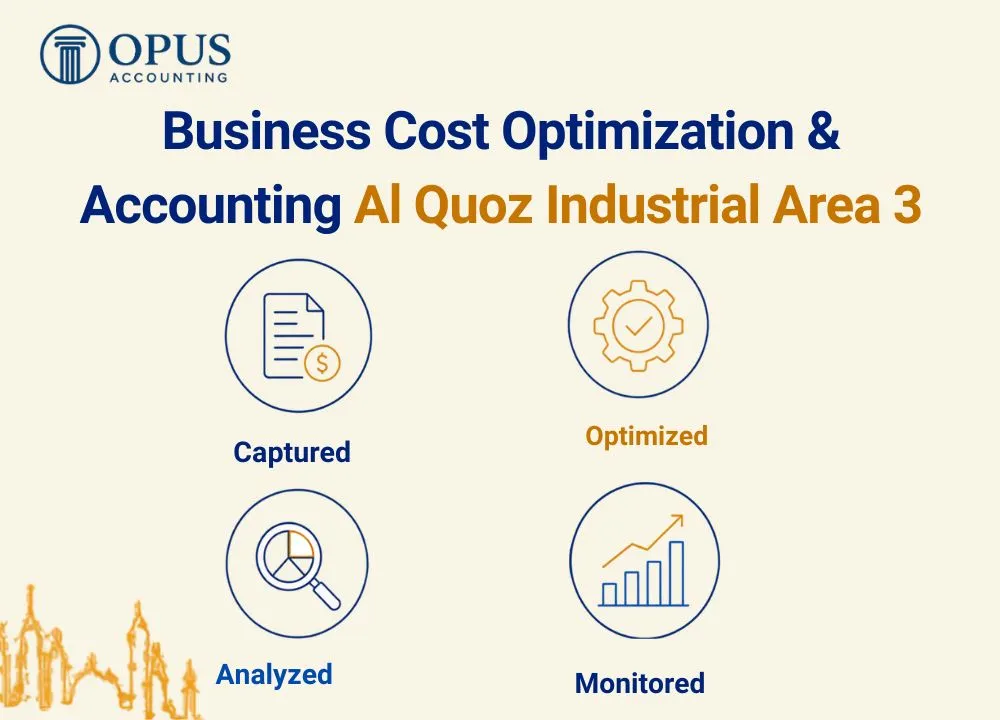
Opus Accounting provides a comprehensive suite of business cost optimization and accounting services for Al Quoz Industrial Area 3 businesses, covering every element of industrial cost management:
- Detailed job costing for manufacturing and fabrication operations
- Overhead cost allocation and absorption rate calculation
- Labour productivity measurement and cost-per-hour analysis
- Monthly management accounts with cost variance reporting
- Make versus buy analysis for production and outsourcing decisions
- Raw material cost tracking and purchase price variance analysis
- Equipment depreciation and asset utilization review
- Product-line and service-line profitability analysis
- Break-even analysis and contribution margin reporting
- Cost reduction strategy development and implementation support
- Bookkeeping integration ensuring cost data flows from accurate financial records
- Corporate tax support, ensuring cost classifications align with CT deductibility rules
Job Costing for Manufacturing and Fabrication Businesses
For manufacturing and fabrication businesses in Al Quoz Industrial Area 3, understanding the true cost of each job is the foundation of profitable operations. Job costing for manufacturing tracks every cost element against each individual production order, project, or customer job.
Direct material costing: Every raw material, component, and consumable used on a job is tracked and costed at actual purchase price. For businesses that hold inventory, the costing method (FIFO, weighted average, or specific identification) directly affects the reported cost of each job. We establish the correct methodology and apply it consistently.
Direct labour costing: The hours each worker spends on a specific job are tracked and costed at the applicable labour rate (including basic salary, allowances, and employer costs). For workshops where the same team works across multiple jobs in a single day, accurate time allocation is essential for meaningful job costing for manufacturing. We help establish practical time-tracking processes that give you reliable data without creating excessive administrative burden.
Overhead allocation per job: Production overheads, including facility rent, utilities, equipment depreciation, and supervision costs, must be allocated to individual jobs to determine the full cost of production. This connects directly to overhead cost allocation and absorption, which we cover in detail below. Without this allocation, your job costs reflect only direct costs, and your pricing decisions are based on incomplete information.
Job profitability reporting: Once all three cost elements are captured, we produce job-level profitability reports showing the revenue earned, total cost incurred, and gross margin achieved on each job. This reveals which jobs, customers, and product types are genuinely profitable and which are eroding your margins, even if they generate revenue. Business cost optimization and accounting in Al Quoz Industrial Area 3 starts with this visibility.
Overhead Cost Allocation and Absorption
Industrial overheads in Al Quoz Industrial Area 3 are substantial. Facility rent, electricity, water, equipment depreciation, insurance, maintenance, and supervisory labour all contribute to the cost of production, but none of them can be traced directly to a single job or product. Overhead cost allocation and absorption is the discipline of distributing these costs fairly across the work your business performs.
Setting overhead absorption rates: We calculate your overhead absorption rate based on your actual overhead costs and an appropriate allocation base, typically direct labour hours, machine hours, or direct material cost, depending on what drives overhead consumption in your specific operation. This rate is then applied to each job or product, ensuring the full cost of production is captured.
Under-absorption and over-absorption analysis: If your actual production volume differs from the budgeted volume used to set the absorption rate, your overheads will be under-absorbed (not enough overhead recovered through jobs) or over-absorbed (more recovered than actually incurred). We track this variance monthly and report it in your management accounts, giving you early warning when overhead recovery is falling short.
Departmental overhead rates: For businesses with multiple production departments (for example, a fabrication shop, a finishing department, and an assembly area), a single plant-wide overhead rate can distort costs. We calculate separate departmental overhead rates where appropriate, giving a more accurate picture of how costs behave in each part of your operation. This level of detail is a core element of effective business cost optimization and accounting in Al Quoz Industrial Area 3.
Periodic rate review: Overhead absorption rates should be reviewed at least annually, or whenever there is a significant change in overhead costs, production volume, or operational structure. We manage this review process to ensure your rates remain accurate and your job costs reflect current reality.
Labour Productivity Measurement
Labour is typically the largest controllable cost for industrial businesses in Al Quoz Industrial Area 3. Understanding how productively that labour is being used is essential for cost optimization. Labour productivity measurement provides the data you need to manage this critical cost element effectively.
Output per labour hour: We measure the productive output generated per labour hour, whether that is units produced, jobs completed, or revenue earned. Tracking this metric over time reveals whether productivity is improving, declining, or static, and helps identify the factors driving the trend.
Direct versus indirect labour ratio: Not all paid labour hours are spent on productive, revenue-generating work. Time spent on setup, cleaning, rework, waiting for materials, or administrative tasks is indirect labour. We measure the ratio of direct to indirect labour, identifying where non-productive time is concentrated and what can be done to reduce it.
Labour cost per unit: For businesses producing standardized products, we calculate the labour cost per unit, which is essential for pricing, quotation accuracy, and benchmarking against industry standards. For custom or project-based work, we calculate labour cost per job. Labour productivity measurement at this level gives you the information needed to set realistic production targets and identify underperformance early.
Overtime analysis: Excessive overtime is a common margin eroder in Al Quoz Industrial Area 3 workshops. We analyse overtime patterns, comparing overtime costs against the additional output generated, to determine whether overtime is genuinely productive or simply compensating for inefficiency during regular hours. This analysis feeds directly into your payroll cost management and your broader cost optimization strategy.
Monthly Management Accounts for Industrial Businesses
Monthly management accounts are the reporting framework that brings all cost data together into a coherent, decision-ready picture. For industrial businesses in Al Quoz Industrial Area 3, standard financial statements alone do not provide the cost visibility needed to manage operations effectively. Monthly management accounts go further, providing the granular, timely, and operationally relevant information that industrial managers need.
Profit and loss by product line or service line: Rather than a single consolidated P&L, we prepare segmented profit and loss reports that show revenue, direct costs, and gross margin for each product line, service type, or business division. This reveals where your business is making money and where it is not.
Cost variance reporting: We compare actual costs against budgeted or standard costs each month, highlighting variances in material costs, labour costs, and overheads. Significant variances are investigated and explained, giving you the information needed to take corrective action before a cost issue becomes a profit problem.
Overhead recovery tracking: Your monthly management accounts include a clear report on overhead absorption, showing how much overhead has been recovered through production activity versus how much has actually been incurred. This is directly linked to the overhead cost allocation and absorption discipline described above.
Cash flow and working capital reporting: Industrial businesses tie up significant cash in inventory, work-in-progress, and receivables. Monthly management accounts include working capital metrics that track inventory levels, debtor days, and creditor days, helping you manage cash flow alongside profitability. For deeper financial planning around working capital and growth, our consultancy team provides additional support.
KPI dashboard: We include a concise set of key performance indicators relevant to your industrial operation, covering labour productivity, overhead recovery, material usage, order backlog, and margin trends. This dashboard gives you a snapshot of operational and financial performance in a format designed for quick review and action.
Make Versus Buy Analysis
One of the most impactful decisions an industrial business can make is whether to produce a component, process, or service in-house or outsource it to an external supplier. Make versus buy analysis provides the financial framework for making this decision objectively, based on data rather than assumption.
Full cost comparison: We calculate the full cost of in-house production, including direct materials, direct labour, allocated overheads, quality control, and any capital investment required. We compare this against the total cost of outsourcing, including purchase price, freight, quality inspection, and any administrative costs. Make versus buy analysis that captures all relevant costs prevents the common mistake of comparing only direct costs (which favours in-house) while ignoring the overhead burden.
Capacity utilization consideration: If your workshop has idle capacity, the incremental cost of producing in-house may be lower than the full allocated cost, because fixed overheads are already being incurred. Conversely, if your production facility is at or near capacity, producing an additional component in-house may require overtime, additional shifts, or capital investment, changing the economics entirely. Our make versus buy analysis accounts for your current and projected capacity position.
Quality and control factors: While the financial comparison is central, we also help you consider the non-financial factors, such as quality control, lead time reliability, intellectual property protection, and supply chain risk, that should inform the decision alongside the numbers.
Ongoing review: Make versus buy decisions are not permanent. As volumes change, supplier pricing shifts, or your production capabilities evolve, the optimal decision may change. We recommend reviewing significant make versus buy positions annually as part of your business cost optimization and accounting in Al Quoz Industrial Area 3 programme.
FAQ’s | Business Cost Optimization & Accounting in Al Quoz Industrial Area 3
1. Our workshop produces custom fabrication jobs. How does job costing work for one-off projects?
Job costing for manufacturing applies to custom work just as effectively as to standardized production. Each fabrication job is set up as a separate cost centre, and all direct materials, direct labour hours, and allocated overheads are tracked against that job from start to completion. When the job is finished, you have a complete picture of actual cost versus the quoted price, showing whether the job was profitable. Over time, this data improves your quoting accuracy and helps you identify which types of custom work are most and least profitable.
2. We think our overheads are too high, but we do not know which costs are the problem. Can you help?
Yes. This is one of the most common reasons businesses seek business cost optimization and accounting in Al Quoz Industrial Area 3. We begin with a detailed overhead cost allocation and absorption analysis, breaking down every overhead cost by category and then measuring how effectively each is being recovered through your production activity. This analysis identifies exactly which overhead categories are disproportionate, whether your absorption rate is set correctly, and where specific cost reduction opportunities exist.
3. How do you measure labour productivity in a workshop where workers do different tasks each day?
Labour productivity measurement for multi-task environments requires a practical time-tracking approach. We help you establish a simple daily time allocation system where each worker records the hours spent on each job or activity category. From this data, we calculate productive hours versus non-productive hours, output per labour hour, and labour cost per job. The system does not need to be complex to be effective; it just needs to capture enough data to identify patterns and drive improvement.
4. What do monthly management accounts include that our normal financial statements do not?
Monthly management accounts are designed for internal decision-making, not just compliance. They include segmented profitability by product or service line, cost variance analysis (actual versus budget), overhead absorption tracking, working capital metrics, and a KPI dashboard tailored to your industrial operation. Standard financial statements show the overall position; monthly management accounts show you why that position is what it is and where to focus your attention.
6. How does cost accounting support our corporate tax filing?
Accurate cost accounting directly supports your corporate tax position. Your cost of goods sold, inventory valuation, depreciation schedules, and overhead classifications all feed into your taxable income calculation. If your cost records are inaccurate or inconsistent, your CT return may overstate or understate taxable income, creating compliance risks. Our business cost optimization and accounting in Al Quoz Industrial Area 3 service ensures your cost data is CT-ready.
7. Can you help us set up job costing if we have never tracked costs at the job level before?
Absolutely. Many Al Quoz Industrial Area 3 businesses come to us without any existing job costing system. We start by understanding your production workflow, identifying the cost elements that apply to each job, and establishing practical tracking processes for materials, labour, and overheads. We then configure your accounting system to capture costs at the job level and produce the reports you need. Job costing for manufacturing does not require expensive software; it requires a well-designed process and consistent execution.
Expert Cost Optimization for Your Al Quoz Industrial Area 3 Business
Industrial businesses in Al Quoz Industrial Area 3 compete on precision, quality, and efficiency. The financial management that supports those operations needs to match that standard. Our business cost optimization and accounting in Al Quoz Industrial Area 3 service provides the detailed cost intelligence that industrial operators need, covering job costing for manufacturing, overhead cost allocation and absorption, labour productivity measurement, monthly management accounts, and make versus buy analysis. Every element is designed to give you clear visibility into your costs, your margins, and the specific actions you can take to improve both.
Contact Opus Accounting today for a free consultation and discover how expert cost accounting can strengthen your Al Quoz Industrial Area 3 business.