
Dubai Industrial City (DIC) stands as a monumental pillar of the UAE’s industrial future. As one of the largest and most strategically vital industrial free zones, it’s a meticulously designed manufacturing hub where diverse industries, from food production and chemical manufacturing to building materials and heavy machinery, operate at a scale demanding highly sophisticated financial reporting services for Dubai Industrial City businesses.
Businesses within DIC are not just manufacturers, they are complex entities with intricate financial structures, often involving substantial inventories, significant export revenues, extensive related party arrangements within international groups, and the stringent Qualified Free Zone Person (QFZP) Corporate Tax (CT) compliance requirements that mak
e IFRS-compliant audited financial statements mandatory for tax-qualifying entities. Navigating this landscape requires more than just basic bookkeeping, it demands expert financial intelligence.
At Opus Accounting, our specialized financial reporting services for Dubai Industrial City businesses provide the large-scale industrial financial reporting capability that every DIC manufacturer needs to thrive, comply, and grow.
The Unique Financial Reporting Challenges of Dubai Industrial City Manufacturers
DIC manufacturers face a distinct set of financial reporting demands that mirror the scale, complexity, and international reach of their industrial operations. Understanding these challenges is the first step toward robust and compliant financial management.
Large-Scale Inventory Reporting and Management
For industrial giants in DIC, inventory is not merely a line item, it’s a dynamic asset with significant financial implications. Managing substantial raw material inventories, complex work-in-progress, and diverse finished goods requires comprehensive IAS 2 inventory reporting. This involves:
- Detailed Valuation Methodologies: Consistent application of cost formulas such as FIFO (First-In, First-Out) or weighted average, tailored to the specific nature of materials and production processes.
- Comprehensive Overhead Absorption: Accurate allocation of fixed and variable overheads to production costs, ensuring that the true cost of goods manufactured is reflected. This impacts gross profit margins and inventory valuation.
- Rigorous Net Realizable Value (NRV) Assessment: Regular evaluation of inventory for impairment, comparing cost to NRV, and making appropriate write-downs to ensure financial statements present a true and fair view.
- Inventory Control and Reconciliation: Implementing robust systems for tracking physical inventory, reconciling with accounting records, and addressing variances efficiently.
The complexity of inventory management alone makes expert DIC manufacturing financial reporting indispensable.
Export Revenue Reporting and Compliance
Many DIC manufacturers are global players, with a significant portion of their output destined for international markets. This necessitates specialized financial reporting to accurately identify and document zero-rated export revenues, which is crucial for VAT zero-rating and CT compliance:
- Granular Revenue Recognition: Clearly separating domestic sales from export sales, often by destination market, product category, and customer type.
- Comprehensive Documentation Schedules: Maintaining meticulous records of customs declarations, shipping documents, bills of lading, and customer acceptance records for every export transaction to substantiate zero-rating claims and satisfy regulatory scrutiny.
- Foreign Currency Translation: Accurately translating export revenues denominated in USD, EUR, or other currencies to AED at the transaction date rate, and subsequently re-measuring outstanding foreign currency receivables at month-end or year-end closing rates, with transparent reporting of exchange differences.
This level of detail is critical for both internal analysis and external compliance for export revenue reporting UAE businesses.
Group Consolidation Reporting for International Entities
A significant number of DIC manufacturers operate as subsidiaries of large international manufacturing groups. This structure introduces an additional layer of complexity: preparing financial statements that not only meet UAE regulatory requirements but also conform to the specific consolidation standards and tight reporting deadlines imposed by the parent company. This often involves:
- IFRS-to-Group GAAP Adjustments: Making necessary adjustments if the parent company reports under different accounting standards, for example US GAAP.
- Intercompany Transaction Eliminations: Identifying and eliminating intercompany balances and transactions to present the group as a single economic entity.
- Standardized Reporting Packages: Preparing comprehensive reporting packages that align with the group’s format and chart of accounts, often under tight monthly or quarterly deadlines.
QFZP CT Compliance and Mandatory IFRS Audited Financial Statements
For DIC companies aspiring to or maintaining Qualified Free Zone Person (QFZP) status for UAE Corporate Tax purposes, IFRS (opens in new tab) compliant financial statements that are audited annually are not optional, they are a mandatory compliance requirement. This means:
- Strict IFRS Adherence: Ensuring all primary statements (Statement of Financial Position, Statement of Profit or Loss and Other Comprehensive Income, Statement of Changes in Equity, Statement of Cash Flows) and comprehensive notes fully comply with International Financial Reporting Standards.
- Audit Readiness: Maintaining impeccable financial records, robust internal controls, and thorough documentation to facilitate a smooth and efficient annual audit.
- Transparency and Accuracy: Presenting financial information that is transparent, accurate, and verifiable, essential for demonstrating compliance with QFZP (opens in new tab) criteria.
Meeting these requirements demands specialized expertise in QFZP CT compliance and IFRS audited financial statements.
Opus Accounting’s Comprehensive Financial Reporting Services for DIC
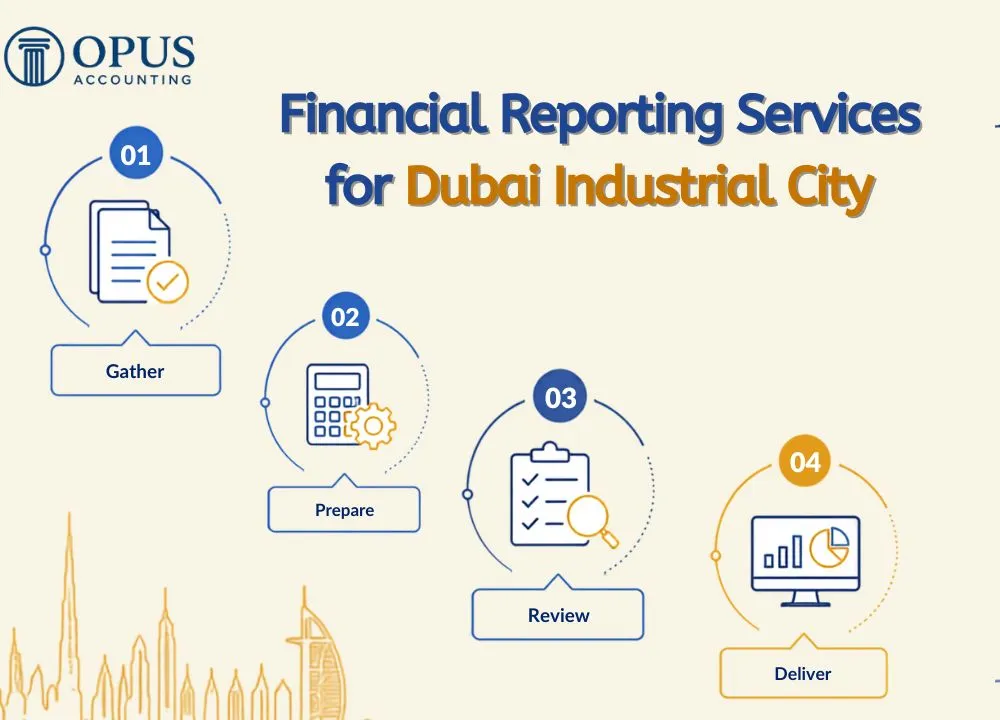
Opus Accounting provides a holistic and expert financial reporting service specifically designed for Dubai Industrial City businesses. Our approach integrates deep industry knowledge with extensive accounting and regulatory expertise to deliver unparalleled support.
Our service offerings include:
- QFZP-Supporting IFRS Financial Statements for UAE CT: We meticulously prepare financial statements fully compliant with IFRS, including all necessary primary statements, comprehensive notes, and the detailed accounting policy documentation required for QFZP status.
- Advanced IAS 2 Inventory Reporting: Covering all categories (raw materials, WIP, finished goods) and cost formulas (FIFO, weighted average), including detailed overhead absorption and NRV assessments.
- Specialized Manufacturing Cost Accounting: Implementing and maintaining standard costing systems, conducting variance analysis (material, labour, overhead), and ensuring accurate overhead absorption.
- Export Revenue and Documentation Schedules: Developing detailed schedules for export revenue by market and product, alongside robust documentation registers for VAT zero-rating and CT purposes.
- Efficient Group Reporting Packages: Preparing and submitting comprehensive reporting packages to international parent companies within their stipulated tight deadlines.
- Related Party Transaction Schedules and IAS 24 Disclosures: Identifying, documenting, and disclosing all related party transactions in compliance with IAS 24.
- Insightful Monthly Management Accounts: Providing operational financial intelligence with key manufacturing KPIs for informed decision-making.
- Strategic Capital Expenditure Planning and Reporting: Assisting in evaluating investment projects, preparing capital budgeting analyses, and ongoing project performance reporting.
- Robust Cash Flow Statements and Working Capital Analysis: Providing critical insights into liquidity, solvency, and operational efficiency through detailed cash flow projections and working capital management strategies.
- IFRS 16 Lease Accounting: Full implementation and ongoing management of IFRS 16 requirements for factory premises, machinery, and equipment leases, including right-of-use asset and lease liability calculations.
- Industry-Specific KPI Development: Collaborating with your team to identify and track bespoke KPIs relevant to your specific manufacturing processes and strategic goals.
Our comprehensive solutions ensure that your financial reporting for Dubai Industrial City is accurate, compliant, and insightful.
Driving Operational Excellence Through Large-Scale Manufacturing Cost Reporting
For large DIC manufacturers, financial reporting extends beyond compliance, it’s a tool for operational intelligence. Management accounts must provide actionable insights at scale to drive efficiency and profitability.
Production Volume and Cost Per Unit Analysis
Our detailed monthly production reports break down units produced by product, identifying direct material cost per unit, direct labour cost per unit, and overhead absorbed per unit. These granular unit economics are fundamental to understanding manufacturing profitability, optimizing pricing strategies, and identifying areas for cost reduction. We help you understand:
- Volume-Cost Relationships: How production volumes impact fixed and variable costs per unit.
- Profitability at Product Level: Identifying which products are most profitable and which may require strategic review.
- Benchmarking: Comparing unit costs against industry benchmarks or internal targets to assess performance.
Standard Cost Maintenance and Variance Analysis
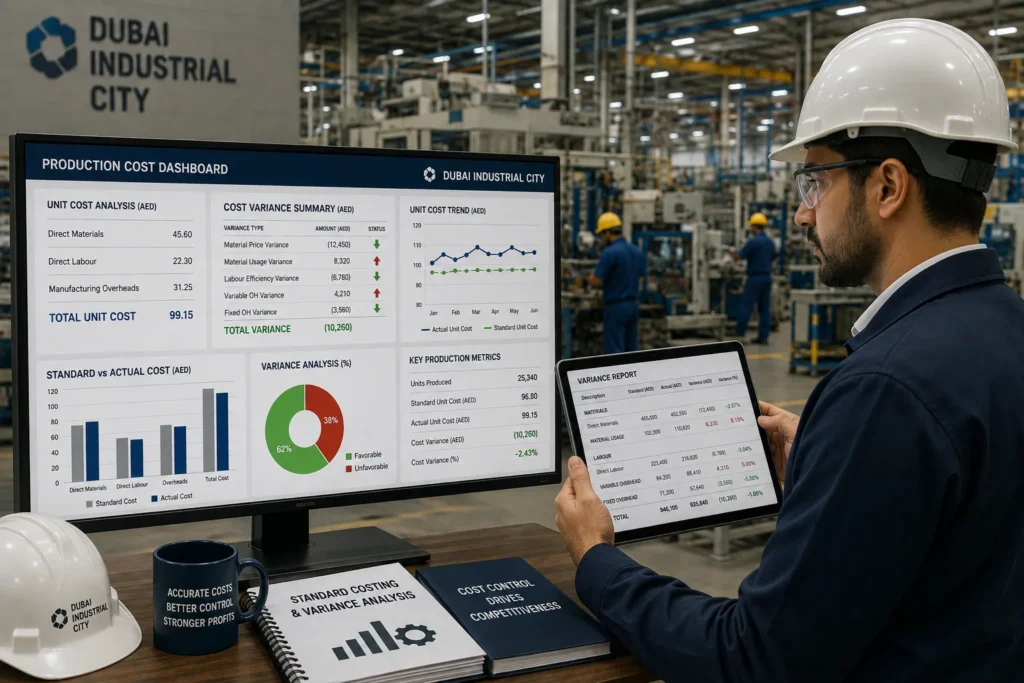
For manufacturers employing standard costing systems, the integrity of these standards is paramount. We provide periodic reviews and updates to ensure standards accurately reflect current material prices, labour rates, and overhead allocation.
Our financial reporting includes a comprehensive standards review report, highlighting significant deviations from actual costs and recommending necessary updates. Furthermore, we provide detailed standard costing and variance analysis:
- Material Price and Usage Variances: Analyzing differences between actual and standard material costs and quantities.
- Labour Rate and Efficiency Variances: Investigating discrepancies in labour rates and productivity.
- Overhead Spending and Efficiency Variances: Unpacking the causes of overhead over or under absorption.
This granular analysis is vital for effective cost control and process improvement within industrial accounting Dubai, drawing on the same managerial and cost accounting discipline that underpins strong manufacturing decision-making.
Waste and Yield Reporting
Manufacturing businesses inevitably generate production waste and experience yield losses, the critical difference between inputs used and outputs achieved. Our monthly waste and yield reporting quantifies these losses by production line or product family, enabling businesses to:
- Identify Improvement Opportunities: Pinpointing specific stages or processes where waste is excessive.
- Track Financial Value of Initiatives: Measuring the monetary impact of yield improvement projects.
- Optimize Resource Utilization: Reducing material scrap and rework to enhance overall efficiency.
Capacity and Utilisation Tracking
For large manufacturers, plant capacity utilisation is a critical profitability driver. Overhead absorption heavily depends on achieving sufficient production volume relative to normal capacity. Our monthly utilisation reporting identifies periods of structural under-utilisation, signaling the need for strategic interventions such as:
- Volume Growth Strategies: Identifying market opportunities to increase sales.
- Capacity Rationalisation: Considering adjustments to plant size or resource allocation.
- Fixed Cost Reduction Initiatives: Exploring ways to lower fixed overheads.
This data empowers DIC manufacturers to make strategic decisions that optimize their operational footprint and ensure the long-term viability of their DIC manufacturing financial reporting.
Specialized Export Financial Reporting for Global DIC Businesses
The global reach of many DIC manufacturers necessitates specialized financial reporting capabilities for their export activities, ensuring both operational insight and regulatory compliance.
Comprehensive Export Revenue Schedule
We develop a monthly export revenue schedule that provides a multidimensional view of your international sales. This schedule typically shows revenue by destination market, by product category, and by customer. Such granularity enables sophisticated analysis of export market performance, identification of emerging trends, and assessment of customer concentration risk within the export portfolio. This is a critical component of robust export revenue reporting and VAT zero-rating compliance.
Robust Export Documentation Register
Maintaining an exhaustive register of export transactions is non-negotiable for compliance. Our service includes establishing and maintaining a comprehensive register for the period, detailing all critical documentation such as customs declarations, shipping documents (bills of lading, air waybills), and customer acceptance records. This provides the complete documentation trail required for VAT zero-rating claims and UAE Corporate Tax purposes, ensuring audit readiness.
Foreign Currency Export Proceeds Management
Export revenues often involve multiple foreign currencies. We ensure that all export revenues in USD, EUR, and other currencies are accurately translated to AED at the transaction date rate. Furthermore, we perform monthly and year-end re-measurement of outstanding foreign currency receivables using closing rates, with all exchange differences separately reported. Our monthly foreign currency analysis provides clear insights into the AED equivalent of export revenues and precisely tracks the impact of exchange rate movements on your profitability.
Export Market Working Capital Analysis
Export receivables, amounts owed by overseas customers, typically have longer collection cycles and higher inherent risks compared to domestic receivables. Our aged export receivables analysis, broken down by market and by customer, is crucial for:
- Identifying Collection Risks: Highlighting potentially problematic accounts or markets.
- Informing Credit Limit Management: Guiding decisions on credit terms and limits for international customers.
- Optimizing Working Capital: Strategies to minimize the cash conversion cycle for export sales.
This detailed analysis is a cornerstone of effective financial management for global DIC businesses, ensuring the integrity of your financial reporting for Dubai Industrial City.
FAQ’S | Financial Reporting Services for Dubai Industrial City
1. How do you separate domestic and export revenue in our financial statements?
We code revenue by market, typically UAE domestic, GCC export, and international export, with product-level detail where needed. This gives clear visibility into gross margins by revenue stream, while our export revenue schedule identifies zero-rated sales and keeps full supporting documentation on file.
2. Our overseas parent company needs management accounts within 8 working days of the month-end. Is that realistic?
Yes, with an efficient month-end process it’s achievable. We set a structured close schedule, production records confirmed by day 2, inventory valued by day 3, payroll processed by day 4, accounts reconciled by day 5, leaving time to finalise comprehensive management accounts.
3. What’s involved in preparing QFZP-compliant financial statements, and how long does it take?
QFZP status requires audited, IFRS-compliant financial statements. We prepare the full statements and disclosures, then our audit team completes the review. For a manufacturer of significant scale, the combined process typically takes around 8 to 12 weeks from year-end.
4. How does IFRS 16 lease accounting affect our reporting on a long-term factory lease?
IFRS 16 requires recognising the lease as both a right-of-use asset and a lease liability on your balance sheet, calculated at the present value of future payments. On the income statement, rent expense is replaced by depreciation and interest expense. We prepare and update the full schedule annually.
5. How are customs duties and import or export costs treated in our accounts?
Costs on imported raw materials are typically capitalised into inventory under IAS 2, affecting cost of goods sold. Export-related fees are generally expensed as selling and distribution costs. Our systems are set up to capture this detail accurately for both domestic and export sales.
6. How does technology help streamline financial reporting for a large DIC manufacturer?
Accounting software and ERP systems automate data entry and reconciliations, cutting manual errors and speeding up month-end close. Cloud access supports real-time collaboration, inventory systems track stock from raw material to finished goods, and digital documentation keeps your export audit trail intact.
7. Do you handle standard costing and variance analysis for manufacturers our size?
Yes, this is a core part of our service. We review material price and usage variances, labour rate and efficiency variances, and overhead spending and efficiency variances, with periodic standards reviews to keep your cost data aligned with actual performance.
Unlock Your Potential with Expert Financial Reporting for Your Dubai Industrial City Business
Dubai Industrial City manufacturers are at the forefront of building the UAE’s industrial future at an unprecedented scale. To navigate the complexities of this environment, from stringent QFZP compliance and intricate IFRS requirements to the detailed management of vast inventories and global export operations, requires a financial reporting partner who truly understands your unique challenges.
Our expert financial reporting services for Dubai Industrial City ensure your manufacturing operations are supported by sophisticated financial intelligence. This empowers you to manage effectively, comply seamlessly with all regulatory requirements, and communicate your performance credibly to stakeholders, investors, and parent companies.
Opus Accounting is your trusted partner in achieving financial clarity and operational excellence in DIC. Contact us today for a free consultation to discuss how our tailored solutions can benefit your business, and for Legal Contract Drafting contact Omam Consultancy in Dubai.