
VAT Penalties UAE: UAE VAT penalties were significantly restructured under Cabinet Decision No. 129 of 2025, effective 14 April 2026. The old compounding system — 2% immediately, then 4% monthly, capping at 300% — is gone, replaced by simpler, generally lower rates across the board.
The change didn’t just adjust a few numbers. It rebuilt the entire logic of how penalties escalate, and it reshaped the calculation for voluntary disclosure specifically, which is now the single most effective lever a business has for controlling its own penalty exposure.
This guide lists every current VAT penalty and explains the one lever that consistently reduces exposure: correcting your own errors before the Federal Tax Authority finds them. For the underlying filing calendar these penalties attach to, see our guide to the Q3 VAT return.
Quick Answer
VAT penalties in the UAE now range from a flat AED 500 for an incorrect return to 14% per annum on unpaid tax and a fixed AED 10,000 for late registration. The single biggest lever to reduce exposure is voluntary disclosure — correcting an error yourself costs 1% per month of the underpaid amount, while waiting for the FTA to find it costs a flat 15% plus that same 1% monthly charge on top.
Why the Penalty Regime Changed
The old structure under Cabinet Decision No. 49 of 2021 was widely criticised for compounding too aggressively — a modest initial delay could snowball toward the 300% ceiling within a relatively short period, disproportionate to the underlying error in many cases.
- Cabinet Decision No. 129 of 2025 replaced this with flatter, more predictable rates that apply consistently across VAT, corporate tax, and excise tax, rather than each tax having its own separate, more complicated schedule.
- The explicit intent behind the redesign was to reward proactive, voluntary compliance more clearly than the old system did, while still maintaining meaningful consequences for genuine non-compliance.
The Full VAT Penalty List (Post-14 April 2026)
| Violation | Penalty |
| Late VAT registration | AED 10,000 flat |
| Late filing — first offence | AED 1,000 |
| Late filing — repeat within 24 months | AED 2,000 |
| Late payment | 14% per annum, non-compounding, calculated monthly on the outstanding balance |
| Incorrect tax return | AED 500 flat |
| Error found by the FTA (audit-discovered) | 15% flat, on the unpaid tax amount |
| Voluntary disclosure — before FTA contact | 1% per month of the underpaid amount, from the original filing deadline |
| Voluntary disclosure — after audit notification | 15% fixed surcharge, plus 1% per month |
These rates apply consistently across VAT, corporate tax, and excise tax under the same Cabinet Decision — one unified, simplified framework replacing what used to be separate, more complicated structures for each tax.
Late Payment: What 14% Per Annum Actually Means
The old system front-loaded pain — a 2% hit on day one, then 4% every 30 days, compounding fast toward a 300% ceiling. The new system is flatter and easier to predict.
- 14% per annum works out to roughly 1.17% per month, charged on a non-compounding basis on the outstanding VAT balance
- Example: AED 50,000 owed, paid 3 months late — roughly AED 50,000 × 14% ÷ 12 × 3 ≈ AED 1,750 under the new rules, compared to AED 7,000 or more under the old compounding structure for the same delay
- This is generally a meaningful reduction for most late-payment scenarios compared to pre-April 2026 rules, though it’s still real money that compounds the longer payment is delayed
There’s No VAT Equivalent to the Corporate Tax Waiver
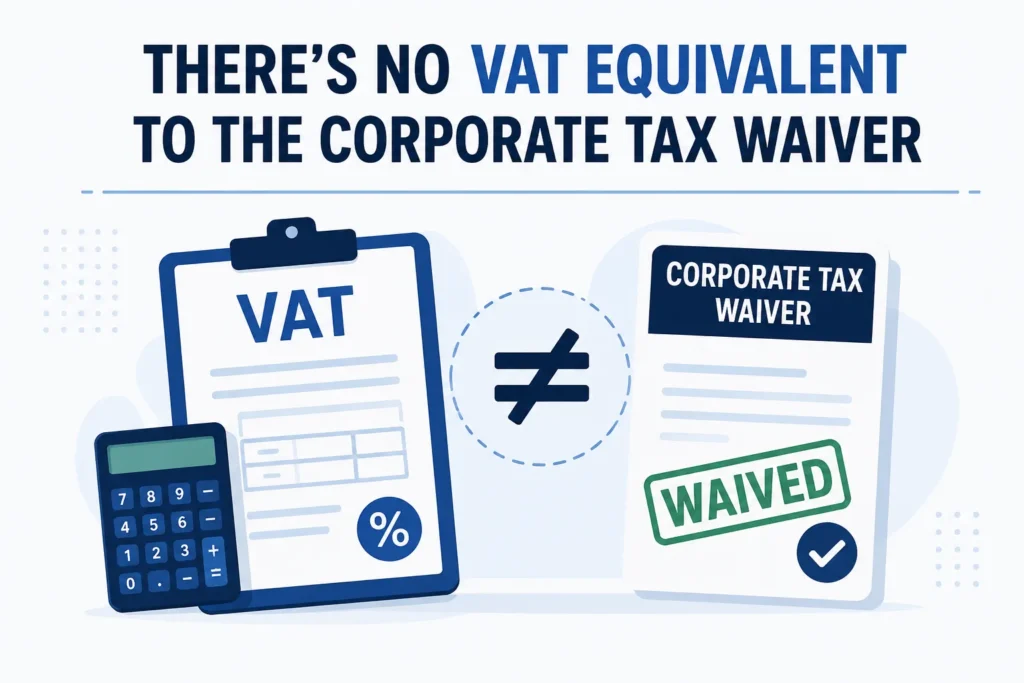
This trips businesses up who assume VAT works the same way as our guide on the corporate tax late registration waiver. It doesn’t.
- The FTA’s automatic penalty-waiver initiative applies only to corporate tax late registration, not VAT
- If you miss a VAT filing or payment deadline, the penalty is payable in full — there’s no equivalent 7-month early-filing relief that cancels it
- Filing and paying on time remains the only reliable protection for VAT specifically, since there’s no automatic recovery mechanism to fall back on
Voluntary Disclosure: The Real Cost Comparison
Voluntary disclosure — filed via Form VAT211 on EmaraTax — is required when you discover an error in a previous return, assessment, or refund claim with a net tax impact above AED 10,000. Below that threshold, it can generally be corrected directly in your next return instead, without a formal disclosure process.
The decision of when to disclose isn’t really a decision at all once you understand the mechanics — every month of delay adds a fixed, predictable cost, with no scenario where waiting produces a better outcome than acting immediately.
| Scenario | Penalty Calculation |
| Self-disclosed before FTA contact | 1% per month of the underpaid amount, from the original filing deadline |
| Disclosed after FTA audit notification | 15% fixed surcharge, plus 1% per month on top |
| Found by the FTA during audit, undisclosed | 15% flat penalty on the unpaid tax |
The gap between the first row and the other two is the entire point of the system — self-correction is deliberately, substantially cheaper than being caught.
Worked Example: Timing Changes Everything
A business discovers a AED 100,000 VAT underpayment from an earlier period. The cost of disclosing it depends entirely on how long it waits:
| Time to Disclosure | Calculation | Penalty |
| 6 months | 1% × 6 × AED 100,000 | AED 6,000 |
| 12 months | 1% × 12 × AED 100,000 | AED 12,000 |
| 36 months | 1% × 36 × AED 100,000 | AED 36,000 |
Unlike the old system, there’s no cap bringing this back down — the 1% monthly charge simply keeps accumulating for as long as the error goes uncorrected. Under the previous tiered system (5% within the first year, rising to 40% for older errors), a very old error could actually cost less than it does under some points of the new linear model — worth checking your specific numbers rather than assuming the new system is always cheaper.
The 20-Business-Day Disclosure Window
- Once you discover an error with a net tax impact above AED 10,000, you’re required to file a voluntary disclosure within 20 business days of that discovery
- This window starts from when the error is actually identified, not from when the original return was filed — but waiting to “discover” something you already suspect doesn’t reset this clock in your favour if the FTA later disagrees on timing
- Voluntary disclosure applies to errors in a return that’s already been filed — it doesn’t apply to a return you simply haven’t filed at all, which needs to be submitted directly as an overdue return instead
How Far Back Can the FTA Go?
Understanding the audit look-back period puts the cost of delay in perspective — an undisclosed error doesn’t simply age out of scrutiny the way some businesses assume.
- Standard limitation period: 5 years from the end of the relevant tax period
- If an audit was notified before the 5 years expired, the FTA gets 4 further years to complete it — extending the effective window considerably beyond the headline 5-year figure
- A voluntary disclosure filed in year 5 extends the window by one further year
- Tax evasion cases: 15 years from the end of the relevant tax period, or 15 years from when registration should have happened if the business never registered at all
- No voluntary disclosure can be filed after the standard 5-year window has closed, which makes early correction not just cheaper but, past a certain point, the only option available at all
An error sitting undisclosed doesn’t become safe simply because time has passed — it stays open to review for years, with the voluntary disclosure penalty growing the entire time it remains uncorrected.
Can Penalties Be Disputed?
Penalties apply automatically once a violation is identified, but the FTA does provide a formal route to challenge them:
- A reconsideration request can be submitted asking the FTA to review a specific penalty decision, typically where there’s a genuine dispute over the facts or the calculation applied.
- The FTA has 40 business days from the reconsideration application to issue a formal decision.
- If that decision is unfavourable, the taxpayer has 20 business days to escalate to the Tax Disputes Resolution Committee.
- This process is for genuine disputes, not a routine alternative to paying — approval isn’t guaranteed, and it doesn’t pause the underlying obligation to file or pay while under review.
A Separate Penalty Track: E-Invoicing
As UAE e-invoicing rolls out, it carries its own, separate penalty framework — worth tracking distinctly from the VAT penalties above, since it’s easy to assume one compliance calendar covers both:
- The e-invoicing pilot begins 1 July 2026 under its own Cabinet Decision and Ministerial Decisions No. 243 and 244 of 2025
- Businesses with revenue of AED 50 million or more must appoint an Accredited Service Provider by 31 July 2026
- Mandatory e-invoicing for this group begins 1 January 2027, with its own penalty schedule — fines of up to AED 5,000 per breach
- This is governed separately from Cabinet Decision No. 129 of 2025 — don’t assume the VAT penalty rates above cover e-invoicing compliance, or that e-invoicing penalties offset VAT penalties in any way
What If You Have Multiple Errors Across Different Periods?
Businesses catching up on a backlog of VAT issues often have more than one error to address, sometimes spanning several tax periods:
- Each period’s error is generally assessed and disclosed separately, rather than combined into a single blended calculation.
- The 1% monthly voluntary disclosure penalty runs independently for each disclosed error, calculated from that specific period’s original filing deadline.
- Addressing the oldest, largest errors first tends to make the most financial sense, since those are the ones accumulating penalty exposure the longest.
- A structured review across all open periods, rather than disclosing errors one at a time as they’re noticed, gives a clearer picture of total exposure and lets you prioritise correctly.
This is exactly the kind of situation where a professional review pays for itself quickly — identifying every open error at once, rather than discovering them piecemeal over successive filing cycles, minimises the total penalty accumulated across the whole backlog.
FAQs | VAT Penalties UAE
Do these new, lower penalty rates apply to VAT debts from before April 2026?
Verify with the FTA which rate applies to any outstanding balance predating 14 April 2026 — some pre-existing debts may still be calculated under the old structure for the period before the change took effect, with the new rate applying only going forward.
Is voluntary disclosure mandatory, or can I just fix the error quietly in my next return?
For errors with a net tax impact above AED 10,000, voluntary disclosure is legally required, not optional. Below that threshold, correcting it in the next return is generally acceptable, provided it doesn’t affect net tax payable in a way that requires disclosure regardless.
What if I can’t pay the VAT I owe right now — does that make the penalty worse than being late on a small amount?
The late payment penalty is proportional to the amount owed and the time it remains unpaid, so a larger balance does generate a larger absolute penalty. Filing on time even if you can’t pay immediately still avoids the separate late-filing penalty, which is worth doing regardless of your payment position.
Does a voluntary disclosure trigger an automatic audit?
Not automatically, though it does create a record the FTA can review. Self-correction is generally viewed far more favourably than an error the FTA discovers independently, and is far less likely to prompt broader scrutiny than being caught.
Are penalties for VAT and corporate tax tracked separately, or combined?
Separately. A business behind on both VAT and corporate tax compliance accumulates two independent sets of penalties — being current on one doesn’t offset or reduce exposure on the other.
Can I be penalised twice for the same error — once for the incorrect return and again through voluntary disclosure?
The voluntary disclosure penalty is generally the mechanism that addresses the error itself; a separate incorrect-return penalty typically applies where the FTA identifies the mistake independently rather than through your own disclosure. Filing the disclosure proactively is what keeps you in the lower-cost track rather than the FTA-discovered one.
What counts as an “error” that requires voluntary disclosure — does a simple typo count?
The trigger is the net tax impact, not the nature of the mistake itself. A typo that changes the tax payable or recoverable figure by more than AED 10,000 requires disclosure regardless of how minor the underlying cause was; a typo with no net tax effect generally doesn’t.
If I’m audited and disclose an error during the audit itself, which rate applies?
Once an audit has been formally notified, disclosures made after that point fall under the higher post-audit-notification rate — the 15% fixed surcharge plus 1% per month — rather than the lower pre-notification rate, even if the disclosure happens before the audit formally concludes.
Key Takeaways
- Cabinet Decision No. 129 of 2025 simplified most VAT penalties from 14 April 2026 — generally lower and more predictable than the old compounding system.
- Late payment now costs 14% per annum, non-compounding, replacing a structure that could reach 300%.
- There’s no VAT equivalent to the corporate tax late-registration waiver — VAT penalties are payable in full if deadlines are missed.
- Voluntary disclosure before FTA contact costs 1% per month; waiting for the FTA to find the error costs 15% flat plus that same 1% monthly on top.
- The disclosure threshold is AED 10,000 in net tax impact, with a 20-business-day window to file once an error is discovered.
- The FTA’s look-back period is 5 years standard, extending to 15 years for tax evasion — an error doesn’t become safe simply by going unnoticed for a while.
- E-invoicing penalties run on a separate track from the VAT penalties covered here.
Get Ahead of VAT Penalties Before They Compound
The pattern across every penalty on this list is the same: acting sooner is cheaper than acting later, and self-correction is consistently cheaper than being caught.
Whether you’re managing routine quarterly compliance, catching up on a specific known error, or reviewing a backlog across multiple periods, the same principle applies — the FTA’s system rewards the business that comes forward first, every time.
Our VAT compliance support, alongside our bookkeeping service, catches errors early and manages voluntary disclosures when needed. Contact Opus Accounting for a VAT compliance review.