
Dubai International Academic City (DIAC) is the largest purpose-built higher-education hub in the world, home to universities, colleges, research institutions, training providers, and education-technology ventures operating as free zone entities. For these organisations, UAE corporate tax raises a genuinely specialised question, one that generic tax guidance does not answer: how does the Qualifying Free Zone Person regime apply to educational and research income? That precise question is what corporate tax filing Academic City QFZP is built to address.
Educational and research entities in DIAC have some of the most technically nuanced corporate tax profiles in the UAE. Their income spans tuition fees, research grants, and commercial activity; their free zone status opens the door to the QFZP 0% rate on qualifying income; and some may qualify for exemption entirely as non-profit educational bodies. Getting this right requires specialist analysis. Our corporate tax filing Academic City QFZP provides exactly that, and it forms part of our wider corporate tax filing services in Dubai.
Why DIAC Education and Research Entities Need Specialist Corporate Tax Support
The corporate tax position of an Academic City entity is rarely straightforward. A university or college may earn tuition income, research grant income, and commercial or consultancy income, each of which may be treated differently. As a free zone entity, it may be eligible for QFZP status and the 0% rate on qualifying income, but only if its income is correctly categorised and the strict conditions are met. And some educational bodies may qualify for outright exemption as non-profit organisations, subject to their own conditions.
These are not questions a general corporate tax approach can handle. Misclassifying qualifying income, mishandling research grants, mistreating advance tuition, or misjudging exemption eligibility can all lead to an incorrect filing and lost tax advantages. Our corporate tax filing Academic City QFZP brings the specialist knowledge these entities need, grounded in reliable data from strong bookkeeping for Academic City entities.
Our Corporate Tax Services for Academic City QFZP Entities
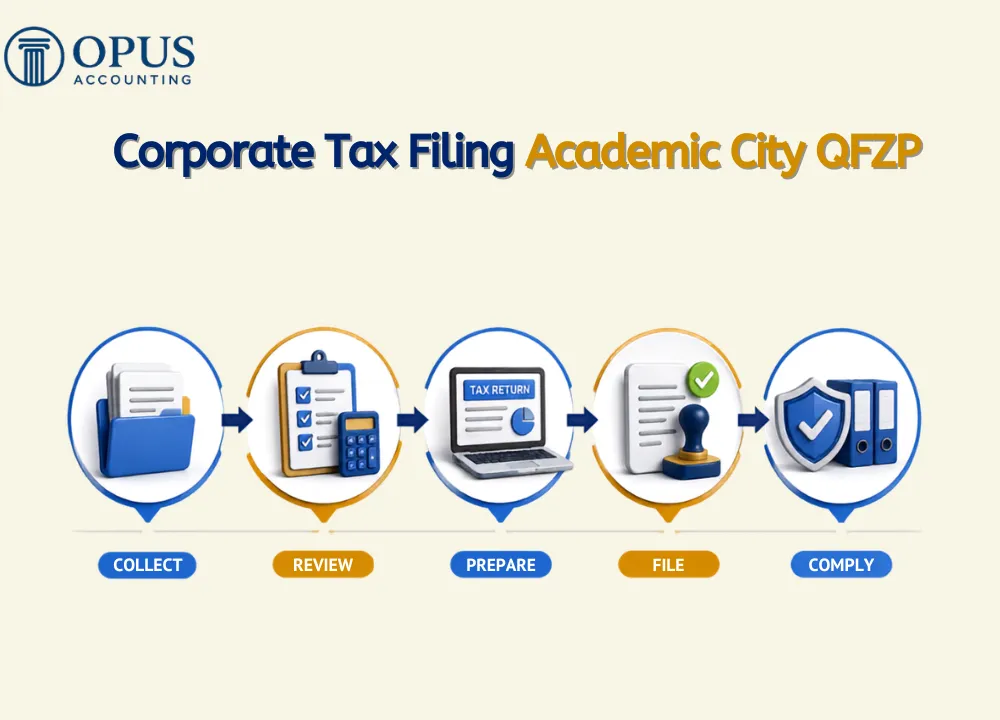
We provide a comprehensive, specialist corporate tax service for DIAC education and research entities:
- QFZP eligibility assessment for DIAC entities
- Educational income qualifying status analysis
- Research grant CT treatment
- Tuition fee deferred income management
- Non-profit educational entity exemption assessment
- Qualifying versus non-qualifying income mapping
- Substance and documentation review for QFZP
- Corporate tax return preparation and FTA submission
- CT liability forecasting and provisioning
- Coordination with financial reporting and bookkeeping
Getting this right protects both compliance and potentially valuable tax advantages, and it depends on accurate financial reporting for Academic City entities.
QFZP Status and Qualifying Educational Income
At the heart of corporate tax for DIAC free zone entities is the Qualifying Free Zone Person regime, and its correct application to educational income:
QFZP eligibility assessment for DIAC entities: a Qualifying Free Zone Person can benefit from a 0% corporate tax rate on qualifying income, provided the strict conditions are met, adequate substance in the free zone, correct income categorisation, and satisfaction of the regulatory requirements. Our QFZP eligibility assessment for DIAC entities evaluates your entity against the current Federal Tax Authority conditions and confirms whether QFZP status is available and how to maintain it.
Educational income qualifying status analysis: not all income earned by a DIAC entity is automatically qualifying income for QFZP purposes. Tuition, commercial training, consultancy, and other revenue streams may be treated differently. Our educational income qualifying status analysis maps your income streams, determining which qualify for the 0% rate and which do not, so your filing correctly reflects your true position and preserves the benefit where it applies.
Getting QFZP status and income categorisation right is the single most valuable element of corporate tax planning for an eligible DIAC entity.
Research Grants and Deferred Tuition Income
Two income types are especially common among Academic City entities, and both carry specific corporate tax treatment:
Research grant CT treatment: research institutions and universities frequently receive grant funding tied to specific projects and deliverables. The corporate tax treatment of grant income, whether and how it is taxable, and how associated costs are treated, requires careful analysis rather than assumption. Our research grant CT treatment establishes the correct position for your grant-funded activity, ensuring it is handled accurately in your filing.
Tuition fee deferred income management: educational entities routinely collect tuition and course fees in advance, often for a term, semester, or full academic year. Under proper accounting and tax treatment, this income should be recognised over the period it is earned, not entirely when the cash is received. Recognising it too early distorts taxable profit. Our tuition fee deferred income management ensures advance tuition is recognised correctly across the delivery period, so your taxable profit and CT position are accurately stated.
Handling both correctly is essential to an accurate corporate tax filing for a DIAC education or research entity.
Non-Profit Educational Entity Exemption
Some educational organisations in Academic City may qualify for corporate tax exemption on a different basis entirely:
Non-profit educational entity exemption assessment: certain qualifying public benefit and non-profit organisations, including some educational entities, may be exempt from corporate tax, subject to meeting the specific conditions and, where required, being listed or approved under the relevant rules.
Our non-profit educational entity exemption assessment evaluates whether your organisation meets these conditions, so that, where exemption genuinely applies, it is claimed correctly, and where it does not, your entity is filed correctly under the standard rules. This ensures you neither miss an exemption you are entitled to nor wrongly assume one you are not.
Getting the exemption question right is fundamental, and it should be assessed properly rather than presumed.
FAQ’s | Corporate Tax Filing Academic City QFZP
1. Our DIAC entity is a free zone company. Do we automatically get the 0% corporate tax rate?
No, the 0% rate applies only to qualifying income of a Qualifying Free Zone Person that meets the strict conditions, including adequate substance and correct income categorisation. Our QFZP eligibility assessment for DIAC entities evaluates your entity against the current Federal Tax Authority conditions and confirms whether QFZP status is available and how to maintain it, so you benefit from the 0% rate only where you genuinely qualify.
2. We earn tuition, training, and some consultancy income. Is it all qualifying income?
Not necessarily. Different income streams, tuition, commercial training, consultancy, and others, may be treated differently for QFZP purposes. Our educational income qualifying status analysis maps each of your income streams and determines which qualify for the 0% rate and which do not, so your filing correctly reflects your true position and preserves the qualifying benefit wherever it legitimately applies.
3. We receive research grants. How are they treated for corporate tax?
Research grant income requires careful analysis, its taxability and the treatment of associated project costs depend on the nature of the grant and the arrangement. Our research grant CT treatment establishes the correct corporate tax position for your grant-funded activity, ensuring both the income and its related costs are handled accurately in your filing rather than treated on assumption.
4. We collect a full year of tuition in advance. Is that all taxable when received?
No, and treating it that way would distort your taxable profit. Advance tuition should be recognised as income across the period it is earned, the term, semester, or academic year, not entirely on receipt. Our tuition fee deferred income management ensures your advance tuition is recognised correctly over the delivery period, so your taxable profit and corporate tax position are accurately stated.
5. We are a non-profit educational body. Are we exempt from corporate tax?
Possibly, but exemption is not automatic, it depends on meeting the specific conditions for qualifying public benefit or non-profit status, and in some cases being formally approved or listed. Our non-profit educational entity exemption assessment evaluates whether your organisation genuinely meets these conditions, so exemption is claimed correctly where it applies and your entity is filed correctly under the standard rules where it does not.
Specialist Corporate Tax Filing for Your Academic City Entity
DIAC education and research entities have some of the most technically demanding corporate tax profiles in the UAE, spanning QFZP status, qualifying income, research grants, deferred tuition, and potential exemption. Our corporate tax filing Academic City QFZP brings the specialist analysis these organisations need, ensuring an accurate filing that preserves every advantage you are genuinely entitled to.
Explore our full range of corporate tax filing services, browse all Opus Accounting services, then contact us today for a free consultation. For broader guidance, our financial consultancy for Academic City entities can support you further, and for legal contract drafting, our partners at Omam Consultancy in Dubai provide specialist support.