
Dubai South is one of the UAE’s most strategically significant economic zones, a vast development built around Al Maktoum International Airport that houses aviation businesses, logistics operators, manufacturing companies, and a growing commercial community. Our corporate tax filing services for Dubai South businesses are built around the Dubai South Free Zone (DSEZ) framework, which creates potential access to the Qualifying Free Zone Person regime and its 0% rate on qualifying income, alongside the standard 9% CT rate on non-qualifying income that does not meet QFZP conditions.
Our corporate tax filing service for Dubai South businesses provides the specialist DSEZ CT expertise needed to navigate this framework, delivering accurate QFZP analysis for free zone entities and comprehensive standard CT compliance for mainland businesses operating in this strategically important corridor.
Corporate Tax for Dubai South Free Zone Companies
Dubai South Free Zone companies face CT considerations that reflect both the QFZP framework and the specific sectors that define the zone:
Aviation and aerospace: Aviation businesses in Dubai South’s Aviation District have qualifying income considerations specific to the aviation sector, including MRO services, aircraft handling, cargo operations, and aviation training. The classification of aviation revenue as qualifying or non-qualifying for QFZP purposes requires sector-specific analysis as part of corporate tax filing services for Dubai South businesses in the aviation cluster.
Logistics and freight: Dubai South Logistics District companies generate revenue from freight forwarding, warehousing, customs handling, and logistics management. The qualifying income classification of logistics revenue depends on the counterparty, whether other free zone persons, overseas clients, or UAE mainland entities. Accurate bookkeeping is essential to support this revenue classification at the transaction level.
Manufacturing: Dubai Industrial City companies in Dubai South are subject to the DIC free zone CT framework, with QFZP considerations specific to manufacturing activities and the relevant permitted activity classifications. Cost control and management accounting play a critical role in determining deductible manufacturing costs for these entities.
Commercial and residential: Community businesses in Dubai South’s residential and commercial zones are generally subject to standard CT, with community business Small Business Relief assessment available for eligible smaller enterprises whose annual revenue falls within the qualifying threshold.
Our Corporate Tax Filing Services for Dubai South
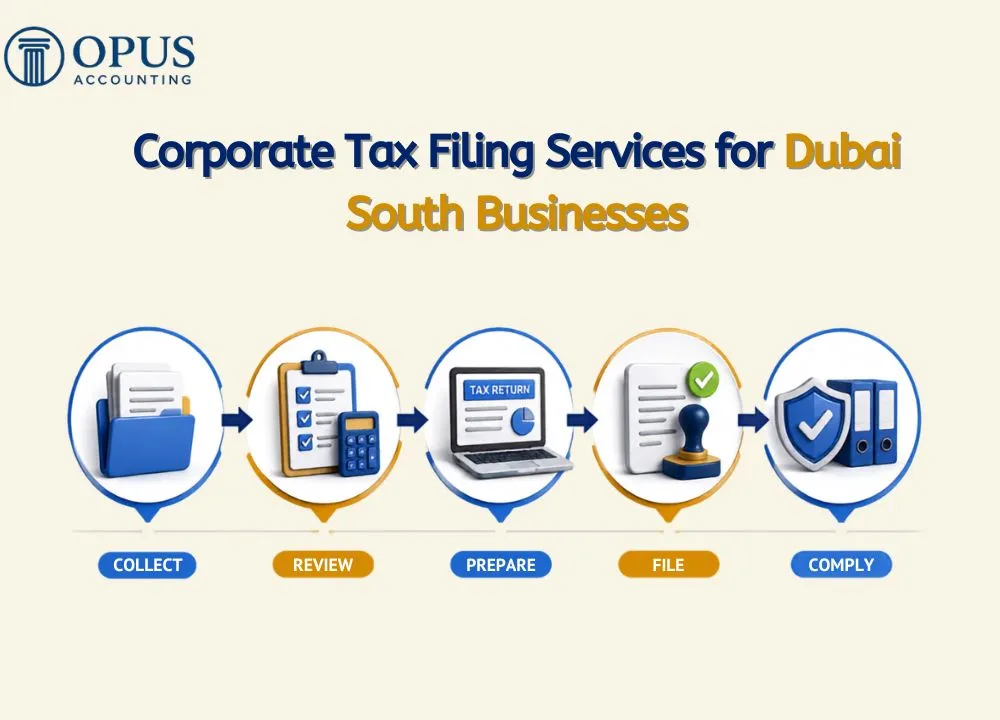
We provide comprehensive corporate tax filing services for Dubai South businesses across all entity types:
- Dubai South Free Zone QFZP eligibility assessment
- Aviation sector qualifying income analysis
- Logistics and freight business income classification
- Manufacturing CT compliance for DIC entities
- Community business Small Business Relief assessment
- Substance documentation for DSEZ QFZP entities
- FTA corporate tax registration for all Dubai South business types
- Annual CT return preparation and FTA submission
- Related party transaction transfer pricing documentation
- Advance CT payment management
- FTA query support and audit defence
Our corporate tax filing for Dubai South businesses covers the full compliance cycle, from initial registration through annual return submission, so every entity in the zone meets its obligations accurately and on time.
Aviation Sector QFZP Analysis
Aviation businesses in Dubai South’s Aviation District face specific QFZP qualifying income considerations that require dedicated corporate tax filing expertise:
MRO revenue classification: Revenue from aircraft maintenance and repair services, which are core aviation activities in Dubai South, may qualify as qualifying income if the services are provided to other free zone persons or if the activities fall within specified qualifying categories under the QFZP framework. Tracking maintenance cost per aircraft helps aviation entities separate qualifying and non-qualifying revenue streams accurately.
Airport services income: Ground handling, cargo handling, and airport support services revenue has qualifying income considerations that depend on the client classification, whether other UAE free zone companies, overseas airlines, or UAE domestic operators.
Aviation training income: Revenue from aviation training and simulator services may qualify as qualifying income under specific QFZP activity categories.
Substance for aviation businesses: Aviation businesses must demonstrate adequate substance, including qualified engineers, certified maintenance equipment, and appropriate hangar and workshop facilities, as evidence of genuine economic activity within the free zone.
Air Operator Certificate and GCAA approval compliance costs: The costs of maintaining Air Operator Certificates,GCAA approvals, and other aviation regulatory compliance are fully deductible as business operating expenses. Air Operator Certificate and GCAA approval compliance costs represent a significant annual outlay for aviation entities, and correct classification of these expenses directly reduces taxable income under the corporate tax filing process for Dubai South aviation businesses.
Logistics Company CT Compliance
Dubai South Logistics District companies have CT compliance characteristics shaped by the economics of freight logistics:
Service revenue and qualifying income: Revenue from freight forwarding, customs clearance, and logistics management services must be classified as qualifying or non-qualifying based on the counterparty. Services to overseas clients and other UAE free zone companies may qualify under the Dubai South Free Zone QFZP eligibility assessment, while services to UAE mainland clients generally do not.
Agent versus principal CT implications: Logistics businesses that act as agents (arranging services on behalf of clients) rather than principals (taking responsibility for the logistics service) report only their service fee as revenue, not the full freight amount. Getting this classification right is important for both revenue reporting and QFZP threshold management.
Warehouse and facility cost deductibility under IFRS 16: Warehousing costs, including storage facility rent, utilities, and equipment depreciation, are deductible operating expenses. Under IFRS 16, finance lease warehouse arrangements create right-of-use asset depreciation and interest deductions. Correctly applying warehouse and facility cost deductibility under IFRS 16 ensures logistics companies in Dubai South claim the full extent of allowable deductions in their corporate tax filings.
Customs duty pass-through: Customs duties paid by logistics companies on behalf of clients and subsequently reimbursed are pass-through items, not revenue. Ensuring these are correctly excluded from reported revenue is important for accurate taxable income calculation.
Related party transaction transfer pricing: Where logistics companies engage with related parties for shared warehousing, fleet management, or inter-company service arrangements, related party transaction transfer pricing documentation must demonstrate arm’s length pricing. Our corporate tax filing services for Dubai South businesses include full transfer pricing analysis and documentation to support these transactions during FTA review.
FAQ’s | Corporate Tax Filing Services for Dubai South Businesses
1. What does the Dubai South Free Zone QFZP eligibility assessment involve for my business?
The Dubai South Free Zone QFZP eligibility assessment involves reviewing your company’s revenue mix to determine whether qualifying income meets the de minimis threshold. We examine the nature of your activities, identify qualifying versus non-qualifying income streams, and verify that your entity meets all substance and record-keeping requirements under the QFZP framework.
2. We are a Dubai South Free Zone aviation MRO business. Our clients include both UAE mainland airlines and overseas carriers. How does this affect our QFZP status?
Revenue from UAE mainland airline clients is generally non-qualifying income, while revenue from overseas airline clients may qualify. We assess your specific revenue mix against the de minimis threshold and advise on whether QFZP status is maintainable given your client profile. This analysis is a core component of our corporate tax filing services for Dubai South aviation businesses.
3. Our Dubai South logistics company acts as freight forwarding agent for both UAE mainland importers and overseas shippers. How is our revenue classified?
For agents, revenue is the service fee, not the gross freight amount. Service fees from UAE mainland clients are generally non-qualifying, while service fees from overseas clients may qualify. We assess both the gross versus net revenue question and the qualifying income classification for each client type as part of your annual corporate tax filing for Dubai South.
4. We are a Dubai Industrial City manufacturer in Dubai South. What CT considerations apply to us?
DIC manufacturers are subject to the DIC free zone CT framework with QFZP considerations specific to manufacturing activities. We assess QFZP eligibility based on your manufacturing income mix, the DIC-specific qualifying activity classifications, and your financial reporting records.
5. How does warehouse and facility cost deductibility under IFRS 16 affect my Dubai South logistics company’s CT return?
Under IFRS 16, finance lease warehouse arrangements create right-of-use assets on your balance sheet. The resulting depreciation and interest deductions reduce your taxable income. Warehouse and facility cost deductibility under IFRS 16 requires accurate lease classification and calculation, which we handle as part of the corporate tax filing process.