
Golf City is a lifestyle community in Dubailand built around the Els Club golf course, a growing destination where golf academies, food and beverage businesses, pro shops, and wellness enterprises generate revenues from a sport-loving, quality-conscious community.
The UAE Corporate Tax considerations for Golf City businesses reflect the specific economics of golf and lifestyle services, including seasonal revenue patterns, membership economics, coaching fees, and the capital investment in sports facilities and equipment that creates significant depreciation deductions. This is exactly why specialist corporate tax filing services for Golf City businesses matter.
Our corporate tax filing service for Golf City businesses provides the specialist CT guidance that golf and lifestyle enterprises need, ensuring accurate compliance, effective seasonal planning, and the confidence of knowing every tax obligation is managed professionally.
Corporate Tax for Golf City Businesses
Golf City businesses face UAE CT considerations shaped by the seasonal character of golf in Dubai:
Seasonal revenue and CT timing: golf revenues are significantly higher during the October to April playing season than during the summer. Understanding how this seasonal pattern affects CT payment timing, and planning cash flow around the obligation to make advance CT payments when required, is an important financial management discipline for Golf City businesses.
Membership income recognition: annual membership fees collected at the start of the season create deferred income that is recognised over the membership period. For a business that sells most of its memberships in October, the October collection is not fully taxable in October; it is recognised monthly across the membership year.
Coaching and lesson income: coaching fees for individual sessions are recognised when the session is delivered. Coaching packages, prepaid blocks of lessons, create deferred income recognised as lessons are given.
Tournament and event income: revenue from golf tournaments and events is recognised when the event is held, concentrated in the busy season months.
Our Corporate Tax Filing Services for Golf City
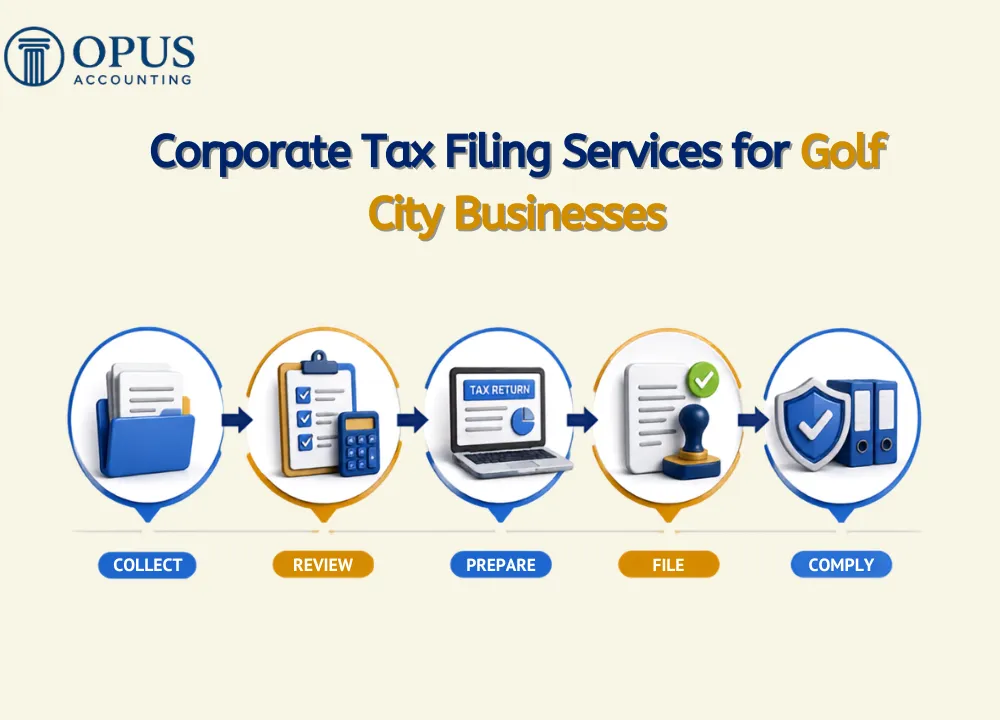
We provide a comprehensive corporate tax filing service for Golf City businesses:
FTA corporate tax registration. Small Business Relief assessment for eligible Golf City businesses. Seasonal CT planning with payment timing aligned to revenue patterns. Golf membership deferred income management. Coaching package revenue recognition analysis. Tournament and event income timing. Golf course and equipment capital allowance review. International coaching staff cost deductibility. F&B expense deductibility for golf club F&B operations. Annual CT return preparation and FTA submission. Multi-year CT planning for Golf City businesses.
Because accurate accounts underpin every CT return, our financial reporting services support the deferred income and depreciation treatment that Golf City filings depend on. Businesses that want the underlying numbers kept in order year-round can also review our Golf City bookkeeping services and financial reporting for Golf City businesses for locally tailored support.
Seasonal CT Planning for Golf City Businesses
The seasonal concentration of Golf City revenues creates specific CT planning requirements, so seasonal CT planning sits at the heart of how we manage these filings:
CT payment cash flow planning: for Golf City businesses above the Small Business Relief threshold, CT payments must be made after the tax period end. For businesses with concentrated October to April revenues, the available cash in September (when CT returns are due for December year-end businesses) depends on how well the summer has been managed. Reserving funds during the busy season for the upcoming CT payment is important financial management.
Advance CT payment obligations: for businesses whose annual CT liability exceeds applicable thresholds, advance CT payments may be required during the tax period. We assess whether Golf City businesses are subject to advance payment requirements and manage the payment schedule accordingly.
Summer cost management and CT: cost reductions during the summer, reduced staffing, maintenance rather than operations, create lower deductible costs in the summer months. The summer season’s net financial position, revenue minus reduced costs, forms part of the full-year taxable income.
Year-end timing considerations: for Golf City businesses with significant advance bookings at the tax year end, members paying for the next season in advance, or corporate golf days already booked and paid, the deferred income treatment of these advance payments affects the year-end taxable income position.
Golf Business Capital Allowances
Golf and sports businesses in Golf City invest significantly in course infrastructure, equipment, and facilities, creating important capital allowance deductions. A thorough golf course and equipment capital allowance review makes sure none of these deductions are missed:
Golf course infrastructure: the development or improvement of golf course infrastructure, including irrigation systems, course surfacing, and buggy paths, is a capital expenditure depreciated over the infrastructure’s useful life. Annual depreciation deductions reduce taxable income over the asset’s life.
Golf carts and vehicles: golf carts and maintenance vehicles are capital assets with typical useful lives of 5 to 7 years. Annual depreciation is a deductible expense.
Pro shop fit-out and equipment: pro shop retail fixtures, point-of-sale systems, and sports technology equipment are capital assets depreciated over their useful lives, typically 3 to 7 years depending on the asset type.
Simulator and technology assets: golf swing simulators, video analysis equipment, and shot-tracking technology are high-value assets depreciated over their typically shorter technology useful lives of 3 to 5 years.
FAQ’s | Corporate Tax Filing Services for Golf City Businesses
1. Our Golf City academy has revenues of AED 2.3 million, mostly earned between October and April. Are we eligible for Small Business Relief?
Yes. At AED 2.3 million annual revenue, you qualify for Small Business Relief regardless of seasonal concentration. We assess eligibility, register with the FTA, and elect SBR in the annual return.
Yes. At AED 2.3 million annual revenue, you qualify for Small Business Relief regardless of seasonal concentration. We assess eligibility, register with the FTA, and elect SBR in the annual return.
2. We receive most of our annual membership fees in October, and our tax year ends in September. Are these fees taxable in October or over the membership year?
Membership fees received in October for an October to September membership year are taxable over the membership year, not just in October. This is where golf membership deferred income management matters. By the September year-end, the full year’s membership fees will have been recognised, so all membership income earned in the tax year is included in the return.
3. Our golf academy pays four international coaches with housing, schooling, and annual flight packages. Are all these costs deductible?
Yes. Under international coaching staff cost deductibility, all components of the packages are deductible employment costs. Housing allowances, schooling allowances, and annual flight provisions paid to employees are recognised as staff costs and fully deductible against taxable income.
4. We purchased new golf simulators this year for AED 450,000. Can we deduct the full cost in this year’s CT return?
No. Capital equipment is deducted through depreciation over its useful life, not in full in the year of purchase, which our golf course and equipment capital allowance review sets out clearly. For technology equipment like golf simulators, a 3 to 5 year useful life is typical, so the annual depreciation charge of AED 90,000 to 150,000 is the deductible amount each year.
5.How does seasonal CT planning help a Golf City business manage its tax payment?
Seasonal CT planning aligns your payment timing with your revenue pattern. Because most income arrives between October and April, we help you reserve funds during the busy season for the CT payment that falls due later, and we assess whether advance CT payment obligations apply so there are no cash flow surprises.
6. When does a Golf City business need to register for corporate tax with the FTA?
Any Golf City business carrying on a taxable activity must register for UAE corporate tax with the FTA, regardless of whether it expects to elect Small Business Relief. We handle FTA corporate tax registration for you and confirm the registration deadlines that apply to your specific tax period.
Expert Corporate Tax Filing for Your Golf City Business
Golf City businesses are built on a passion for sport and a commitment to excellence. Our expert corporate tax filing service brings that same commitment to excellence to your tax compliance.
Explore our full corporate tax filing services or browse all Opus Accounting services, then contact us today for a free consultation.