
Input vs Output VAT: Every VAT-registered business deals with two sides of the same tax: VAT you charge customers, and VAT you pay suppliers. Get comfortable with the difference, and the rest of VAT compliance becomes far less confusing.
Most of the confusion around VAT compliance traces back to this one distinction not being fully clear from the start. Once input and output VAT click, concepts like refund positions, reverse charge, and mixed-supply recovery all become much easier to follow, because they’re really just variations on the same basic subtraction.
This guide breaks both down in plain terms, with worked examples. For the registration rules that determine whether this applies to your business at all, see our guide to VAT registration in the UAE.
Quick Answer
Output VAT is the 5% VAT you charge customers on your sales. Input VAT is the 5% VAT you pay suppliers on your business purchases. Each VAT return calculates the difference between the two — if output exceeds input, you pay the FTA the difference; if input exceeds output, the FTA owes you a refund.
The Simplest Way to Think About It
Picture VAT as passing through your business rather than belonging to it, on both sides of every transaction:
- When you sell something, you collect VAT from your customer on the government’s behalf — that’s output VAT.
- When you buy something for the business, you pay VAT to your supplier, who is collecting it on the government’s behalf too — that’s input VAT, and as a registered business, you can generally get it back.
- At the end of each period, you settle up: hand over what you collected, minus what you already paid. That net figure is the only VAT amount that’s actually yours to deal with.
Businesses that struggle with VAT often think of it as a cost or a fee on their own sales. It’s neither — it’s a collection mechanism you administer on the FTA’s behalf, and the net calculation is what determines your actual involvement.
Output VAT: What You Charge
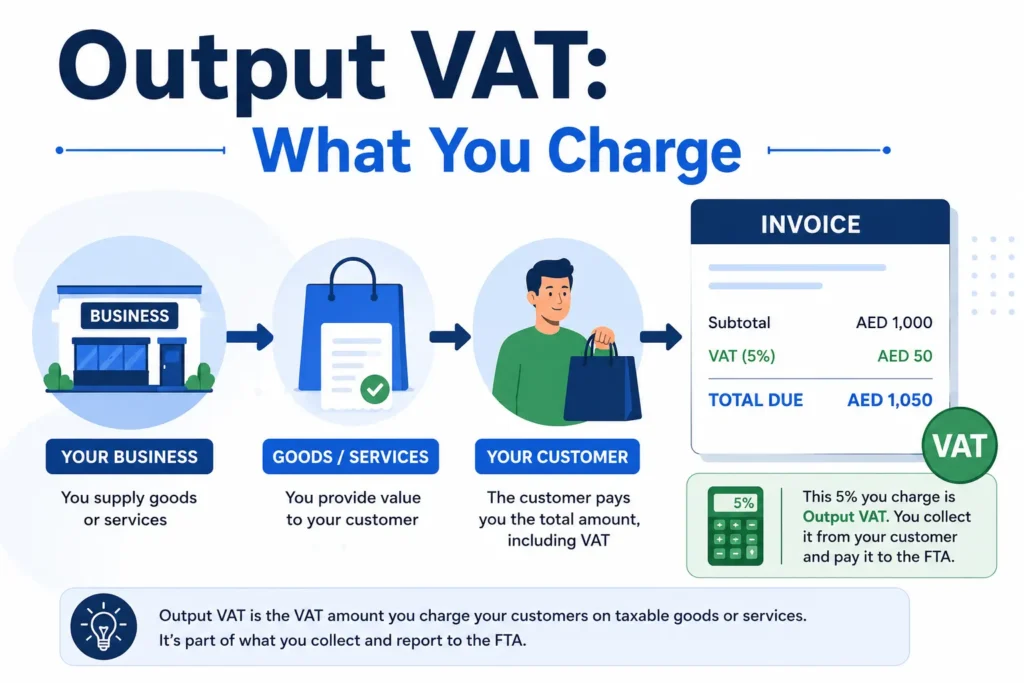
Output VAT is the tax you, as a VAT-registered business, add to your sales price and collect from your customer on the FTA’s behalf.
- You charge 5% on top of the price for most standard-rated goods and services
- The customer pays the VAT to you, and you’re responsible for passing it on to the FTA through your VAT return
- You don’t get to keep this money — it flows through your business rather than adding to your revenue
- Output VAT is also due on zero-rated supplies, but at a 0% rate — the sale still needs reporting even though no actual VAT is charged
- Some supplies are exempt entirely — no output VAT applies, and these sit outside the VAT system rather than simply being taxed at 0%
Example: You sell a service for AED 1,000. You charge the customer AED 1,050 total — AED 1,000 for the service, plus AED 50 output VAT. That AED 50 belongs to the FTA, not to you.
A common mistake is treating the AED 1,050 as the business’s revenue for planning purposes. The genuine revenue is still AED 1,000 — the extra AED 50 was never the business’s money to begin with, just money temporarily held on its way to the FTA.
Input VAT: What You Pay
Input VAT is the tax you pay when you buy goods or services for your business — and if you’re VAT-registered, you can generally claim it back.
- You pay 5% VAT to your suppliers on eligible business purchases and expenses
- As a registered business, you can recover this VAT, reducing what you owe the FTA — or increasing your refund if input exceeds output
- Recovery requires a valid tax invoice showing the supplier’s TRN and the VAT breakdown — a simple receipt generally isn’t enough
- The purchase needs a genuine business purpose — personal expenses, even if paid through the business, aren’t eligible for input VAT recovery
- Recovery generally needs to be claimed in the correct tax period — the period the invoice relates to, or a subsequent period within the applicable time limit, not an arbitrary later date
Example: You buy office equipment for AED 2,000 plus AED 100 VAT, total AED 2,100. If the purchase is for genuine business use and you hold a valid tax invoice, that AED 100 is recoverable input VAT.
The practical effect: your real cost for that equipment is AED 2,000, not AED 2,100 — the VAT you paid comes back to you through the recovery mechanism, provided the paperwork supports it.
Putting Them Together: The Net VAT Calculation
Every VAT return boils down to one simple subtraction:
| Output VAT (collected from customers) | Input VAT (paid to suppliers) | Net Result |
| AED 10,000 | AED 4,000 | AED 6,000 payable to FTA |
| AED 3,000 | AED 7,000 | AED 4,000 refundable from FTA |
| AED 5,000 | AED 5,000 | AED 0 — nothing owed either way |
This is the entire mechanism behind every VAT return — collect on sales, recover on purchases, and settle the net difference with the FTA each period.
The Three VAT Categories That Affect Both Sides
Not every transaction is taxed the same way, and the category matters for both output and input VAT:
| Category | Output VAT Effect | Input VAT Effect |
| Standard-rated (5%) | 5% charged on sale | 5% generally recoverable on related costs |
| Zero-rated (0%) | 0% charged, but still reported | Input VAT on related costs generally still recoverable |
| Exempt | No VAT charged, outside the system | Input VAT on related costs generally not recoverable |
The zero-rated versus exempt distinction trips people up constantly, since both result in 0% VAT on the sale itself. The real difference shows up on the input side — a zero-rated business usually still recovers input VAT normally, while an exempt business generally can’t.
Why Some Businesses Are Regularly in a Refund Position
Being owed money by the FTA rather than owing them isn’t unusual — it’s a predictable outcome for certain business types:
- Exporters — since exports are typically zero-rated, output VAT is often minimal while input VAT on domestic costs continues as normal
- Businesses making large capital investments — a big equipment purchase in one quarter can push input VAT well above output VAT for that period
- Start-ups in a pre-revenue or early-revenue phase — spending on setup costs while sales are still ramping up
- Businesses with genuinely low margins and high input costs relative to sales
None of these situations are problems on their own — a refund position is simply the mathematical result of the underlying business activity, not a red flag by itself.
Not All Input VAT Is Recoverable
This is where businesses most often overclaim, sometimes without realising it — the assumption that VAT paid on any business expense is automatically recoverable is one of the most common misunderstandings in day-to-day VAT compliance. Our bookkeeping service is built specifically to catch these before they reach a return:
- Entertainment expenses are generally not recoverable, even when genuinely business-related
- Certain motor vehicle costs, particularly those with any personal use element, have specific restrictions
- Expenses without a valid, compliant tax invoice can’t be claimed, regardless of how clearly business-related they are
- Businesses making both taxable and exempt supplies must apply a partial recovery calculation — not all input VAT on shared overhead costs is automatically recoverable in full
- VAT on goods or services used for a genuinely personal purpose, even if paid through a business account, isn’t recoverable
Mixed Supplies: When Recovery Isn’t All-or-Nothing
Businesses making both taxable supplies (VAT-able) and exempt supplies (like certain financial services) face a more complex recovery calculation than a business dealing purely in one category or the other.
- Input VAT directly tied to taxable supplies is generally fully recoverable
- Input VAT directly tied to exempt supplies is generally not recoverable at all
- Input VAT on shared overhead — costs that support both types of activity, like general office rent — needs to be apportioned using a specific method, rather than claimed or excluded in full
- Getting this apportionment wrong is a common source of FTA correction, particularly in sectors like real estate, education, and healthcare where mixed supplies are routine
A simplified illustration: if 70% of a business’s activity is taxable and 30% is exempt, roughly 70% of its shared overhead input VAT might be recoverable — though the actual apportionment method used can be more specific than a flat revenue-based split, depending on the business.
Reverse Charge: A Special Case for Both Sides at Once
Reverse charge transactions are unusual because the same business handles both the output and input side of the same transaction. See our full guide on Q3 VAT filing mistakes for how this commonly goes wrong:
- When you import a service from an overseas supplier not registered for UAE VAT, you self-account for the VAT as if you were both the seller and buyer
- You declare output VAT on the transaction, and — if the purchase is for a genuine business purpose — recover the same amount as input VAT in the same return
- Done correctly, this is often cash-neutral, since the output and input amounts offset each other exactly
- The risk isn’t the calculation itself — it’s forgetting to include the transaction at all, which understates your return even though the correct treatment would have cost nothing
A Worked Example, Start to Finish
A trading business for one quarter:
| Transaction Type | Amount |
| Domestic sales (5% VAT) | AED 8,000 output VAT |
| Export sales (0% VAT) | AED 0 output VAT (zero-rated) |
| Domestic purchases with valid tax invoices | AED 3,500 input VAT |
| Reverse charge on imported services | AED 500 output VAT, AED 500 input VAT (net nil) |
| Entertainment expenses (non-recoverable) | AED 200 input VAT (not claimed) |
Total output VAT: AED 8,500. Total recoverable input VAT: AED 4,000 (the AED 200 entertainment VAT is excluded). Net VAT payable to the FTA: AED 4,500.
FAQs | Input vs Output VAT
Do I need to pay VAT to the FTA on my total sales, or just the net amount?
Just the net amount — output VAT minus recoverable input VAT. You’re never paying the FTA your full output VAT collected without first deducting what you’ve already paid on business purchases.
What if I don’t have a tax invoice for a purchase — can I estimate the input VAT instead?
No. A valid tax invoice is required to support any input VAT claim. Without one, the VAT on that purchase generally can’t be recovered, regardless of how confident you are in the amount.
Is a VAT refund automatic once input exceeds output for a period?
You can request the refund, or choose to carry the credit forward against future VAT liabilities instead. Refunds are subject to FTA review and aren’t paid out instantly — processing takes time, and the claim needs to be properly supported.
Can I recover input VAT on an expense before I’m actually registered for VAT?
Generally, input VAT recovery applies from your effective date of registration onward. Some pre-registration costs may be recoverable under specific conditions, but this needs checking against the specific rules rather than assumed automatically.
How long do I have to claim a refund if I don’t request it straight away?
Excess input VAT can generally be claimed as a refund within 5 years from the end of the relevant tax period, after which unclaimed balances expire and become non-refundable — worth actioning promptly rather than letting credits sit indefinitely.
If a supplier’s invoice is missing the VAT breakdown, can I still recover the VAT?
Generally no — a compliant tax invoice with a clear VAT amount and the supplier’s TRN is required to support the claim. If the invoice is incomplete, request a corrected version from the supplier before including it in your VAT return.
Does the input/output calculation work differently for a business making only zero-rated sales?
Not fundamentally — output VAT on zero-rated sales is simply 0%, while input VAT on related purchases is generally still recoverable in full. This is exactly why exporters often sit in a consistent refund position: substantial recoverable input VAT with minimal output VAT to offset it.
If I made an error in a prior period’s input VAT claim, does it affect this period’s calculation too?
An error in a prior period generally needs correcting for that specific period, either directly in the next return for small amounts or through a formal voluntary disclosure for larger ones — it doesn’t automatically fold into or distort the current period’s otherwise-correct calculation.
Key Takeaways
- Output VAT is what you charge and collect from customers; input VAT is what you pay and can generally recover from suppliers.
- Every VAT return nets the two off against each other — you pay or get refunded the difference, not the full output amount.
- Zero-rated and exempt supplies both mean 0% output VAT, but differ significantly on the input recovery side — exempt supplies generally block recovery, zero-rated ones generally don’t.
- A refund position is a normal outcome for exporters, capital-heavy businesses, and start-ups — not a red flag by itself.
- Not all input VAT is recoverable — entertainment, certain vehicle costs, and expenses without a valid tax invoice are common exclusions.
- Mixed taxable and exempt supplies require a proportional recovery calculation, not a simple full claim or full exclusion.
- Reverse charge transactions involve both output and input VAT on the same transaction, often cash-neutral if handled correctly.
Get Your Input and Output VAT Calculated Correctly
Understanding the mechanics is the first step — applying them correctly, transaction by transaction, is where most VAT errors actually happen.
Whether you’re setting up VAT processes for the first time, checking why your business consistently sits in a refund position, or reviewing whether your mixed-supply recovery calculation is right, the underlying logic is always the same simple subtraction — output minus recoverable input.
Our VAT compliance support, alongside our financial reporting service, keeps your input and output VAT accurate every period. Contact Opus Accounting for a VAT review.