
VAT Registration UAE: If your taxable supplies and imports exceed AED 375,000 over a rolling 12-month period, VAT registration in the UAE isn’t optional — it’s mandatory. Below that, down to AED 187,500, you can choose to register voluntarily. Below AED 187,500, you generally can’t register at all.
What makes this genuinely confusing for a lot of new business owners is the rolling nature of the mandatory test — it’s not a simple once-a-year check against last year’s revenue. Understanding exactly how the calculation works is the difference between registering proactively and discovering, after the fact, that you should have registered months ago.
This guide covers exactly when the obligation kicks in, how the rolling 12-month test actually works, and what the registration process involves. For how VAT sits alongside corporate tax, see our guide to corporate tax vs VAT in the UAE.
Quick Answer
VAT registration is mandatory once taxable supplies and imports exceed AED 375,000 over a rolling 12-month period, or are expected to exceed that amount in the next 30 days alone. Voluntary registration is available from AED 187,500. Non-resident businesses making taxable supplies in the UAE must register regardless of value, with no minimum threshold.
Why the Threshold Exists at All
VAT registration thresholds are a common feature of VAT systems globally — they exist to keep the smallest businesses out of a compliance burden that wouldn’t be proportionate to their scale, while still capturing the vast majority of actual economic activity.
- A business below AED 187,500 in taxable activity is judged too small for VAT to meaningfully apply, and is excluded from the system by default.
- The AED 187,500 to AED 375,000 band is a deliberate middle ground — big enough that VAT registration could be genuinely useful, but not yet mandatory.
- Above AED 375,000, the FTA considers the business large enough that VAT compliance is a reasonable and expected part of operating.
The Three Registration Bands
| Band | Threshold | Registration Status |
| Below voluntary threshold | Under AED 187,500 | Cannot register |
| Voluntary registration | AED 187,500 to AED 375,000 | May choose to register |
| Mandatory registration | Above AED 375,000 | Must register |
These thresholds are based on taxable supplies and imports — or, for voluntary registration specifically, taxable expenses can also be used to qualify if that route is more relevant to your situation, such as a pre-revenue startup incurring VAT-bearing costs.
What Actually Counts as “Taxable Supplies”?
Getting the threshold calculation right depends on correctly identifying which of your revenue streams actually count toward it:
- Standard-rated supplies (the 5% category) count in full toward the threshold
- Zero-rated supplies — exports, international transport, and specific qualifying categories — also count toward the threshold, even though no VAT is actually charged on them
- Exempt supplies, such as certain financial services and bare land, do not count toward the threshold at all
- Imports of goods and services subject to VAT are included in the calculation alongside domestic taxable supplies
A business making mostly zero-rated export sales can easily underestimate its position, since no VAT appears on those invoices — but those sales still count fully toward whether registration is required.
How the Rolling 12-Month Test Actually Works
This trips up more businesses than any other part of VAT registration — it’s not a calendar-year or financial-year test.
- The mandatory threshold is assessed on a rolling 12-month basis, looking back from any given point in time, not from 1 January or your financial year-end specifically.
- You must also register if you expect your taxable supplies to exceed AED 375,000 within the next 30 days alone — a large anticipated contract or project can trigger registration before the rolling 12-month figure itself crosses the line.
- This means a business needs to monitor its position continuously, not just check once a year — a strong month can push a previously-compliant business over the threshold mid-year.
- Once the threshold is crossed, registration must happen promptly — waiting until the next natural review point risks becoming a late registration.
Worked Examples
| Business | Situation | Registration Status |
| New consultancy, AED 250,000 in year one | Above AED 187,500, below AED 375,000 | Can register voluntarily; not required to |
| E-commerce store, AED 410,000 trailing 12 months | Above AED 375,000 | Must register — mandatory |
| Startup, AED 90,000 revenue but AED 220,000 taxable expenses | Expenses exceed voluntary threshold | Can register voluntarily based on expenses |
| Overseas SaaS company selling to UAE customers | Non-resident making taxable supplies in the UAE | Must register — no minimum threshold applies |
Why Voluntary Registration Is Worth Considering
Registering before you’re required to isn’t just about compliance readiness — it carries real, practical advantages for the right business:
- Input VAT recovery on startup and operational costs — without registration, VAT paid on business expenses simply isn’t recoverable at all
- Credibility with larger clients and institutional partners, some of whom expect a Tax Registration Number as a basic sign of an established business
- Avoiding a scramble later — if growth is trending toward the mandatory threshold, registering proactively means the process happens on your timeline, not under deadline pressure
| Voluntary Registration Helps If… | Voluntary Registration May Not Help If… |
| You have significant upfront VAT-bearing costs to recover | Your expenses and revenue are both minimal |
| Your clients specifically require or prefer a TRN | Your clients are mostly individuals unaffected by your VAT status |
| You’re confident growth will cross AED 375,000 soon anyway | Your business model is genuinely staying small for the foreseeable future |
The trade-off is added compliance overhead — quarterly filing, VAT-compliant invoicing, and ongoing record-keeping — even while revenue remains modest. Weigh this against the recovery and credibility benefits for your specific situation.
Non-Resident Businesses: No Minimum Threshold
This is a category that catches overseas businesses off guard more often than any other part of UAE VAT registration.
- Non-resident businesses making taxable supplies in the UAE must register for VAT regardless of the value of those supplies — there’s no AED 375,000 or AED 187,500 threshold that applies to this group
- This catches overseas businesses selling digital services, software, or goods into the UAE who might otherwise assume UAE-specific thresholds apply to them the same way they’d apply to a domestic business
- A UAE-based customer using the reverse charge mechanism for a genuinely non-resident supplier’s services doesn’t remove this obligation in every case — the specific facts of the transaction determine which party actually needs to register
- Non-resident registration often requires appointing a UAE-based tax agent or representative to manage the relationship with the FTA, which adds a layer of complexity beyond what a domestic registration typically involves
What Documents You’ll Need
Registration happens through EmaraTax, and gathering these in advance speeds up the process considerably — most delays come from missing or mismatched documents, not from the application itself being complex:
- Valid trade licence
- Certificate of Incorporation or equivalent legal formation document
- Emirates ID and passport copies for owners, partners, or authorised signatories
- Bank account details
- Evidence of taxable supplies or expenses supporting your threshold calculation — financial statements, sales records, or projected figures for anticipated registration
- Customs registration details, where relevant to import/export activity
The Registration Process, Step by Step
The process mirrors corporate tax registration closely, since both run through the same EmaraTax portal and share the same UAE Pass login requirement:
- 1. Log in to EmaraTax via UAE Pass
- 2. Select or create your Taxable Person profile
- 3. Choose the registration type — mandatory, voluntary, or non-resident
- 4. Enter legal entity details, business activity descriptions, and financial turnover figures exactly as they appear in your supporting documents
- 5. Upload the required documents as PDFs
- 6. Review and submit the application
- 7. The FTA typically issues a Tax Registration Number within 5 to 20 business days
- 8. Once issued, update your invoices to display the 15-digit TRN and confirm your assigned filing frequency
Registering as a VAT Group
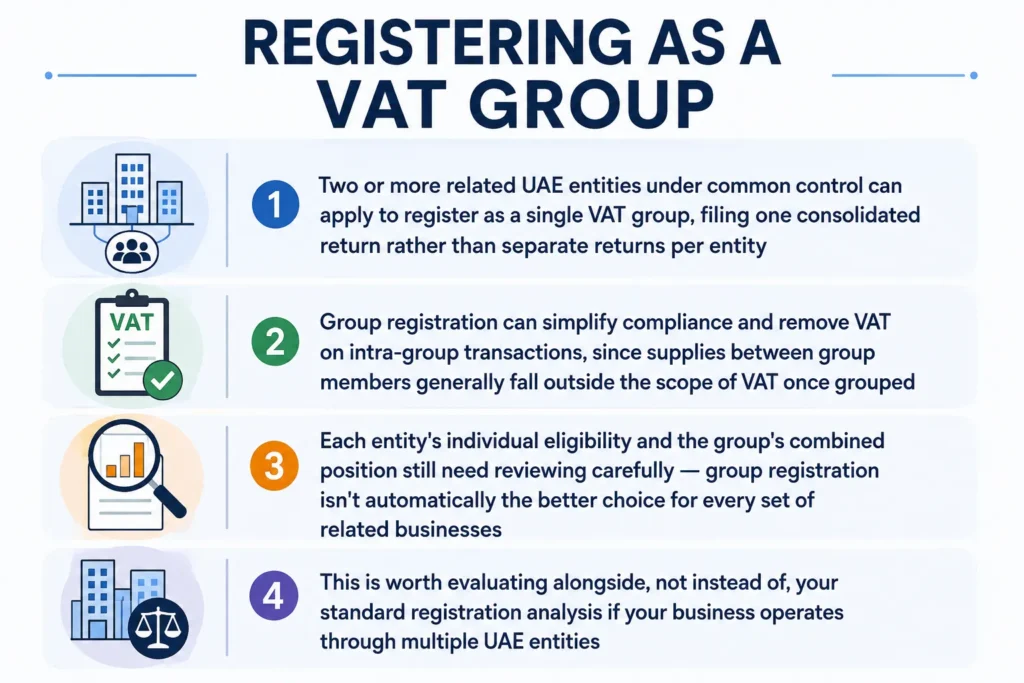
- Two or more related UAE entities under common control can apply to register as a single VAT group, filing one consolidated return rather than separate returns per entity
- Group registration can simplify compliance and remove VAT on intra-group transactions, since supplies between group members generally fall outside the scope of VAT once grouped
- Each entity’s individual eligibility and the group’s combined position still need reviewing carefully — group registration isn’t automatically the better choice for every set of related businesses
- This is worth evaluating alongside, not instead of, your standard registration analysis if your business operates through multiple UAE entities
What Happens If You Register Late?
Missing the mandatory registration deadline carries the same fixed penalty as most other UAE tax registration failures — see our guide to VAT penalties in the UAE for the full picture.
- Late VAT registration carries a fixed AED 10,000 penalty
- Unlike corporate tax, there’s no equivalent automatic waiver initiative for VAT late registration — the penalty applies in full once the deadline is missed
- Beyond the penalty itself, VAT owed on supplies made before registration was completed can still be assessed, since the underlying liability doesn’t disappear just because registration was delayed
Deregistration: The Other Side of the Threshold
Registration isn’t necessarily permanent — businesses that shrink, stop trading, or restructure need to actively manage their VAT status rather than assuming it lapses automatically:
- A business must apply for deregistration within 20 business days if it stops making taxable supplies, or if its taxable supplies fall below the AED 187,500 voluntary threshold for 12 consecutive months
- Before deregistration is approved, all outstanding VAT returns must be filed and any unpaid tax settled
- A voluntarily registered business generally can’t apply for deregistration within the first 12 months of registering — this isn’t a same-year opt-out if voluntary registration turns out to be more overhead than expected
- Failing to apply for deregistration on time carries its own penalty — AED 1,000, plus AED 1,000 for each further month, capped at AED 10,000
- A registration left open on a genuinely dormant business still carries filing obligations — the TRN remaining active means returns are still expected each period, even at nil, until deregistration is formally processed
FAQs | VAT Registration UAE
I’m just under AED 375,000 but growing fast. Should I register now or wait?
If you expect to cross the threshold within the next 30 days, registration is actually mandatory at that point, not optional. If growth is trending that way over a longer period, registering proactively avoids the risk of a late registration once the trailing 12-month figure catches up.
Does free zone status exempt my business from VAT registration?
No. Free zone status doesn’t exempt a business from VAT registration if taxable supplies exceed the threshold. Designated Zone treatment affects the VAT treatment of goods movements specifically, not the underlying registration obligation.
Can I register for VAT if my revenue is below AED 187,500?
Generally no — registration below the voluntary threshold isn’t available under standard rules. Non-resident businesses making taxable supplies in the UAE are the notable exception, since no minimum threshold applies to that category.
How long does VAT registration actually take?
Typically 5 to 20 business days once a complete application is submitted, though incomplete documentation or mismatched details can extend this. Gathering everything in advance is the biggest factor in a fast approval.
If I register voluntarily and my revenue drops, can I deregister immediately?
Not immediately. A voluntarily registered business generally can’t deregister within the first 12 months of registration, and even after that, deregistration requires taxable supplies to have stayed below AED 187,500 for a full 12 consecutive months first.
Does registering for VAT automatically register me for corporate tax too?
No — the two are entirely separate registrations, each with its own Tax Registration Number and its own trigger conditions, even though both run through the same EmaraTax portal. See our guide on corporate tax vs VAT for the full comparison.
Can I register two related companies together, or do they need separate VAT numbers?
Related UAE entities under common control can apply to register as a single VAT group, filing one consolidated return, rather than maintaining fully separate VAT registrations for each entity.
Key Takeaways
- VAT registration is mandatory above AED 375,000 in taxable supplies and imports over a rolling 12 months, or if you expect to cross that figure within 30 days.
- Voluntary registration is available from AED 187,500, based on either supplies or taxable expenses.
- Non-resident businesses making taxable supplies in the UAE must register regardless of value — no minimum threshold applies.
- Zero-rated supplies count fully toward the threshold even though no VAT is charged on them — easy to underestimate for export-heavy businesses.
- Late registration carries a fixed AED 10,000 penalty, with no equivalent waiver initiative to VAT the way corporate tax has for its own late-registration penalty.
- Deregistration has its own rules and timing restrictions — it isn’t simply the reverse of registration on demand.
- Related entities can register as a VAT group, worth evaluating alongside standard registration if you operate through multiple UAE companies.
Get Your VAT Registration Timing Right
Whether you’re approaching the mandatory threshold, weighing voluntary registration, or catching up after missing the deadline, getting the timing right avoids both unnecessary compliance overhead and unnecessary penalties.
The rolling 12-month calculation means this isn’t a once-a-year question — it’s worth reviewing your position every quarter, particularly if your business has any seasonal or project-based revenue swings that could push you past the threshold faster than expected.
Our VAT compliance support, alongside our bookkeeping service, monitors your rolling 12-month position and manages the registration process end to end. Contact Opus Accounting to check where you stand.